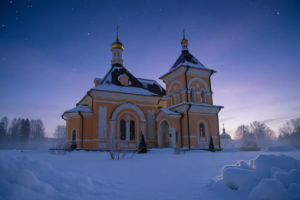
jaroslavl— a city in Russia, the administrative center of the Yaroslavl region. Yaroslavl is the third largest city in the Central Federal District of the Russian Federation. The city is a transport hub from which railway lines and roads diverge in the direction of Moscow, Vologda, Rybinsk, Kostroma, Ivanov and Kirov. There is also a river port and an airport in Yaroslavl. The area of the city is 205.8 km2.
 yaroslavl— one of the oldest Russian cities, founded in the XI century and reached its heyday in the XVII century; in 2010 the city celebrated its millennium. City Day in Yaroslavl is usually celebrated on the last Saturday of May (in 2010, in connection with the millennium of the city, the celebration was held from 10 to 12 September). The historic city center, located at the confluence of the Volga and Kotorosli rivers, is a UNESCO World Heritage Site. Yaroslavl was included in the tourist route «Golden Ring of Russia» in 1967 by Bychkov Yuri Alexandrovich, the creator of this route, and in subsequent decades from the list of cities of the «Golden Ring» did not fall out, although the list itself has been repeatedly modified. Since 2017, Yaroslavl has the status of the “capital” of the Golden Ring of Russia.
The largest center of culture and art remainedSpassky monastery. His magnificent handwritten Fyodorov gospel (2nd half of the XIV century) testifies to the preservation of the best traditions of pre-Mongol heritage here.
The preserved and restored monastic buildings are today the only monumental monuments of the XVI century in Yaroslavl. Among the buildings of the Savior Monastery, the central place is occupied by the oldest building of modern Yaroslavl — the Transfiguration Cathedral, whose architectural «biography» has seven and a half centuries. It was built in 1505-1516.
 FrescoesThe Transfiguration Cathedralappear as the most valuable works of Russian monumental painting of the XVI century. To the west of the cathedral square of the monastery stands a large building of the refectory chamber. The refectory chamber was one of the most comfortable and ornate buildings of its time. In winter, it was heated by warm air coming from the kitchen hearth through the outlet. Food was served from the cookhouse through vertical hatches in the thickness of the wall. Vaults, walls, slopes of the windows of the chamber were covered with frescoes. In the XVI century it was the largest and most beautiful hall in Yaroslavl, serving as a dining room for the brethren of this rich monastery. During the arrival of noble guests, solemn receptions were arranged here. The front porch connects the refectory chamber with the abbot. In the first floor of the building there were utility rooms: bread room, quarry, cellar for storing food; in the second floor the living quarters of the abbot were located.
A truly pearl of ancient Russian architecture can be calledChurch of Elijah the Prophet.The construction of the temple began in 1647 by merchants Skripin. Extraordinarily beautiful is this simple in form, strict and solemn temple with five widely set chapters. Its composition is complemented by two snow-white tents — on the bell tower and the aisle of the Location. The Church of Elijah the Prophet is also famous for its interior decoration. Walls, vaults, slopes — all the free space is filled with paintings that were made in 1680-1681 by an artel of fifteen masters under the guidance of the famous artists Guri Nikitin and Sila Savin. The fresco painting is located in large wide belts of four tiers. The first tier is occupied by compositions on evangelical subjects, in the second tier — the deeds of the apostles, in the third — the life and miracles of the prophet Elijah, in the lower, in the fourth tier — the deeds of his disciple Elisha. The entrance to the temple is painted with frescoes based on the book of the Apocalypse of John the Theologian and the painting of the four horses of the Apocalypse to the left of the entrance is noteworthy.
Church of John the Baptist (1671-1687)— the peak of Yaroslavl architecture of the XVII century, a monument of world importance recommended by UNESCO for display to tourists.
 On the left bank of the Volga within the city limits there is a unique ensemble of the Tolga Monastery (XVII-XIX centuries).Tolga Monastery— one of the oldest in Russia — was founded at the beginning of the XIV century by the Rostov bishop Tryphon on the occasion of the appearance of the icon of the Most Holy Mother of God to him. In 1314 Tryphon, touring the diocese, stopped for the night on the banks of the Volga near the mouth of the now defunct river Tolga. At midnight he woke up from a bright light and saw a glow on the opposite bank. A bridge stretched across the river to him from unknown source. Crossing the bridge, the bishop found that the radiance came from the image of the Mother of God, who was in the branches of the tree. The next day Tryphon and his companions laid a temple on this site. The icon that marked the beginning of the monastery has survived to this day, and August 19 – the day of its miraculous discovery – became a solemn holiday of the Tolga monastery. Now it is a convent, more than a hundred sisters live in it.
The architectural center of the ensemble isIntroduction Cathedral(1681-1688); south of the cathedral preserved the oldest building —Church of the Cross with refectory.One of the most interesting buildings.Savior Church with hospital wards(1710s) — the only significant monument of the «Moscow Baroque» style in the whole Yaroslavl architecture. On the territory of the ensemble of the Tolga Monastery there is also one of the oldest monuments of domestic garden and park art — a cedar garden (2nd half of the XVII century).
One of the most beautiful monuments of YaroslavlBuilt in 1672, the Church of the Savior on the City.To the north side of this four-pillar five-domed temple adjoins a small chapel with a tent finish; to the south there is another chapel, longer and lower. A low tented bell tower on the northwest corner of the building separates the galleries. Drums with heads in their height exceed the main club of the building. During its existence, the church has been rebuilt many times. Transcription of the Savior Church was made in a very short time — from June 12 to August 2, 1693 by twenty-two masters led by Lavrentiy Sevastyanov and Fyodor Fedorov; in its style and theme it is typical for the Yaroslavl painting school of the late seventeenth century.
No less interesting are other Yaroslavl temples:The Church of Epiphany, the Church of Dmitry of Thessaloniki, the Peter and Paul Church (XVII century), the ensemble of the Church of Sretenya (XIX century), etc.