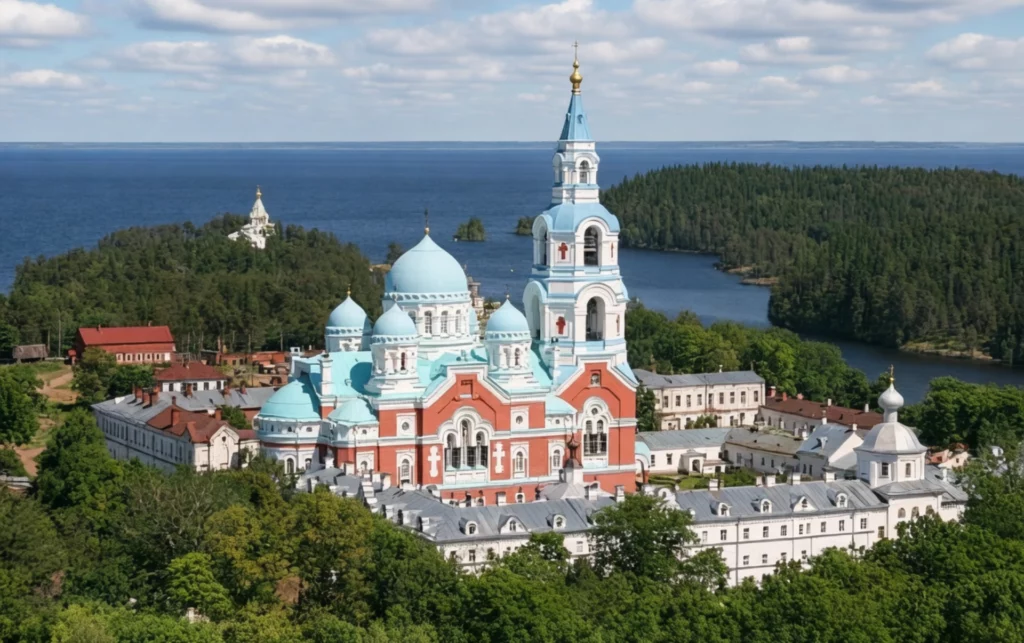
A trip to the archipelago in the northern waters of Lake Ladoga opens up a secluded world for pilgrims, where the rocky shores keep the memory of ascetics, and the monastery buildings crown the peaks. The main point of attraction is the Spaso-Preobrazhenskaya stavropegian male monastery, which dominates the expanses of the largest island.
Acquaintance with the central estate begins from the mooring of the Monastery Bay. From here you can clearly see the ensemble growing directly from a high rock. A wide stone staircase of sixty-two steps, equipped in the middle of the nineteenth century, raises to the top of Tabor. On the left hand stretches the monastery garden, especially captivating in flowering and in the period of autumn gold. Above the green array along the cast-iron lace grille stretches a path where the former monks saw off the court with the pilgrims. The Holy Gate is crowned by the Gateway Peter and Paul Church; today an exposition of icons of the Northern Ladoga region is deployed inside. The central place is given to a visit to the Transfiguration Cathedral — an active temple, under the vaults of which the remains of the founders, St. Sergius and Herman of Valaam, are buried. The route also includes the Assumption Refectory — the oldest surviving stone structures of the island, the Church of the Valaam image of Our Lady, consecrated in 2002, and the Old Brotherly Cemetery.
One of the trips leads to the Big Nikon Bay, where according to legend, the Apostle Andrew the First-Called installed a stone cross. In the Resurrection Skete located here, the formation of the “Russian Jerusalem” on Valaam was completed. The neighboring heights are called Zion and Eleon. The thirty-meter ascent of the latter is crowned with a wooden five-domed chapel of the Ascension, consecrated in 1912. In the area of the Konev Lakes lies the desert of the future hegumen Damascene and the smallest hermitage of the archipelago, dedicated to the Konev Icon of the Mother of God. The walk near the old dairy farm, which once provided the brethren with provisions, ends.
Another route runs to Nikolsky Island, where in 1833 the zeal of the merchant Nikolai Solodovnikov grew the temple according to the project of the architect A.M. Gornostaev. Contemporaries called the church an architectural jewel. The master, like the creator of the Moscow Cathedral of Christ the Savior K.A. Ton, relied on the motives of pre-Petrine architecture. The prototypes were the capital buildings of the sixteenth century.
On the second largest island Skitsky leads the way to two polar points of monastery history. The earliest in the time of foundation of the Skete of All Saints was laid by Elder Nazarius of Sarov at the end of the eighteenth century; with its white islander towers, it resembles a fortress from legends. And one and a half kilometers south is the Smolensk hermitage, consecrated in 1917. Its construction is associated with the names of the Romanov brothers: the Supreme Commander-in-Chief Grand Duke Nikolai Nikolaevich ordered a temple for the daily commemoration of fallen soldiers, and the project in the Russian style with elements of modernity was carried out by his brother Peter Nikolaevich. After the revival in 2007, the interiors were decorated with paintings “Army of the King of Heaven”. Completes the picture St. Vladimir’s Skete, built today as a patriarchal residence and consecrated in autumn 2008 in honor of the 1020th anniversary of the baptism of Russia.