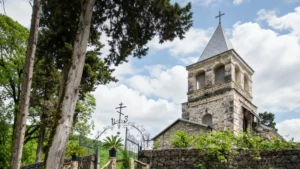
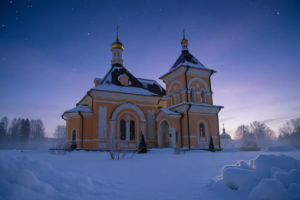
Nilo — Stoloben Desert— Orthodox male monastery located on the island of Stolobnom[1]and partly on the Svetlitsa peninsula, 10 km north of the city of Ostashkov, on Lake Seliger. On the road from Ostashkov to the monastery about 25 km.
St. Nile Stolobensky was born at the end of the XV century near Veliky Novgorod. What his name was in the world is now unknown, as is who his parents were. It is known that after their death he went to the St. John theological Krypetsky monastery, which is located near Pskov. There he received tonsure under the name Neil in honor of the Reverend Neil Postnik.
In 1515, the Monk Nile left the Krypetsky monastery and cut down a small cell in the forest in the Rzhevsky district near the Seremkhi River. He lived alone, ate herbs and oak acorns, spent all his time in prayer.
According to legend, once robbers came to St. Nile, who decided to kill him. When he prayed, he came to them with an icon of the Most Holy Mother of God. The robbers dreamed that the monk was surrounded by a multitude of armed men. In horror, they fell at his feet, repented and began to ask for forgiveness.
Gradually, the fame of the hermit spread to the surrounding villages. People came to him asking for prayers and guidance. Such rumor began to burden the monk, and 13 years after settling near the Seremkhi River, in 1528, he moved to a new place — Stolobny Island on Lake Seliger, seven versts from Ostashkov. The first year he lived in a dugout, then built himself a cell and a chapel for prayers. According to legend, the devil sent various misfortunes to the hermit — fires, attacks of robbers, tried to throw him into the lake with his cell. However, the Monk Nile remained adamant, overcoming all attacks with prayer and faith.
The Monk Nile lived on the island for 27 years and before his death bequeathed to build a monastery on this site, which was later done. There is a belief that the Monk Nile took a vow of non-lying, in connection with which he was never in a horizontal state. And even slept, hanging himself by the shoulders with ropes or hooks driven into the wall.
In 1555, the Nile died and was buried on Stolobnoye Island. In 1594, with the permission of Patriarch Job, a monastic monastery was opened. Thus began the history of the monastery of the Nilo-Stolobene desert. The founder of the monastery was Hieromonk Herman.[1].
After the death of the Monk Nile, hermits-prayers began to settle on the island near his grave, and a monastery was founded by them. Before the revolution of 1917, Nilo-Stolobensky Monastery was one of the most revered in Russia, thousands of people came here every year. In 1820 the monastery was visited by Emperor Alexander I.[2]. In 1858, a granite embankment was built around the island.
At the beginning of the XX century, the number of permanent residents reached 1000 people, the monastery even had its own hospital. As of November 2012, there were about 50 inhabitants in the monastery, about 20 in the sacred order.[1].
The monastery has several farmsteads, including in Torzhka. In the monastery there are candle, dairy and carpentry shops, there is a barn, stable, apiary, in the church shop you can buy consecrated honey. The monastery has its own jewelry workshop (revived fishing)[3]. The monastery conducts trade at Orthodox fairs in Moscow.
In the monastery there is a hotel for pilgrims.
Schedule of travel
|
TRAIN DESCRIPTION (Travel description and all dates are conditional) |
TIME OF TRIES |
Orientation cost Rides. Clarify. |
|---|---|---|
The monastery, which was founded on the site of the skete of the Monk Wonderworker Nile, suffered during the years of Soviet power. The monks were dispersed, and the premises were used for a hospital, a camp, a nursing home. Work on restoration began in the 90s, after the return of the monastery of the Church. Unfortunately, in a dashing year, many shrines were lost: the icons of the Seliger-Vladimir and Smolensk Mother of God, the icon of the Tikhvin Mother of God, the ancient cancer of St. Nile.
The heart grieves for the lost shrines, but rejoices at the sight of those who remain.
The main one is the holy relics of St. Nile Stolobensky. Saint Nile lived as a hermit for 27 years, praying day and night to the Lord. For forgiveness, blessing, consolation people turn to St. Nile Stolobensky. The Divine Liturgy in the cathedral of the monastery purifies the soul and strengthens the spirit.
The Holy Land Charitable Foundation thanks everyone for donations to God-pleasing cause. You can also purchase a trip for yourself and your family.
The Holy Land Charitable Foundation
Soul investment!