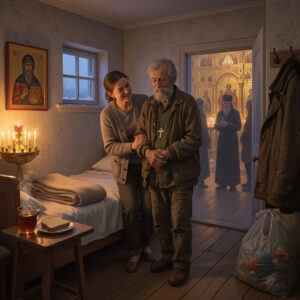
Misha inherited from a previous novice of the monastery kiosk. I start work and I see a 45-year-old man sitting nearby. He is dressed thinly, unshaven, a ski cap on his head, slippers on his feet. And the eyes are kind and clear, like a child.
Misha helped those who carried out obedience in the monastery kiosk when men’s hands were needed: train water in a barrel for tea, arrange tables and chairs in the morning, and collect them in the evening or in case of rain. Wipe tables and remove disposable dishes forgotten by pilgrim buyers.
In fact, to bring water and arrange tables and chairs should the brother in obedience, who brings bread and cakes on the cart and takes away empty boxes. But he’s very busy and can’t always wait. And Misha’s here.
On weekends, when there are many people in the monastery, there are so many people who want to drink tea with monastic cakes that I sometimes go without lunch. There’s no time to go outside and clean up. Here’s Misha.
— Get some water, huh?
— Give me a rag, the kids spilled tea, we need to wipe the table, in!
Let me start cleaning your furniture.
Misha doesn’t work anywhere now. I decided to rest in the summer. In the autumn, she is going to work again. Misha is on summer vacation.
People who know him say he’s been a loader all his life. And this winter at the bus wash. They say he doesn’t drink. A very gentle man. But Misha’s mental development is like a child.
He says to himself:
— I’m not very smart. Alive, in!
— Misha, how did you learn?
Smiling, he shows one finger and then two fingers.
— Cokes and deuces! In! He finished eight classes!
— Misha, why did you leave work?
— Bus washing! Winter! In! Try washing buses with cold water in winter!
Optina sometimes has beggars, asking for alms. Misha doesn’t ask for money.
— Misha, what do you live on? Aren’t you begging?
— Nah! I wash my cars. I get paid for it. And sometimes they don’t. Laughing.
Today Misha was given a hundred rubles for work. Misha is happy. He proudly shows me a hundred-ruble piece of paper: «Money!» Sitting at the table. From time to time he gets a hundred rubles, smooths, examines, again carefully puts in his pocket.
The kiosk is approached, smiling like a child, blessed Mary, she is already elderly. The poster on her chest reads, “Help Mary’s orphan for medicine.”
Misha is fussing, running up to me:
— In! Give Mary tea! And cakes! This is… Potatoes. And a poppy bun! In! I’ll pay! I have money!
And Misha joyfully hands out her jewel — a hundred-ruble piece of paper. Misha buys Mary what she loves, leads the old woman, sits down and treats her joyfully. He’s happy. He has money and can spend it on someone in need.
Misha enjoys the simple things – the sun and the rain. Tea and a bun. A sparrow pecking crumbs from his palm. Red cat at the calculator. Opportunities to help people. Misha doesn’t have a crisis. He doesn’t read the newspapers or know about him.
— Misha, are your parents alive?
— Nah! Misha answers briefly and walks away.
Sitting at the table, thinking, apparently, sad, then comes up:
— Alyonushka! Do you know where I buried my mother? The new cemetery! My mommy was very nice. She held me tight — in! And I did! And now I’m all alone. Bad, Alyonushka, alone.
— Well, nothing, Mishenka! You’re not the only one! You’re with me!
— Yes, I’m with you! I’m helping you, right?!
Misha was treated to candy. He brings them to me:
— Alyonushka, sister, candy, in!
He is pleased to share his joy.
Misha has a dream.
You know what, I want my house! I’ll have a bath there, in! I want two pigs, a lamb, a geese. Good!
A police officer approaches the kiosk:
— Misha! Bear! Don’t you shave? You’re like a comilfo! Don Juan!
And speaking to me:
— Is he bothering you?
Misha is embarrassed by the word «comilfo.» I can see he’s very delicate. For all its simplicity, Misha’s subtlety of feelings could compete with the most educated person. Misha blushes and tries to smile at the policeman, and I feel uncomfortable for making rude jokes. His soul is childish and pure.
Today, Misha has all the temptations. After the policeman to the kiosk on an expensive foreign car came a young man. I bought a cake with fish and coffee. And then he went to Misha sitting at the table and, sitting down, threw him: “Get out of here!” Divorced here, you miserable bums!
Misha blushed and stood up. He glanced at me and meekly walked away from the stall. Sit on the curb next to the column. Sitting. Head down.
A man from a foreign car comes up to me a second time: «Please pour more coffee.»
I take a deep breath. I say goodbye to the obedience I love and I say, “I’m sorry, but I can’t pour you coffee until you apologize to my brother, whom you just hurt.”
The man is amazed:
— In front of your brother?
— Yes, Misha is my brother. And your brother. He’s very upset. Comfort him.
I look into the eyes of a man. Add a soft voice:
— Please!
The expression of a man’s face changes. It’s as if he’s looking at me and he understands me and he feels my tenderness for Misha.
The man goes to Misha, says something to him, slaps on the shoulder. They return together, and Misha is even offered coffee, although he delicately refuses. Peace is restored.
The man sits in a foreign car, he looks cheerful. He waved his hand at us and shouted, «Hello Optina!»
Mishin’s day ends well.
God gives wisdom, wealth, and beauty to someone. And Misha is a gentle disposition and a good heart.
God’s birds are scurrying at the stall. Those who do not sow or plow. And God feeds them. The merciful Lord sends to everyone in need. In the words of the psalmist David, “I am fed up with my sons and leave the remains as my child.” And the crumbs are enough for the servant of God, Misha.
Author: Olga Rozhneva
The Holy Land Charitable Foundation
Soul investment!
Orthodox stories from life