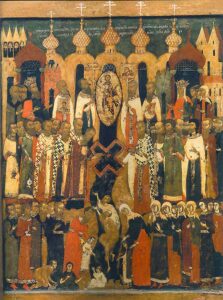
The spiritual heritage of the Apostle Bartholomew (he appears as Nathanael in the Gospel texts), who was one of the twelve closest disciples of the Savior, is inextricably linked with the amazing history of his incorruptible remains. He completed his earthly mission with a martyrdom in the year 71 in the Caucasian Alban, on the site of which Baku today lies. Preaching the word of God in Armenia, India and Asia Minor, the saint suffered a cruel death – according to some legends, he was crucified upside down, according to others – beheaded, having previously peeled off his skin.
Initially, local Christians carefully preserved the body of the saint right where he died. The relic quickly became famous: miraculous healings occurred from it, forcing pagans to accept the new faith en masse. However, historical upheavals forced the shrine to go on its way. At the beginning of the VI century, under the Byzantine emperor Anastasia, the remains were transferred first to Martiropol, and about 507 to the Mesopotamian city of Dara (it was also called Anastasiupol). There the ark rested until the end of the sixth century, until Daru was besieged by the Persian lord Khosra.
In an effort to protect the relic from abuse, the local flock together with Bartholomew’s cancer took four more caskets – with the ashes of the martyrs Akakios, Gregory, Lucian and Papianos – and tried to go to the Black Sea. But the pursuers caught them by the water. The hostile priests took the relics from the fugitives and mercilessly threw all five boxes into the depths of the sea, believing that the waves would forever consume the shrines.
But a miracle happened: the wooden arks did not sink. Driven by an invisible force, they dispersed through the waters and after a long time reached the coast of Italy. The Lars landed separately: the relics of Acacius were at Asculum, Gregory in Calabria, Lucian in Messina, and Papiana in Sicily.
The cancer with the remains of Bartholomew himself was carried to the Liparsky Islands. The local bishop Agathon was given a mystical revelation. Realizing that he was waiting for the shrine, he gathered the clergy and went to the shore. Right out of the foam of the sea, they took the precious ark and triumphantly brought it into the temple. Immediately after that, fragrant myrrh began to exude from the remains, which had a powerful healing power.
For three centuries, until the mid-ninth century, Lipara served as a reliable home for the relic. But when infidels began raiding the island, Orthodox traders took the cancer and smuggled it to the mainland, Benevent. Residents of the city met the apostle with incredible honor, installing a casket in the main city cathedral.
Today, fragments of relics are scattered around the world. Most of the ashes rest in Benevento, within the walls of the Basilica of San Bartolomeo. Since the tenth century, a particle is known, located in a Roman temple on the island of Tiberius. In addition, small parts of the relics are stored in the monasteries of Athos and, symbolically, in Baku — in the cathedral of the Myrrhbearing Women, not far from the place of the martyrdom of the saint.
In the liturgical calendar of the Russian Orthodox Church, the apostle is remembered three times. June 11 (June 24, according to the new style) is dedicated to the day of his martyrdom. August 25 (September 7) is a feast dedicated to the transfer of the remains, and June 30 (July 13) the saint is honored together with the other eleven disciples of Christ on the day of the Council of the Twelve Apostles.
The Church looks at the history of these pilgrimages much deeper than simply moving relics from point A to point B. The miraculous salvation from the depths of the sea and the arrival in Italy are direct proof of the invisible presence of God and the defense of Christian values. Any place where the shrine stayed, eventually turned into a powerful spiritual center. For centuries, people came to these relics for healing bodily ailments and spiritual consolation, receiving help and confirmation that the intercession of St. Bartholomew knows neither boundaries nor time.
Memorial Day
5 MayThe Day of the Apostle’s Martyrdom
June 24 —martyrdom
July 13 —Cathedral of the Glorious and All-Captive 12 Apostles (on this day all twelve are honored, including Bartholomew)
September 7— transfer of relics
Charity foundHoly Land.
Soul investment! News