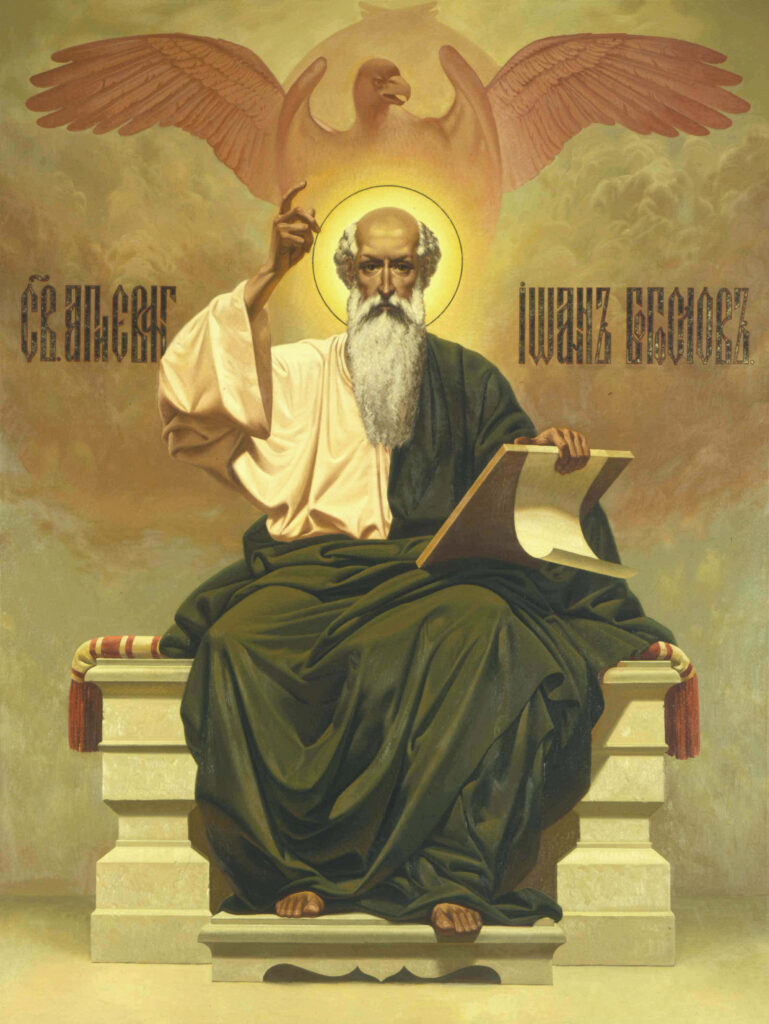
October 9 The Orthodox Church remembers the repose of the holy Apostle and Evangelist John the Theologian. This year the holiday falls on Friday — a fast day, but with permission for vegetable oil. For Ryazan residents, the date also has a special local meaning: in Poshupovo, just half an hour from Ryazan, stands one of the oldest monasteries in Russia, dedicated to this particular saint.
The Fisherman, whom Christ called “the son of thunder”
John was the youngest son of the Galilean fisherman Zebedee. Together with his older brother James, he was mending nets near Lake Galilee when Jesus passed by and called both of them to follow him. They left everything — their father, the boat, their usual life — and went.
Paradox: Christ gave the brothers the nickname “Boanerges” — “sons of thunder,” hinting at a tough, hot-tempered disposition. But it was John who, years later, would write the lines that would become the most famous definition of God in Christianity: “God is love.” From thunder to silence. From impulse — into contemplation.
The one who did not run away
Of the twelve apostles, John was one of the three closest to Christ — along with Peter and James. Only they saw the Transfiguration on Tabor. Only they went with the teacher to the Garden of Gethsemane on the last night. And only John remained at the cross when the rest fled.
It was there, on Golgotha, that Christ entrusted his Mother to him. “Here is your son,” He said to the Mother of God. “Here is your Mother,” said John. He accepted her into his home and did not leave Jerusalem until her Assumption. This is not just a gesture of care — it is a sign: John became a living keeper of the memory of Christ’s earthly life, because he was there every day.
The oil that did not take life
After the death of Christ, John preached in Asia Minor and settled in Ephesus. His activities irritated the Roman authorities. Church tradition, based on the testimony of Tertullian, says: in Rome, John was sentenced to execution and thrown into a cauldron of boiling oil. He came out unharmed. Having failed to kill him, Emperor Domitian sent him into exile on the rocky island of Patmos in the Aegean Sea.
There, in exile, John saw what he wrote down as the Revelation — the Apocalypse. The last book of the Bible, full of visions, beasts, seals and numbers. Twenty centuries later, it is interpreted in different ways, but few argue: this is one of the most mysterious texts in the history of mankind.
The Fourth Gospel
In addition to Revelation, John is credited with the authorship of the Gospel, which differs sharply from the other three. Matthew, Mark and Luke retell events — parables, miracles, the road to Jerusalem. John talks about meaning. He begins not from birth, but from eternity: “In the beginning was the Word, and the Word was with God, and the Word was God.” The Greek “Logos” is a concept familiar to both philosophers and scribes. But only John connected the abstract Logos with a living man, crucified and resurrected.
He does not have the usual parables in the form of short stories. But there are long conversations of Christ — with the Pharisee Nicodemus, with the Samaritan woman at the well, with the disciples at the Last Supper. There are formulas in which Christ calls himself the bread of life, the light of the world, the way and the truth. For John, it is important not so much to record what happened as to show who the One with whom he walked for three years was.
John’s three cathedral epistles are also his. Short but rich. The main word in them is love. “Beloved! let us love one another, because love comes from God.” These lines are read at services to this day.
The Mystery of the Empty Tomb
John is the only one of the twelve apostles who did not suffer martyrdom. He lived to a ripe old age, according to some estimates — up to a hundred years. In recent years I could hardly walk. The disciples brought him to meetings, and he repeated one thing: “Children, love one another.” When he was asked why he did not say anything more, he replied: “Because this is the commandment of the Lord, and it alone is enough.”
Anticipating death, John asked to dig a cross-shaped grave, lay down in it alive and ordered to cover himself with earth. The students complied with the request. A few days later they dug it up — there was no body. But every year, on May 21, fine fragrant dust rose from the grave. Believers collected it and associated it with healings. In honor of this miracle, a second day of remembrance was established — spring.
What does the holiday mean for believers
On October 9, a special service is held in churches. During the liturgy, the Gospel of John and his first conciliar epistle are read — the one about love. Believers turn to the saint with prayers for health, for family, for safety on the road, for protection from poisoning (John is credited with miraculous invulnerability to poison). In the folk calendar, the day was called Ivan the Traveler — the saint was asked for protection on distant journeys.
In Rus’, on this day they baked pies and treated them to passers-by and wanderers. Meeting a traveler was considered a good sign. If no one was found, the bread was given to the birds. They tried to work until lunch: according to legend, hard work in the afternoon could bring “forty troubles.” The Church, however, treats such everyday prohibitions with restraint, recalling that the holiday should be celebrated in peace and kindness, and not in fear of omens.
The monastery in Poshupovo is a Ryazan connection
For residents of the Ryazan region, the day of remembrance of St. John the Evangelist also has a local dimension. St. John the Theologian Monastery in the village of Poshupovo is one of the oldest monasteries in the region, according to legend, founded in the 12th century by Byzantine monks. They came here with an icon of the Apostle John, which, according to legend, was painted in the 6th century by an orphan boy nicknamed Hussar. The icon was named in honor of this event, and the monastery received the name of the saint.
The monastery experienced both prosperity and closure during Soviet times, and revival in 1989. Today it is a functioning monastery that attracts pilgrims from all over Russia. The Theological Cathedral houses the relics of several saints, and under the altar there is a ossuary — a temple-tomb, where the remains of the last abbots of the monastery, who ruled it until its closure in the 1930s, rest.
Charity FundndHoly Land
Investments in Soul! News