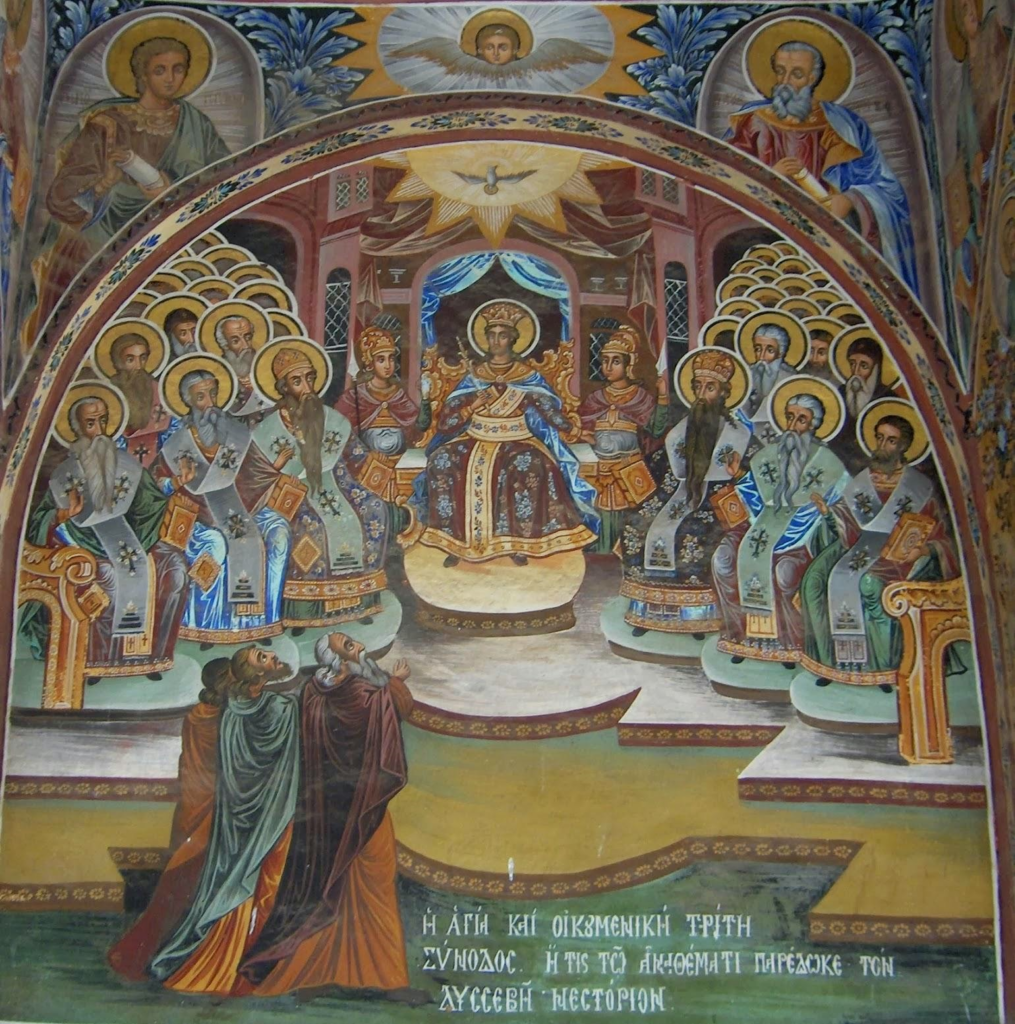
In 431, bishops gathered in Ephesus to solve a seemingly simple question: how to properly call the Virgin Mary the Mother of God or the Mother of Christ. Behind this controversy about words was the essence of the Christian teaching about Christ. If Mary is only the “Mother of Christ,” then God was not truly born of her, but only “joined” the man Jesus. If this is the case, then salvation is different: it is not God who came to man, but man who somehow “ascended” to God. That is why the dispute quickly ceased to be a cabinet theology and became a matter for the whole Church.
Two looks, two characters
Nestorius, Patriarch of Constantinople, was a bright, strict and straightforward man. He wanted to defend the idea of God’s holiness: in his view, the Deity could not be “born” in the ordinary sense, because birth is a human, bodily event. Hence the proposal: to call Mary the Mother of Christ, but not literally the Mother of God.
Confronted him Cyril of Alexandria — a man no less bright, but a completely different warehouse. For Cyril, the unity of Christ was most important: if we divide Him into “God” and “man,” we lose the very essence of incarnation. He formulated his objections in the form of twelve short and hard theses – anathematisms, each of which cut one of the loopholes in the logic of Nestorius. The correspondence between them resembled an exchange of blows: polite formulas, behind which there was a feeling of intransigence.
When it became clear that it would not work out, the emperor Theodosius II intervened. He decided to convene an Ecumenical Council in Ephesus, a city that in the Christian mind was associated with the Virgin Mary.
The Cathedral, which almost became two cathedrals
The Cathedral opened on June 22, 431 in the Church of the Virgin. The atmosphere was tense: there was a sense in the air that more was being decided than the wording of the title. Nestorius was invited three times, but he did not come, citing the fact that not all the bishops had yet gathered. The council decided to consider the case without him.
And then the main drama of those days appeared: some bishops, especially from Antioch, led by John of Antioch, arrived later. They did not recognize the decisions taken without their participation, and assembled their own council, where they deposed Cyril and Memnon of Ephesus. Two church centers operated simultaneously in the city, each declaring the other heretical.
The emperor found himself trapped by two mutually exclusive solutions. At first he ordered the arrest of both Cyril and Nestorius, trying to restore order by force. But it quickly became clear that prison could not untie the knot. It took long negotiations, mediation and a willingness to make concessions.
What was decided in Ephesus
The Council adopted several key provisions that defined the face of the Christian faith:
- The Virgin Mary is the Virgin.This is not just an honorary title, but a dogma: Mary gave birth to the God of the Word, who became man. The name “Mother of God” protects faith in the real incarnation of God.
- One face of Christ under two natures.In Christ there is one Person (hypostasy), in whom the divine and human natures are united. They do not merge with each other, but they do not exist separately.
- Inviolability of the Creed.The Council forbade any changes to the Nicene-Tsaregrad Creed – neither to add words, nor to remove, nor to replace. This inviolability has become an important principle of church tradition.
- Condemnation of Pelagianism.The Council affirmed that man cannot be saved by his own strength without the grace of God.
- Eight canonical rules.They concerned the order of church life: how to judge bishops, how to convene councils, how to behave to clerics.
The path to reconciliation
There was no unity immediately after the Council. Antiochian theologians feared that Cyril’s position might lead to the other extreme: the erasure of the human side of Christ. It was only in 433 that the so-called Antioch reconciliation was achieved: the parties developed a common formula that suited both the Alexandrians and the Antiochians.
This does not mean that all the disputes are over. The question of how the two natures are united in Christ remained acute for another two decades. It was finally clarified by the Fourth Ecumenical Council at Chalcedon in 451. But it was Ephesus who put a barrier against the division of Christ into “two different” and affirmed that Mary was indeed the Mother of God.
Memorial Day
22 September
Charity foundHoly Land.
Soul investment! News