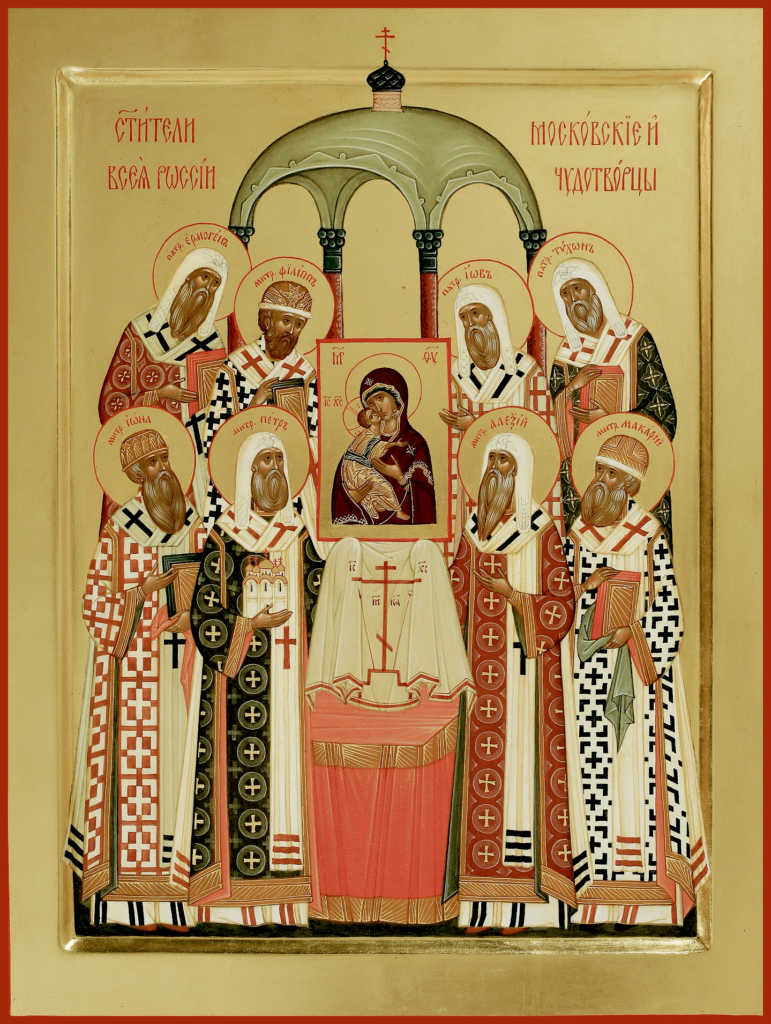
There are such dates in the Orthodox calendar when one day is not just the memory of one saint, but the whole history of the country — in the faces, fates and decisions on which the fate of the people depended. October 18 is just such a day: the Church celebrates the Council of Moscow Hierarchs. This is not just a list of names in the saints, but a living chronicle of Moscow, told through those who stood at the helm of the Russian Church in the most critical epochs.
How did the holiday come about?
The history of this day begins at the end of the XVI century. In 1596, His Holiness Patriarch Job established a celebration in honor of three great hierarchs – Peter, Alexis and Jonah. At that time it was not just a ecclesiastical establishment, but an affirmation of Moscow’s special role as the spiritual center of Russia. Three hierarchs, three pillars on which the church and state life of its time rested.
But the list has not remained unchanged. He grew up with history. In the XIX century, Saint Philip was included in the Council, a man who was not afraid to tell the truth to the king and paid for it with his life. Then came the turn of Patriarch Hermogenes, whose firmness in the years of the Troubles became the support for the whole people. And already in our time, in the XXI century, the Holy Synod supplemented the Council with new names: it included Patriarchs Job and Tikhon, Metropolitans Macarius, Philaret, Innocent and others. Today in the Cathedral of Moscow Hierarchs there are seventeen names. And each of them is a separate chapter in the history of Russia.
Faces that cannot be forgotten
When you read their lives, you are amazed at how different these people were and how deeply they loved their homeland.
St. Peter, the first of the metropolitans who seriously connected his fate with Moscow, not only moved here from Vladimir, he made the city the spiritual heart of Russia. Under him, the first stone Assumption Cathedral was laid in the Kremlin, and it was not just a construction project, but a sign: Moscow becomes the main city of the country.
Saint Alexis was not only an archpastor, but also a statesman. In the years when Prince Dmitry was still a child, it was Alexy who actually ruled the principality. He was able to negotiate, reconcile the warring and strengthen the union of Russian lands. And he took care of monasticism: with him in Moscow appeared Chudov monastery, which became one of the centers of spiritual life.
Patriarch Hermogenes is the voice of conscience in the Age of Troubles. When the country was on the verge of destruction, he did not stop: he sent letters, called on the people to resist, did not compromise with the invaders. Even from prison, he continued to inspire people to fight for the freedom of the Motherland. His feat is an example of how faith becomes a force that can keep people from falling apart.
St. Philip is a story about the price of truth. He was not afraid to tell Ivan the Terrible about the cruelty of oprichnina, even realizing what it threatens him personally. His courage was not rebellion, it was a pastoral word addressed to the conscience of the ruler. And when they did not hear the word, he accepted a martyr’s death, remaining faithful to his duty to the end.
No less important is the figure of St. Tikhon, the first patriarch after the restoration of the patriarchate in 1917. His ministry came at a time of revolutions and persecutions. He did not call for armed resistance, but firmly defended the Church, tried to preserve its unity and prevent the destruction of faith in people. His path is an example of quiet but unyielding fortitude.
Why are they remembered together?
It would seem that between these saints there are centuries and different historical conditions. One lived in the era of the rise of Moscow, the other in the Time of Troubles, the third in the years of revolutionary upheavals. But the Church unites them in one holiday not by chance. They were not just hierarchs, but real pastors who did not separate the fate of the Church from the fate of the people. They prayed, taught, reconciled, defended, and when necessary, sacrificed themselves.
The Cathedral of Moscow Hierarchs reminds that the spiritual history of the city is not only churches and icons, but above all people who made Moscow what it became: the heart of Russia.
What does this holiday mean today?
For modern people, the memory of the Moscow hierarchs is an opportunity to see how faith manifests itself in real life: in responsibility for the country, in the ability to tell the truth, in the willingness to serve without thinking about rewards. Their examples show that a feat is not always a high-profile event. Sometimes it’s doing your duty every day, even when there’s chaos and uncertainty around.
In the churches of October 18, special prayers are heard in which the Church asks these saints for intercession for the city and for all who live in it. And this has a deep meaning: the saints who once built, strengthened and saved Moscow, and today remain its heavenly patrons.
Charity foundHoly Land.
Soul investment! News