

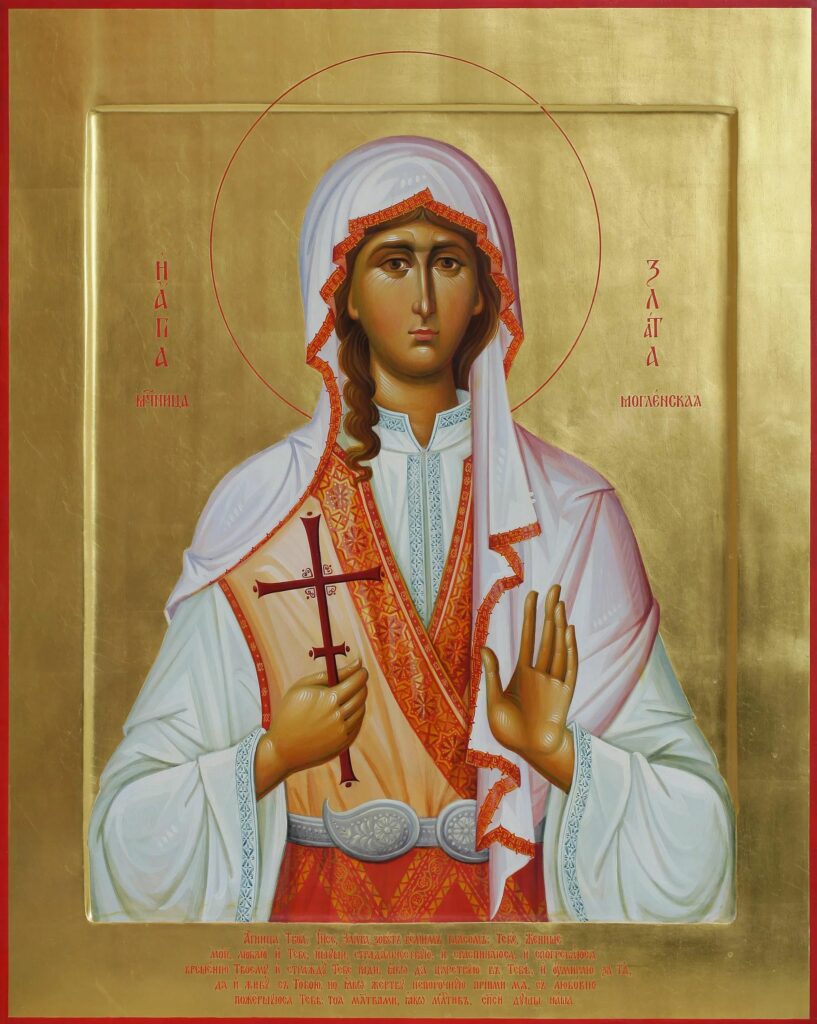
The relics were found near the ruins of the ancient Church of the Assumption of the Blessed Virgin Mary, located in the fortress of the village of Chrysi (formerly Zlatina) in the community of Almopia, peripheral unit of Pella. The village is closely connected with the life of the saint — it was here that she was born and here she suffered a martyr’s death.
Research carried out in specialized laboratories in Germany showed that the remains belong to a young girl aged about seventeen. The established date of death is 1795, which completely coincides with the data from the life of the saint. Traces of severe trauma were found on the bones, which, according to the Church, correspond to the torture described in hagiographic texts.
The remains exude fragrance and ointment — a phenomenon traditionally revered in the Orthodox Church as a sign of holiness. Now the relics are placed in the local church, and on October 13, the day of remembrance of the martyr, celebrations will take place on the occasion of their discovery. After the holiday, the shrine will be moved to the city of Edessa, where it will decorate the local temple for the constant prayerful worship of believers.
Metropolitan Joel (Frangakos) of Edessa, Peli and Almopia noted the special significance of the event in his district message. According to him, the discovery of the relics was a “great blessing” sent down “two centuries after the glorious martyrdom of Saint Zlata, in the days of great spiritual trials and temptations.” The Bishop called on all believers to resort to the heavenly intercession of the martyr and receive grace from her venerable relics.
The Orthodox Church celebrates the memory of Saint Zlata twice: October 13/26 and October 18/31. This year, the first of these days takes on special significance — it is then that solemn services dedicated to the discovery of the shrine will take place. The Greek Church, using the New Julian calendar, celebrates the holiday on October 13.
Who is the martyr Zlata
According to her life, Zlata was born into a poor Bulgarian family living in the village of Zlatina (now Chrysi) on the territory of Macedonia, which was then under Ottoman rule. The girl stood out for her extraordinary beauty and deep faith.
One of the Turkish elders, seeing Zlata, admired her and decided to persuade her to marry at any cost. Having kidnapped the girl, he tried to force her to convert to Islam and become his wife. Zlata categorically refused — she did not want to change her faith or marry someone of a different faith.
The Turk tried to influence her through persuasion, gifts and threats. When everything turned out to be unsuccessful, he subjected the girl to severe torture. Zlata’s mother, having learned about what had happened, secretly visited her daughter in prison and cried, begging her to renounce her faith in order to save her life. But Zlata replied that she preferred temporary suffering to eternal torment and that the mother should not cry, but rejoice — her daughter was going to Christ.
After prolonged torture, on October 13, 1795, the martyr was hanged by her hair on a tree and beheaded. Christians buried the body secretly. Decades later, the Church of the Assumption of the Blessed Virgin Mary was built near the burial site, next to which the relics were found.
Significance of the discovery
The discovery of the relics of the new martyr 231 years after her death is of particular significance for the local church community. Saint Gold is revered as a symbol of firmness in faith and fidelity to Christ in the face of a mortal threat. In the Orthodox Church she is known by two names: in the Slavic tradition — as the Great Martyr Zlata, in the Greek — as Saint Chrysa (Chrisia), which in translation also means “golden”.
The celebrations of October 13 will be the first large-scale celebration associated with the relics of the saint, and will gather pilgrims from all over Greece and neighboring countries. Metropolitan Joel emphasized that the shrine will “sanctify and bless the faithful people of God and strengthen the entire Orthodox Church.”
Charity FundndHoly Land
Investments in Soul! News


