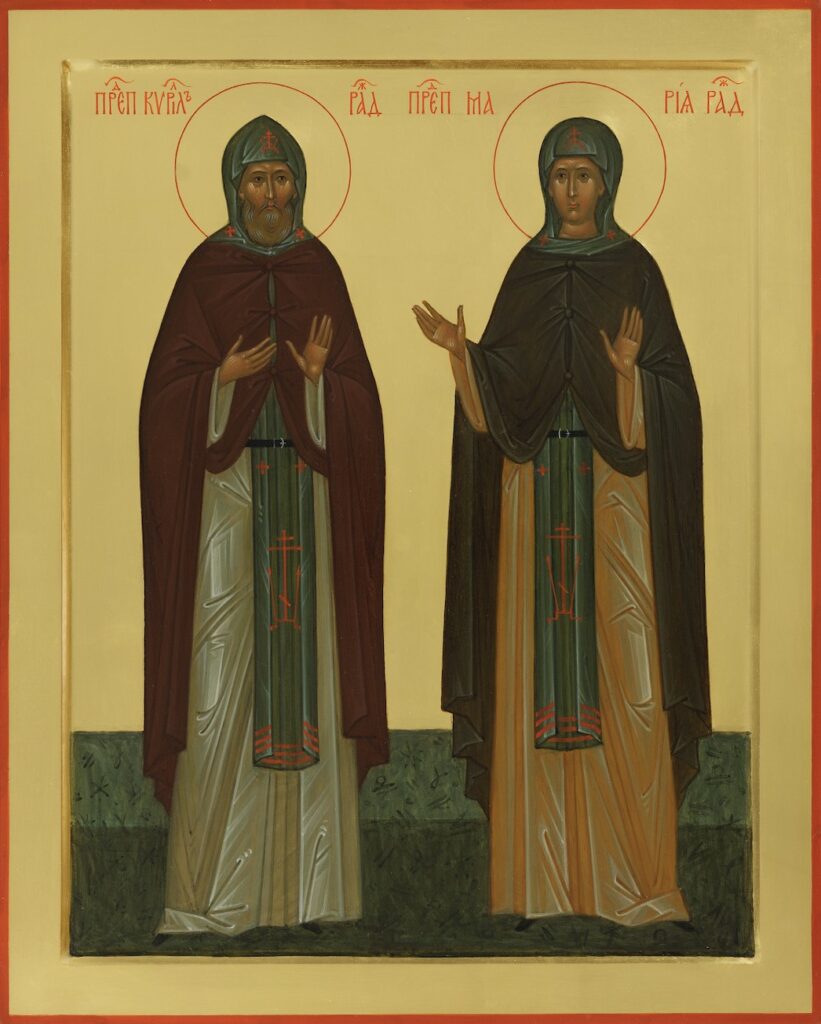
When we remember St. Sergius of Radonezh, images of the Trinity-Sergius Lavra, monastic feat, and great deeds immediately appear before our eyes. But behind every such person there is a quiet, unnoticed, but incredibly important story — the history of the family. Sergius’s parents were the Monks Cyril and Maria, and it was in their home, in their everyday life, that the very character traits that later made Bartholomew (the name of Sergius in the world) who he became were laid.
Life without ostentatious luxury
Cyril and Maria lived in difficult times — Rus’ suffered from Horde raids, princely strife, famine and heavy tributes. Moreover, the family belonged to a noble boyar family, and Kirill himself served at the court of the Rostov princes and even traveled with them to the Horde — a risky business and requiring considerable courage. But, despite their position, the couple did not strive for pomp and wealth. Their house in the village of Varnitsa near Rostov was arranged simply, without frills.
This simplicity was their strength. Cyril and Maria did not separate faith from everyday life. They didn’t just keep fasts and attend church—they lived according to the gospel commandments every day. Helping the poor, welcoming strangers, caring for the sick and lonely were for them not “a good deed according to a schedule,” but a natural part of life. And the children grew up amid this care, saw how their parents gave their last, how they greeted tired travelers, how they prayed not for show, but sincerely.
Education in deeds, not words
Cyril and Mary had three sons: Stefan, Bartholomew (the future Sergius) and Peter. Education was based not on strict instructions, but on personal example. If a father helped a neighbor repair a hut, if a mother fed a hungry wanderer, if there was always a place in the house for someone who was in trouble, the children learned this not from books, but from life.
One episode is especially important, which reveals the essence of their parental approach. When Bartholomew, in his youth, firmly decided to go to a monastery, his parents did not dissuade him out of pride or a desire to keep their son with them. But they asked for one thing: to wait until they, no longer young and unhealthy, went to the Lord. “Stay with us, help us, and then go your way,” they said. And Bartholomew obeyed. He stayed close, looked after his parents, tried every day to make their lives easier and brighter. This obedience was not slavish submission, but a manifestation of filial love and gratitude.
It was during these years, next to his father and mother, in a simple but meaningful life, that his heart was formed. The ability to see other people’s pain, the desire to serve others, humility and patience — he absorbed all this in his parents’ home.
Tests as a school of mercy
The family has faced difficulties many times. Due to trips to the Horde, the need to give gifts to the Horde nobles, unbearable tributes and frequent crop failures, the well-being of the family gradually melted. At one point, Kirill and Maria found themselves in a situation where they needed help. But even in need, they did not become hardened, did not murmur, and continued to share what they had.
Moving from Rostov to Radonezh was a new challenge for the family. Once in another place, among new people, they did not try to regain their former position, but again built their lives from scratch: they worked, prayed, helped their neighbors. And in these trials, their parental love manifested itself especially clearly: not in trying to protect children from difficulties, but in going through them together, holding hands, supporting each other.
Monasticism as the End of the Earth Path
As their sons matured and set out on their own path, Kirill and Maria felt that the time had come for their own spiritual step. They took monastic tonsure in the Khotkovo Pokrovsk monastery, and later — and the great schema. Their monasticism was not a break with the past life, but a natural extension of it: the same humility, mercy, and love of God they carried in the family now blossomed fully.
After their death, St. Sergius buried his parents with deep reverence and prayed for their repose for a long time. According to legend, he bequeathed to those who want to come to him, first pray at the grave of his parents. This is a huge gratitude to his son and the recognition that it was in his parental home that he received the most important thing.
What does an example mean today?
The story of Cyril and Maria is not about “perfect parents” who never made a mistake. This is the story of people who in difficult conditions managed to preserve the main thing: love, mercy, respect for each other and for children. They did not try to “make the son of a saint” – they simply lived according to conscience, and this life became the most powerful lesson for Bartholomew.
Today, when we talk about education, we often look for complex methods, new approaches, and “right” words. But the example of St. Cyril and St. Mary reminds us that sometimes the most important thing is simply to be around, to work, to help those around, and to show children that love is not big words, but daily deeds.
Remembrance days
31 January
June 5 — Cathedral of Rostov-Yaroslavl Saints
July 19 — Cathedral of Radonezh Saints
October 11
Charity FundndHoly Land
Investments in Soul! News