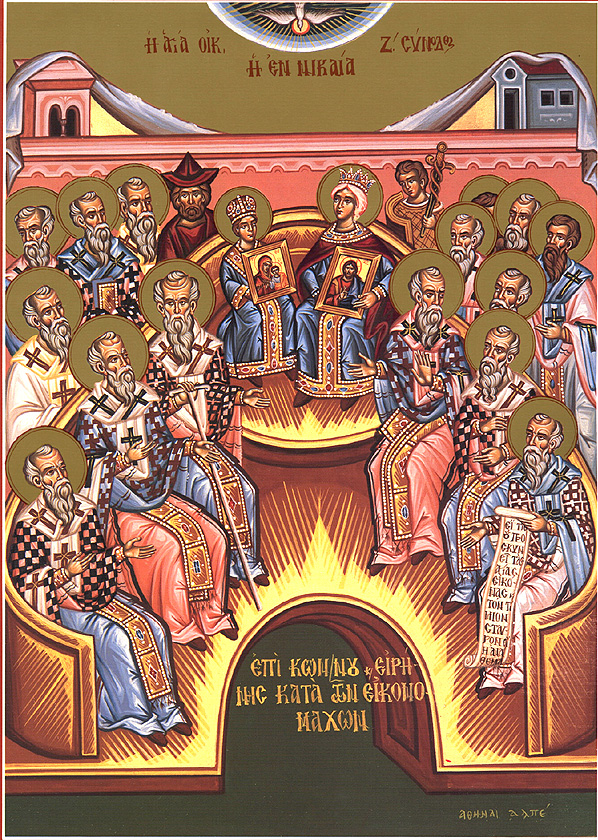
Today, the Orthodox Church commemorates the Holy Fathers of the VII Ecumenical Council, an event that became one of the pillars of the entire Christian tradition. This holiday reminds us how, in an era of severe disputes and persecutions, the Church was able to clearly and firmly formulate the most important dogma that still determines the appearance of the Orthodox church and worship.
The VII Ecumenical Council was held in 787 in Nicaea (now Iznik), and went down in history as the Second Council of Nicaea. Its convocation was a response to the large-scale and brutal movement of iconoclasm that engulfed Byzantium. Supporters of this doctrine considered the veneration of icons idolatry and insisted that the holy images contradict the biblical commandment “do not create an idol for yourself.” Under the pretext of fighting “superstitions”, priceless icons, mosaics and frescoes were destroyed, and believers who defended the right to pray before images were persecuted.
The key act of the Council was the approval of the dogma of icon worship. The Holy Fathers clearly distinguished two concepts: “worship”, which is befitting only God, and “veneration” given to holy images. Their main theological thesis was: “The honor given to the image goes back to the original.” In other words, when a Christian worships an icon, he does not turn to the tree and colors, but to the person depicted on it – to Christ, the Virgin or the saint.
About 350 bishops and representatives of the Church participated in the work of the Council, and St. Tarasius, Patriarch of Constantinople, presided over the meetings. An important role in the preparation of conciliar decisions was played by the theological works of St. John Damascene, who long before the Council consistently justified the admissibility and spiritual value of icons. The Council confirmed that the veneration of images is not an innovation, but a continuation of the Apostolic Tradition, inextricably linked with faith in the incarnation of God: if Christ became a man, He can be portrayed, and through an image, touch the reality of His presence.
The significance of the VII Ecumenical Council goes far beyond the dispute over icons. For the Church, this was a question of the very essence of the Christian view of matter and beauty: the Holy Fathers affirmed that the earthly world, human art and creativity can share in the divine light. That is why the temples were filled with icons, and the worship gained the visible, artistic and prayer system that we know today.
The memory of the Holy Fathers of the Council is celebrated on October 24 (in the new style). If this date falls on a weekday, the celebration is postponed to the next Sunday. In the temples there are special chants in which the Church glorifies the fathers as “lights on the earth”, who confirmed the truth and preserved the purity of the faith.
This holiday is not just a historical date, but a reminder that loyalty to Tradition requires not only prayer, but also a clear confession of the truth, even when it is opposed by influential forces and conventional opinions. That is why the memory of the Holy Fathers of the VII Ecumenical Council remains for Orthodox Christians a day of gratitude and spiritual understanding: we preserve icons not as objects of decor, but as evidence of faith, which has been suffering and confirmed by the labors of many generations.
Memorial Day
25 October
Charity fund
Holy Land.
Soul investment!
News