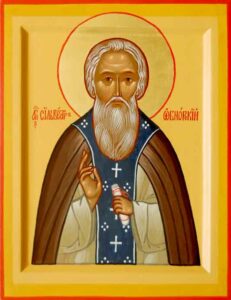
The figure of George, Archbishop of Mytilen, again attracted the attention of researchers of hagiographic monuments. The reason for the discussion was the discrepancy in the sources describing the life path and exploits of this early Christian ascetic. Existing texts interpret his origin, circumstances of service, and even the time of his death in different ways.
Both versions agree that the young man left his parents’ home early and accepted monasticism. The place of his spiritual exploits was the island of Lesbos. One of the manuscripts reports that a native of the west coast of Asia Minor was orphaned at eighteen years old, after which he asceticized in the monastery for two years, and then chose a cave retreat. At the age of twenty-eight, he was called to head the local church pulpit.
The work of the archpastor, which lasted nine years, interrupted the intervention of the city chief. In search of a fair trial, George went to Constantinople. It was there that he was caught by events related to the intensification of the struggle against the worshippers of icons. The priest refused to support the government, for which he paid with freedom. The place of his exile was a small island near the capital. There, according to this source, he died in April 820 or 821, barely reaching the age of forty-five.
Parallel life draws a different chronology. Here George no longer appears as a young bishop, but as a gray-haired elder who survived two waves of iconoclastic persecution. It is claimed that the first persecution he met in the reign of Leo III Isaurus. Later, during the trial of 815, he openly opposed the heretical Patriarch Theodotus and was exiled. But not to the nearby island, but to the distant Chersonese. The story of the star sign on the day of his departure is repeated: the sky glow was observed by the inhabitants of his hometown.
The hagiographers of the past saw no contradiction here. The figure of the saint became overgrown with popular veneration literally immediately after his death. Patriarch Methodius organized the solemn return of the remains to Lesbos. At the tomb, numerous cases of recovery were recorded.
An attempt to reconcile the two chronology led to the emergence of hypotheses about several namesakes. Some scientists insist on the existence of two Georges, dividing the dates of April 7 and May 16. Others admitted the presence of three saints. However, critical analysis shows that most of the discrepancies are generated by the late compilation, which mixed the realities of different eras. The question is not completely closed, and the calendar confusion remains the subject of study.
Memorial Days
April 20
The Holy Land Charitable Foundation
Lives of Saints