

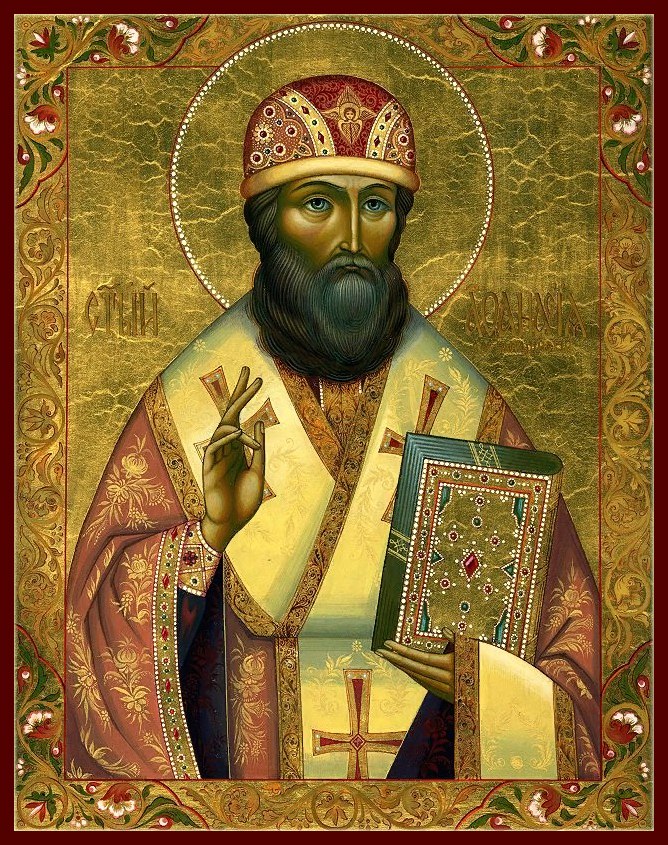
The Ecumenical Council in Nicaea ended in victory, so the textbooks will speak. In fact, it ended with the beginning of a war that would last half a century. And on one side of this war stood a man called Athanasius. Young, short, seemingly unremarkable. He was not an emperor, did not command armies, did not have wealth. But he turned out to be the one that no one could break – not court intrigues, not prisons, not five exiles, not accusations invented from beginning to end.
Alexandrian boy
Athanasius was born around 295 in Alexandria, the largest city in the eastern Mediterranean, where great libraries coexisted with Christian catechetical schools. Almost nothing is known about his parents. Ancient sources say only that the family was Christian and poor. The boy grew up smart, stubborn and absolutely indifferent to worldly career.
Bishop Alexander noticed him when Athanasius was still a teenager. According to legend, he saw a boy playing with friends on the beach and baptizing water, performing the rite of baptism. The priest first became angry, then thought, and then took the young man to his house to teach. This was the usual spiritual mentoring for that time: the bishop became both a teacher and a father.
Nicaea: A lifetime wager
In 325, Emperor Constantine convened the first Ecumenical Council at Nicaea. It was about Christ. Presbyter Arius of Alexandria taught that the Son of God is not the eternal God, but the highest of creation. It sounded logical and tempting to many. Athanasius came to the cathedral as a young deacon — not voting, but as an assistant to Bishop Alexander. But his voice was heard louder than many.
He said a simple thing: If Christ is not God, He cannot save us. Creation does not save creation. Only God can raise a person to God. Therefore, the Son is not a creature, but is consubstantial to the Father. The word “consubstantial” – omusios – will become the main word of his life.
The council accepted that word. The Nicene Creed proclaimed Christ as God of God, born, uncreated, consubstantial to the Father. Arius was convicted. The argument seemed over. In fact, it’s just begun.
Bishop of twenty-eight years
When Bishop Alexander died, the Alexandrians chose Athanasius, who was about twenty-eight. For Alexandria, where the episcopal see was one of the most important in Christendom, it was a bold choice. But the people saw in him what the courtiers did not see: straightness. He didn’t know how to maneuver.
The Arians didn’t forgive him Nicky. They understood that as long as Athanasius stood at the pulpit, their teachings would not return. And they attacked. First, the charges: that he had violated the tax, that he had killed a man and used his hand for witchcraft, that he had organized illegal meetings. Then there was the false council in Tyre, where the bishops were forced to sign the verdict. Athanasius went to the emperor, but from there he was removed — sent to Trier, on the Rhine. First reference.
Five links
There will be five of them. Trier, Rome, then the deserts of Egypt, where he hid among the monks, then again to Trier. Each time, different reasons, the same: the Arians pressed on the emperor, the emperor conceded, Athanasius was taken away. Each time he was returned, because the people of Alexandria did not accept false bishops, and rebellions threatened to destabilize all of Egypt.
The darkest time came under the emperor Constantius, who openly sided with the Arians. In 356, soldiers broke into the church where Athanasius served at night. He didn’t resist — he just disappeared into the crowd. For six years he hid in the desert among Egyptian hermits. He wrote letters that were copied by hand and passed from community to community. The voice that the authorities tried to silence sounded — only quieter and further.
Books written on the run
It was during these years that his main works were born. The Word Against the Arians is three long treatises in which he examines every objection of Arius based on Scripture. On the Incarnation of the Word is an early work where he explains why God became man: «For He became man so that we might become gods.» A phrase that will be repeated for centuries.
He also wrote The Life of Antony, a book about a great deserter whom he knew personally. It’s not just a biography. This is a portrait of a man who defeated evil not by force but by loyalty. The book was distributed throughout the Christian world — in Latin, in Syriac, in Coptic. After that, thousands of people went to monasteries.
Returns and recent years
In 362, after the death of Constantius, Athanasius returned to Alexandria for the last time. He was about seventy. The city met him as a living martyr. Arianism had not yet died, but was already losing, because the idea advocated by Athanasius was stronger than intrigue. In 362 he held a council in Alexandria, where he reconciled the moderate parties and consolidated the Nicene confession.
He died on May 2, 373, at a pulpit in his town. Eight years later, in 381, the Second Ecumenical Council in Constantinople will confirm what it has fought for all its life. But he won’t live to see that day.
What’s left
The Orthodox Church honors the memory of St. Athanasius on January 18 – the day of his namesake and on May 2 – the day of his death. Catholic — May 2. The Coptic Church calls him «Apostolic» — the highest title.
The nickname “Athanasius against the world” is not a metaphor. At some point, he was almost alone. Neighboring bishops signed Arian formulas. Friends turned away. The emperor demanded submission. And he kept repeating the same thing: The Son is God, because otherwise there is no salvation.
Memorial Days
31 January
May 15
The Holy Land Charitable Foundation
Lives of Saints


