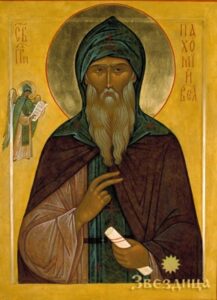
The life of St. Dionysius at first flowed like the life of many Posad people. He grew up, married, had sons. The only thing unusual is that David (as he was called before tonsure) was literate and knew the Holy Scriptures well. In his youth he was trained by priests. He became a priest and served in a small church until he lost his wife and sons. Then he had a desire to retire to the monastery. For several years he lived in the Assumption Staritsky Monastery. Distinguished by reading, the ability to reflect and righteousness, he was soon appointed archimandrite.
In 1607, by order of False Dmitry I, Patriarch Iona was exiled to the Assumption Monastery, with the order to keep in strictness and honor not to give. Dionysius ignored the order and received the patriarch with honors, and when he died, he ordered to be buried in the monastery cemetery, and over the grave he arranged a gazebo.
In 1610 Dionysius became Archimandrite of the Trinity-Sergius Lavra. It’s been a tough time, Troubled. Constant armed conflicts led to the fact that around roamed cripples, refugees, wounded soldiers. Dionysius immediately began to arrange strange houses and hospitals for them.
The archimandrite wrote and sent messages to the cities with an appeal to unite in the struggle against the Polish invaders. We have received 3 such messages.
As the name of Sergius of Radonezh is inextricably linked with the Battle of Kulikovo, the battle not only for independence, but also for the Orthodox faith, so the name of Dionysius is associated with the militia of Minin and Pozharsky. Again, the battle was not only for independence, but also for the possibility of remaining Orthodox. On August 14, 1612, the Archimandrite blessed the militia marching to liberate Moscow. He said that the Lord and Sergius of Radonezh will help them to stand up for the true Orthodox faith.
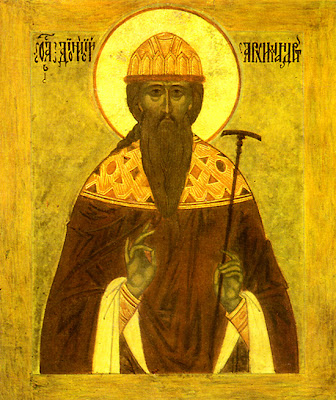
The young Tsar Fyodor went to Moscow for the blessing of the Archimandrite, and in July 1613 Dionysius participated in his coronation.
It would seem to live, but rejoice. Moreover, the patriarch entrusted the Archimandrite with an honorary task. He and his assistants had to make changes to Trebnik. During their work, they found many inconsistencies with earlier texts and made many changes. This angered some of the monks and they appealed to the patriarch, accusing Dionysius and his assistants of distorting the texts. A church court was set up, at which the archimandrite was deprived of the opportunity to conduct divine services and sentenced to a fine. He refused to pay the fine because he felt no guilt. Dionysius was exiled to the Novospassky monastery. Fortunately, soon the father of Tsar Philaret became the patriarch, and Patriarch Theophan of Jerusalem arrived on a visit. They conducted a thorough investigation, checked the texts against Greek samples, and fully acquitted Dionysius and those who helped him. The archimandrite returned to the Lavra and began extensive construction. The chronicle says that if he did not build temples, then he constantly renewed them.
The abbot worked continuously. He did not consider it shameful to participate in fieldwork, he was meek and gracious. If anyone was guilty, he spoke privately, but praised publicly. He lived in a simple cell, with several inhabitants. Every day, in addition to the rule, I read the patch, beat the bows of the earth. Before his death in 1633, he accepted the great schema and died immediately after the ceremony. He was buried in the Lavra. Now the relics are in the Serapionov chamber, under a bushel.
Memorial Day
May 25
July 17 (transitional) – Cathedral of Tver Saints
July 19 — Cathedral of Radonezh Saints
September 4 (transitional) – Cathedral of Moscow Saints
The Holy Land Charitable Foundation
Lives of Saints