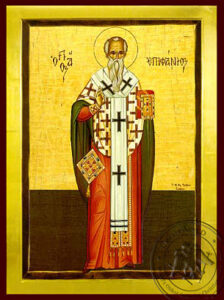
At the beginning of the fourth century, during the repression against the followers of Christianity unleashed by the emperor Diocletian, events occurred in the provinces of Rome Minor, the central figure of which was an elderly priest from Laodicea.
The future hieromartyr was born in the Syrian city of Laodicea in the first half of the III century. His parents brought him up in the Christian tradition, and as a teenager he began to help with worship. At the age of sixteen he was made a reader; on this obedience he remained twelve years. Bishop Sisinius then ordained him deacon, a ministry that Artemon carried out for nearly three decades, after which he became presbyter. As a priest, he preached for 33 years, converting pagans.
The turning point came when Diocletian demanded public sacrifices to idols from all the citizens of the empire. Bishop Sisinius and the already elderly Artemon decided to take a step that left no way to retreat: they entered the temple of Artemis, smashed the statues and put them on fire. The two shepherds then assembled a community in the temple, where they strengthened the faithful in the face of inevitable persecution.
In Laodicea soon arrived the military commander Patrick, who organized five-day pagan festivals. Discovering the destroyed sanctuary and finding out the names of the perpetrators, he headed an armed detachment to the Christian Church. However, on the way, Patrick was suddenly struck by alternate heat and chills. When he was bedridden, he saw the vengeance of the Christian God. The prayers brought to the idols did not help, and then the military commander sent a messenger to Sisinius, promising a golden statue of the bishop for healing. Sisinius said, “Your gold shall be with you, but if you wish to be healed, believe in Christ.” The fear of death caused Patrick to utter the words of faith, and after the bishop’s prayer, the illness receded. Nevertheless, the internal change did not occur: the military commander did not touch Sisinius, but continued to carry out the decree in Caesarea.
On the way to Caesarea, Patrick met an old man, accompanied by six wild donkeys and two deer. It was Artemon. When asked how animals obey him, the presbyter said that the name of Christ is subject to everything. The locals recognized in the traveler the one who destroyed the temple, and Artemon was arrested. Animals he sent to Bishop Sisinius, and one of the deer, according to contemporaries, suddenly found the gift of speech and informed the pastor about what had happened.
At Caesarea, the arrested man was brought to trial by Patrick, who demanded the victims of the idol Asclepius in a temple infested with poisonous snakes. The priest, calling on the name of Jesus, calmly crossed the threshold and brought all the bastards out, and then breathed them to death. The pagan priest Vitaly, becoming an eyewitness, turned to Christ and asked for baptism. However, Patrick considered the incident to be witchcraft and continued interrogation with torture.
Soon the same deer, endowed with speech, ran into the city. He condemned the tormentor and predicted his death in boiling resin. The enraged military commander ordered to prepare a huge cauldron and throw Artemon there. But when Patrick came to see if the resin had boiled, two angels in the form of eagles seized him and threw him into a vat. The elder was unharmed. At the place of execution he scored a spring, the water of which he baptized Vitaly and many pagans.
Subsequently, the bishop of Caesarea marked this place with the construction of a temple. Vitali was eventually made bishop of Palestine. Artemon himself, according to legend, went to preach in Asia, where in the village of Vuli after new conversions was captured by the pagans and beheaded.
Memorial Days
26 April
The Holy Land Charitable Foundation
Lives of Saints