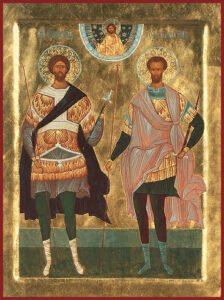
At the height of the persecution under the emperor Diocletian, around 305, a mass execution of seven followers of Christianity took place in the Campanian city of Puteoli (modern Pozzuoli). The convicts were headed by Bishop Beneventa Iannuarius; together with him, three deacons were put to death — Proculus, Sossius and Faustus, the church reader Disiderius, as well as two parishioners — Eutychius and Akution. The sentence was handed down by a provincial governor named Timothy.
The arrest of the Primate took place first. At trial, he rejected the requirement to worship pagan idols. The first torture was a red-hot oven, from which the saint came out without burns. Then followed a sprain on the rack and blows with metal rods; the torture continued until the bones were exposed. Among the onlookers were Deacon Favst and Reader Disiderius. They gave out grief — by tears the pagans identified their co-religionists. The prisoners were immediately taken to prison. There already contained the deacons of Proculus and Sossius, taken earlier, as well as the laity Eutychius and Akution. Thus, seven defendants were gathered in one cell.
The next day, they were taken to the circus, intending to throw them to predators. The beasts, however, did not approach the condemned. The viceroy publicly explained the inexplicable by sorcery — and instantly lost the ability to see. Blinded, Timothy begged for mercy. Iannuarius prayed for the tormentor, and the sight of the ruler returned. But spiritual insight did not happen: the governor again imputed what had happened to sorcery and ordered the beheading of all seven outside the city walls. The massacre took place without delay.
The inhabitants of the surrounding villages were disassembled for burial — each community sought to find its heavenly representative. The Neapolitans got the body of the saint. From the ground where the blood was shed, they collected dried clots. Subsequently, when the ark with this blood was placed near the relics in a Neapolitan temple, the baked substance liquefied and became warm, imitating freshly spilled blood. This phenomenon is recorded in legend as the “miracle of St. Januarius”. It is also mentioned that during the Vesuvian cataclysm, the lava flow froze through the prayer of the citizens, before reaching the outskirts. Another episode tells of a woman who put the image of a martyr on a dead child, after which he allegedly came to life.
The relics of the other six martyrs dispersed to various cities of the Campania, where they are honored as patrons of these places.
Memorial Days
The Holy Land Charitable Foundation
Lives of Saints