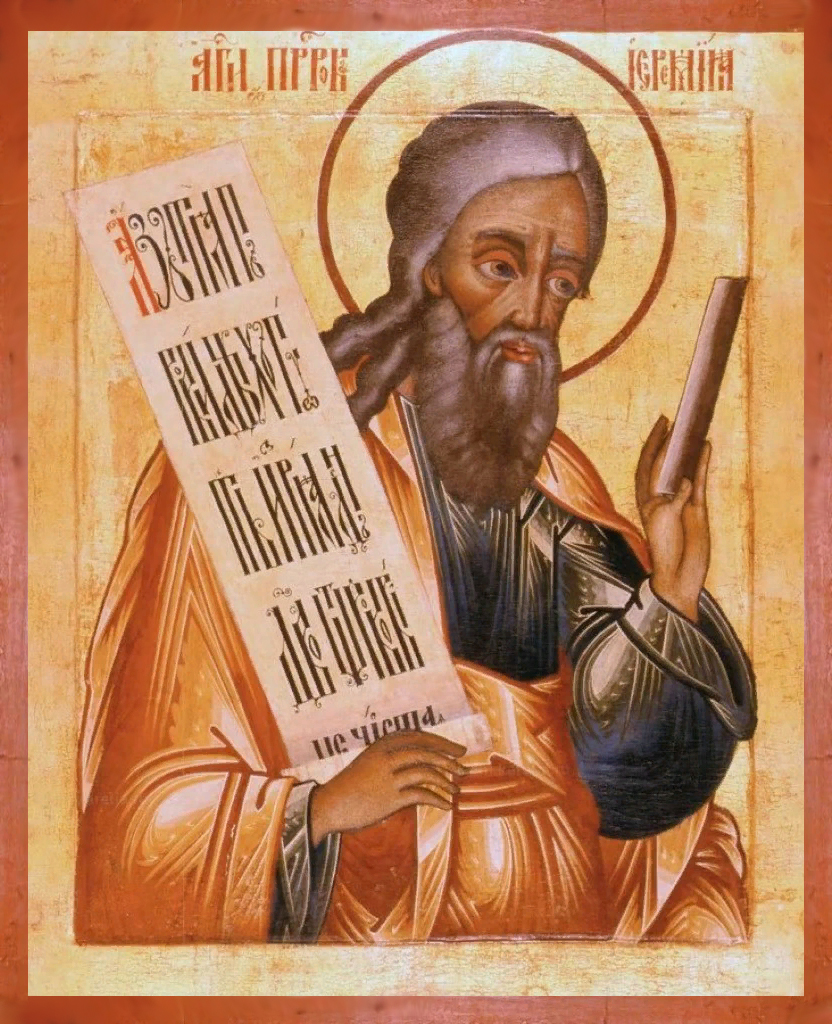
Forty years he spoke, he was not listened to. He wrote scrolls and burned them in front of his eyes. Thrown into a pit with mud, locked in a dungeon, beaten, called a traitor. And he just couldn’t keep quiet because he loved the city too much, which was doomed.
The boy who was entrusted with thunder
Jeremiah was born in Anathof, a small priestly town half an hour’s walk from Jerusalem. His father Helkiah served at the temple, and his son absorbed this world from childhood: the smell of incense, the sounds of psalms, the rhythm of sacrifices. Life was smooth and predictable.
One day it all ended. He was sixteen years old, perhaps a little older, when he heard a voice from which there is nowhere to hide: “Before I formed you in the womb, I knew you, and before you came out of the womb, I sanctified you; I made you a prophet to the nations.” The boy tried to refuse — young, can not speak, afraid of people. They said, “Do not be afraid, for I am with you.” And they touched his lips with their hand, a gesture after which there was no turning back.
From that day on, Jeremiah ceased to belong to himself. Forty years, almost the whole of his conscious life, he will say what no one wants to hear.
The word that was burned
Jerusalem of the late VII – early VI century before Christ lived in deception. Tsars ruled, priests served, people went to the temple — but behind the facade there was rot. The poor were robbed, the courts were sold, idols stood in the streets, and false prophets loudly reassured: “Peace, peace!” Nothing will happen. People wanted to believe, and they believed.
Jeremiah was going against the tide. He stood at the gate and cried out, “Thus saith the Lord, Correct your ways and your deeds, and I will leave you to dwell in this place.” Do not rely on false words: here is the temple of the Lord, the temple of the Lord, the temple of the Lord. The crowd passed by. The priests plugged their ears. He was standing.
Once, on the orders of King Joachim, a written scroll with prophecies was cut with a knife and thrown into a brazier — sheet after sheet, until only ashes remained of the words. Jeremiah dictated again and added more.
Actions instead of words
Sometimes words were missing. Then he showed.
He bought a clay jar, gathered the elders and priests at Tophet, a place where children were sacrificed, and broke the vessel in front of everyone. Thus, he said, the Lord will destroy this people and this city.
I put a wooden yoke around my neck. Walked through the streets, showing that slavery was coming. A false prophet took his yoke and broke it. Jeremiah left and returned with iron.
I bought a field from a relative at Annathof, just in the days when the Babylonian stood by the walls. Everyone knew that the land is worthless, tomorrow it will be occupied by strangers. Buying, sealed and opened, deposited — a gesture that meant: houses and fields would be planted again and people would return.
Dungeon and pit
For the word «captive» he was called a traitor. The patriots accused him of giving the enemy hope. He said, The city will fall, the king will go to Babylon, the people will be taken away, and for this he was hated more than the Babylonians.
He was beaten and held in pads at the gates of Benjamin. Then they threw them into a pit, not into a stone dungeon, but into a dirty well in the courtyard of the guards, where there was no water, only tin. He was sinking into it. He was pulled out by a stranger, the Ethiopian Ebed-Meleh, the slave of the king, a man with a good heart, who asked for permission and lowered the ropes. Without him, the prophet would perish.
Town fell
What he had been screaming for forty years had happened. Nebuchadnezzar took Jerusalem. The walls are dismantled, the temple is burned, the king is blinded and chained. The people were driven to Babylon like cattle.
Jeremiah stayed. He was offered a place among the nobility in Babylon—honor, security, peace. He refused. I went to the poor, to those left in the ashes.
Then he wrote «Crying.» Five chapters, five elegies, in which the city is mourned like a dead child. “How lonely a city once crowded sits, it has become like a widow.” There is no triumph of a prophet who has proved right. There is a grief of a man who loved this city and did not save it.
New will
But even in the ashes, he talked about the future. It was Jeremiah who first uttered the words, which will be repeated in the Christian temples and in the Jewish prayers: Behold, the days come, saith the Lord, when I will make a new covenant with the house of Israel and with the house of Judah. I will put my law within them, and I will write it on their hearts. Not the outer statute on the stone tablets, but the living knowledge of God in the heart of every man.
New Testament. That’s what he called it, long before it has any meaning.
Stones in Taphn
The rest of the people, fearing revenge from the Babylonians, decided to flee to Egypt. Jeremiah prayed, Do not go away, stay, God will keep you here. They did not listen, and they took him with them.
In Taphnach, Egypt, among the refugees who had begun to worship idols again, he continued to speak. His last written words are a sentence: the sword you fear will overtake you here.
Tradition says he was stoned. Those he tried to save killed him. So ended the life of a man who forty years told the truth to people who did not want to hear it.
Memory
The Orthodox Church honors the memory of the prophet Jeremiah on May 14 (May 1 in the old style). In the Western tradition, June 26. In Islam, he is known as the Prophet of the Army, one of the messengers of God who warned the children of Israel.
He didn’t pick up the sword. He didn’t revolt. He didn’t take over. He was just saying, forty years, without losing his voice, knowing that he would not be heard. I cried not for myself, but for a city that loved more than it loved itself.
Memorial Days
May 14
Lives of Saints