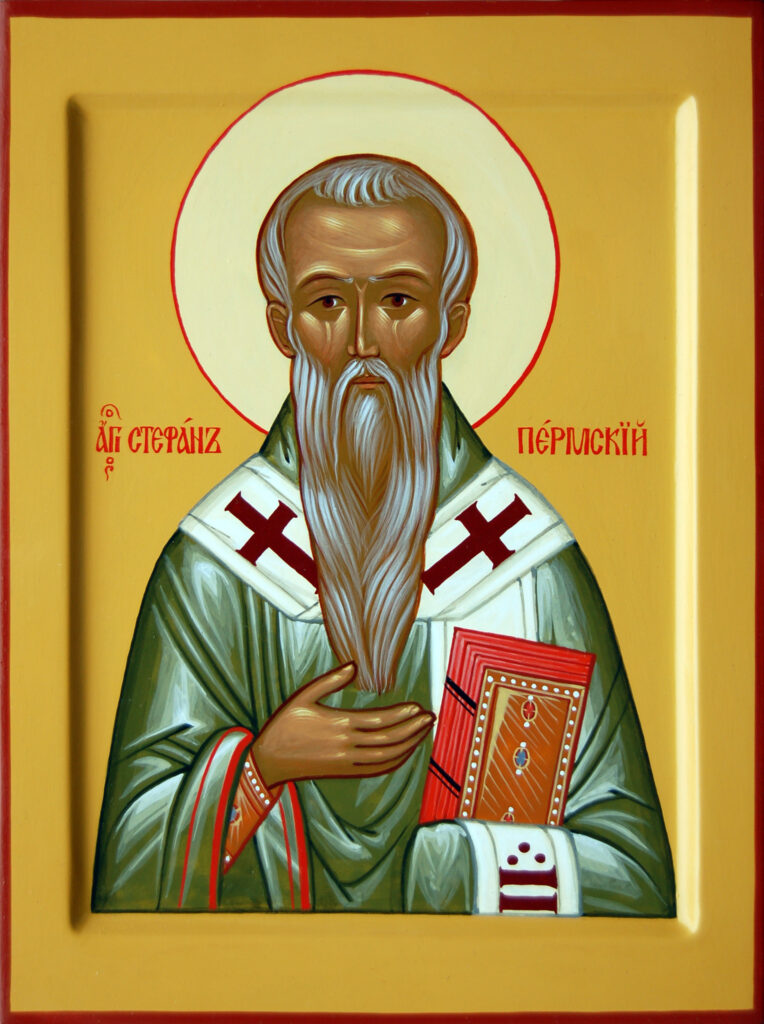
The history of the Russian North knows few examples when one person changed the cultural code of an entire territory in a short time. Stephen, born around 1340 in the family of a clerk from Veliky Ustyug, managed to do what others took centuries to do: he gave the Komi people the alphabet, worship in his native language and the church organization.
His childhood was spent at the temple. He learned to read quickly, and soon helped his father in the services. Trade routes passed through Ustyug, Zyrians visited the city — so the future missionary first heard their speech. Interest in this people did not fade after leaving for Rostov, where Stephen took tonsure in the monastery of Gregory the Theologian. There he mastered Greek and gained access to an extensive library. It was in the monastery walls that the plan ripened: to bring Christianity to the Perm lands not in Slavic, but in the language of local residents.
The task required writing. Stefan developed the alphabet by using Greek graphics with the addition of signs to convey the specific sounds of Komi speech. With this baggage, he arrived in Moscow in 1379, received the rank of hieromonk, antimins, church utensils and princely security certificates.
Then the work on the ground began. The preacher walked along Vychegda, stopped in villages, argued with priests, destroyed idols. The episode with the «lean birch» became a turning point. The tree served as the main shrine of the district. Stephen settled near him, spent months talking with the coming Zyrians, and then burned him. The expectation of reprisal was not justified: the preacher’s words about the impotence of the deity, who could not stand up for himself, made many think. On the ashes built the church of Archangel Michael.
The second blow to paganism was a dispute with Pama. The priest offered the test to pass through the flame. Stefan accepted the challenge and pulled the opponent with him. Pama pulled back. The crowd watching the scene was ready to crack down on the retreater, but Stefan forbade violence. Pama was expelled, and the authority of the preacher grew many times.
In 1383 he was made bishop. From this moment, the systematic arrangement begins: schools at churches, the preparation of priests from the Zyrians, the translation of the Psalms, the Hours, passages from the Gospel and the Apostle, the full liturgical cycle. In parallel, Stefan was engaged in supplying the population with bread in the famine years, sought tax relief in the capital, defended the flock from bureaucratic extortions.
The path was cut off in Moscow in 1395 during a regular trip on church affairs. He was buried in the Kremlin, in the temple of the Savior on Bor. Zyryans unsuccessfully asked to return the body home. The glorification began in the next century, and at the Council of 1549 the saint was ranked among all-Russian saints. Today his memory is celebrated on May 9.
Stephen’s writing remained in use for centuries. The modern Komi alphabet, approved in the XX century, is based on the Cyrillic alphabet, but the very fact of the appearance of the book tradition among this people goes back to the missionary from Ustyug.
Memorial Days
February 11— Komi Cathedral of Saints
February 14 (transient)— The Cathedral of Saints of the Perm Metropolia
May 9
June 5— Cathedral of Rostov-Yaroslavl Saints
July 11 (transient)— Cathedral of Vologda Saints
July 19— Radonezh Saints Cathedral
6 September (transient)— Cathedral of Moscow Saints
November 1— Cathedral of Saints of the Archangel Metropolia
The Holy Land Charitable Foundation
Lives of Saints