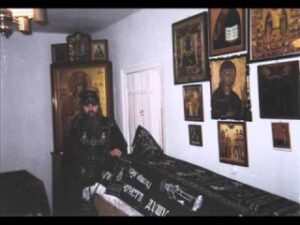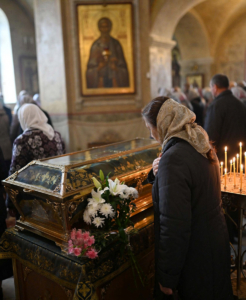
For many people, especially if they did not grow up in a church environment, when they see a shrine with relics, a simple and honest question arises: “Why is this? Why do they go to the remains, kiss them, light candles?” They also often ask: “Is it true that they are being dug up? And if so, why?”
Let’s try to answer without beautiful phrases and without “fabulousness”, simply and humanly.
Not about the remains, but about the person
When we talk about relics, we are not talking about an “object of power” or something frightening. We are talking about a specific person who lived, worked, struggled with his weaknesses and tried to be closer to God. About the one whom the Church recognized as a saint. The relics are a physical reminder of him.
For a believer, it’s like a family photo on a shelf: you look and understand that you are not alone, that there is someone who understands you and is praying for you. Only in the case of a saint, this is not just memory, but the faith that even now, already with God, he continues to intercede for people. Therefore, people go to the relics not to “charge themselves,” but to ask: “Help, I can’t cope.”
Why are relics needed in the church itself — even if no one comes to them
There is a point that is not at all connected with “queues to the shrine,” but it is the most important: without a particle of the relics, you cannot serve the liturgy. When the temple is consecrated, a particle of the relics is placed at the base of the altar and in the antimension — a special platform on which the Eucharist is celebrated.
Why is this so? Because the Church sees itself as a single body: together in it are those who came to the service today and those saints who are already standing before God. A piece of relics in the throne is not a symbol “for beauty.” This is a structural part of the service: a sign that the liturgy is celebrated in communion with the entire Church, earthly and heavenly. Even if the temple is empty and quiet, this meaning does not disappear anywhere.
Incorruptibility is not the main sign
Very often people think: if the relics are incorruptible, it means the saint is real; if there is almost nothing left of it, it means “this is not it.” This is a misconception. In Orthodoxy, incorruptibility is not considered a mandatory sign of holiness. It happens that only particles have been preserved — and they are approached with the same faith. And it happens that the remains look incorrupt, but the Church does not glorify them as relics.
The criterion is not physical, but spiritual: how the person lived, what he taught, how he helped people, is there evidence of his intercession. It is life and deeds that are the basis of glorification.
About hope and about “ordinary” perseverance
Another meaning, very earthly and understandable: veneration of relics is about hope. About the belief that death is not an end, but a transition. If God glorified a person, it means that He showed that victory over death is real.
And it’s also about inspiration. Saints are not “superheroes” for whom everything came easy. These are ordinary people who had fears, fatigue, doubts, and mistakes. But they didn’t give up. And when a person stands in church today, tired and confused, he looks at their path and quietly understands: “He was like me. And he was able to move on. That means I can do it too.”
If you are in the temple for the first time
If you enter the temple and see a line for shrine, there is no need to be embarrassed. You can just stand nearby, look, think. You don’t have to apply yourself — no one is asking you to. A respectful attitude, calm silence, a short request is enough, even if it consists of two words: “Help me.”
And if you want to understand better, you can approach the priest on duty or a temple employee. More often than not, it is these simple conversations that resolve the most pressing issues. Because behind this whole tradition there is not a set of rules, but a living human need: to be heard, to receive support, to feel that you are not alone.
So it turns out that the relics in the temple are not about antiquity and not about rituals “just in case.” This is about connection: with a specific saint, with the Church and with God. About the fact that a person can come and say: “It’s hard for me,” and know that his request did not go unheeded.
Charity fundnd Holy Land
Investment in the Soul!