Where do we get knowledge about God? The answer to this question lives in several dimensions at once — in the beauty of the created world, in the history of salvation and in the living tradition of the Church.
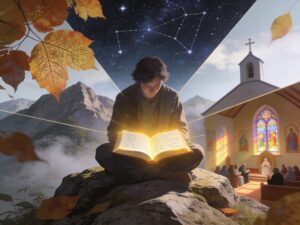
Take a closer look at your surroundings: in the harmony of the starry sky, in the change of seasons, in the subtlest pattern of a leaf or in the silent power of the mountains, you can discern the hand of the Creator. The Apostle Paul also noted that the invisible of God, His eternal power and Divinity from the creation of the world through the examination of creations become visible. Nature seems to speak to man in the language of images, awakening a quiet question in the soul: “Who arranged all this?”
But contemplation alone is not enough. God didn’t just leave the world to us as a mystery—He Himself stepped towards people. This revelation, given from above, is carefully recorded in the Holy Scriptures. The Bible is not a collection of philosophical reflections, but a chronicle of the encounter between God and man. Its pages breathe the breath of the Spirit: the holy prophets and righteous people became like conductors of the Divine message, conveying not their thoughts, but what the Lord revealed to them.
A special chapter of this book is the New Testament. His heart is the Gospel, which in Greek means “good news.” It contains the story of the Savior’s coming into the world: the life of Jesus Christ, His words, deeds, suffering and victory over death. The Gospel was written by Christ’s closest disciples, the apostles, moved by the Holy Spirit. Next to the Gospel there are other apostolic epistles — they reveal the meaning of the Savior’s teachings and show how the first Christians learned to live by faith.
Before the coming of Christ, humanity walked a long path of waiting. The books written before this great event constitute the Old Testament. They contain prophecies, promises, the history of the chosen people, and moral instructions. All this was like a preparation, a quiet dawn before the sunrise: they taught people to recognize the voice of God and wait for the Messiah.
However, not everything that the Church preserves and passes on from generation to generation fits on the pages of Scripture. There is also Holy Tradition — the living experience of faith, which the apostles passed on to their successors not only through books, but also through the spoken word, through worship, through personal example. It included doctrinal truths, the spiritual experience of the holy fathers, and the rules of church life. The Apostle Paul directly called: “Therefore, brethren, stand fast and hold to the traditions which you have been taught, either by our word or by our epistle.” Tradition is not an “additive” to Scripture, but the very environment in which Scripture lives and is revealed.
So knowledge about God is made up of different threads: from the beauty of creation, from the words of the Bible, from the experience of the Church and from personal search. And each of them, in its own way, helps a person hear the quiet but persistent call: “Come and know Me.”
Charity fond Holy Land
Investment in the Soul!