

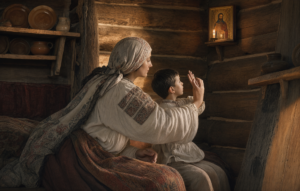
For a child, prayer is not an obligation or an exam. It’s not «you have to learn five lines to be good.» For a child, this is a feeling of security, a feeling that there is someone big and kind who hears him. And the main task of parents is not to turn this conversation into a routine, but to keep it warm.
Where to start: not with a text, but with an example
Children learn not by words, but by actions. If a mother in the morning, before pouring herself coffee, freezes for a moment and quietly says: “Lord, bless the day,” the child reads this as the norm. If dad crosses himself before the road and whispers a short request for protection, the baby remembers: this is what people do, this is what those who love me do.
Therefore, the first and most important step is not to force the child to stand in prayer, but to show that prayer is part of ordinary life. She is not separated from everyday life, she lives in it: before meals, before going to bed, when she’s scared, when she’s happy, when she just wants to say “thank you.”
The rule “within her strength”
It’s very easy to succumb to the temptation: “Let him learn more, it’s a blessing!” But for a preschooler, even one meaningful phrase is more valuable than a dozen mechanically read ones. It is better if a child says one or two short prayers every day with attention, than to stand and wait for everything to end.
You can start with very simple things:
- «Lord, bless!»—before any task: before lessons, before a walk, before sitting down to dinner.
- «Thank you, Lord!”—in your own words, when something good happened: the cat purred, the sun came out, a friend shared a toy.
- “I’m sorry if I offended someone»—this is also a prayer, and it is especially important because it teaches the child to notice his actions and ask for forgiveness.
Such short appeals do not require memorization, but form the most the main thing is the habit of turning to God in different situations.
Favorite children’s prayers: short and clear
There are several prayers that fit especially well with children’s perception:
- «Our Father» — it can be taught gradually. First, one line: “Our Father, who art in heaven.” Then add the next one. Let the child take his time. The meaning does not come immediately, but through repeated, calm repetition.
- “Virgin Mother of God, rejoice”—there is a lot of tenderness in it, and children can relate to it. It can be explained in simple words: “We say kind words to the mother of Jesus, because she is kind and takes pity on everyone.”
- “To the Angel of God, my holy guardian”—this prayer is understandable to the child literally: he has an invisible protector. And the phrase “save from all evil” sounds like a promise of security, which a little person so needs.
You should not strive for the child to know all the words perfectly. Let him speak with a hint the first time, repeat after mom or dad. The main thing is that there is no tension in this.
How to make prayer alive
Sometimes it is useful not just to read, but to “unpack” the meaning a little. For example, after the line “Give us our daily bread this day,” you can calmly say: “This means: Lord, help us so that we have everything, so that we do not starve, so that we have enough for the day.” Such small explanations help the child not to perceive prayer as an incomprehensible set of words.
Another good trick is to sing. Many prayers sound like quiet, calm songs, and children enjoy humming them. Singing relieves stress, makes prayer less formal and more personal.
Prayer as a family affair
It’s good when the family has its own little traditions. For example, in the evening everyone gathers for five minutes: someone lights a lamp or a candle, someone reads one line, someone just stands quietly nearby. Even if the child does not yet say a word, he feels: this is ours, family, important.
At the same time, it is important not to turn prayer into an educational tool. You shouldn’t say: “If you don’t pray, you won’t receive…” or “Until you read it, you won’t go to sleep.” Thus, prayer becomes a bargaining chip, but should remain a space of trust.
Graduality and respect for age
With age, the prayer rule can be gradually expanded. Add one new prayer at a time when the child is already confidently coping with what he knows. But the measure here is not the number of words, but the child’s inner state. If he stretches, if he is calm and not afraid, then everything is going right. If resistance appears, it is better to stop and return to simple, favorite phrases.
And one more important point: prayer should not be the only form of spiritual education. She lives next to kindness, with patience, with the ability to notice other people’s pain. A child should see that faith is not only words, but also actions: to help, to regret, not to offend, to share.
Charitable fond Saint Earth
Investment in the Soul!


