Saint Vladimir brought not only the Orthodox faith to Rus’. He invited the first craftsmen to build and paint temples. Therefore, the influence of Byzantium is clearly visible in the buildings of the pre-Mongol era.
The oldest surviving frescoes (paintings on wet plaster) are now located in Ukraine, where the construction of the first temples began. Fragments of the painting of the first church of Kyiv, Tithes, have been preserved, albeit insignificantly.
On the territory of modern Russia, walls began to be painted in Novgorod. Large stone construction was carried out there, and fragments of the first Russian frescoes have been preserved there.
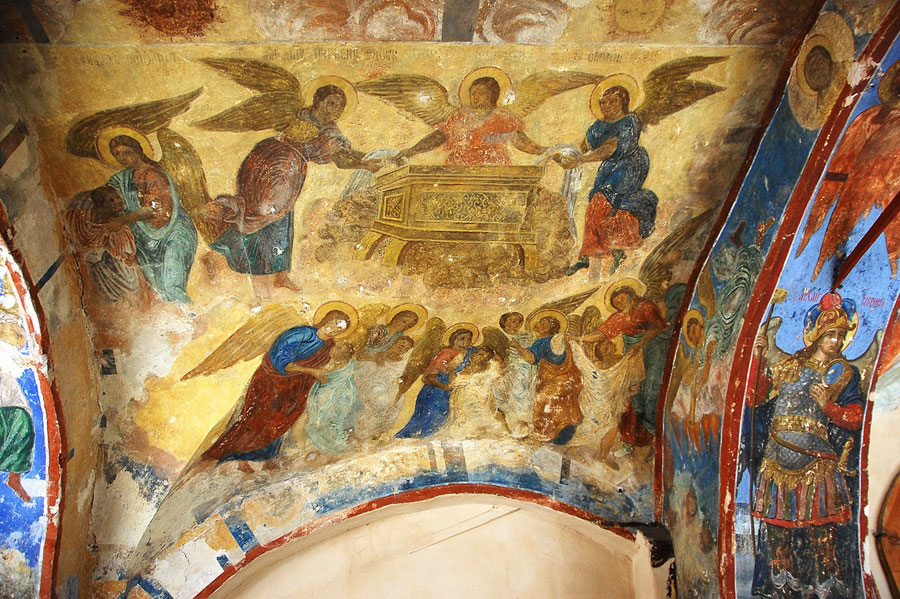
The Temple of Sophia the Wisdom of God was built by order of Vladimir Yaroslavich, the son of Yaroslav the Wise. It is not known when they began to paint the temple, but they finished it almost 100 years later, in 1140.
The faded painting is best preserved, from which it is difficult to judge other frescoes. This is an image of Emperor Constantine, who recognized Christianity as the state religion, and his mother Helen, the first Christian pilgrim in history. Scientists believe that this is not a fresco at all, but a sketch for a mosaic, which for some reason was not made. It says there that the walls were painted by artists from Constantinople (Constantinople) and they painted the image of the Savior with a blessing hand. However, the next day, the hand was clenched into a fist. The image was rewritten, but everything happened again, and then again. On the 4th day, a voice was heard in the temple, which said that the Lord was holding Novgorod in his hand, and as long as it was clenched, the city would stand. A famous world-famous scientist, Academician Likhachev, believed that the prediction had come true. During World War II, an artillery shell hit the image of Christ, destroying it. After this, according to the academician, ancient Novgorod came to an end. The destruction was on such a scale that it is no longer possible to imagine the city in its original architecture.
But the frescoes suffered even without shelling, in peacetime. The next bishop gave an order and the old plaster was simply knocked down, and with it the works of ancient masters. The painting was whitened, and what is now called a “remake” was applied on top.
So only small fragments remained of the ancient painting. They can be seen on the dome; the figure of Solomon is clearly visible there. In the gallery you can see fragments from the life of St. George.
2. Spassky Church on Ilyin Street, Veliky Novgorod
In the second half of the 14 century, Byzantium was going through difficult times. Constant coups and external wars weakened the state and depleted the treasury. In such conditions, many talented artists sought happiness in foreign lands. This is how the famous Byzantine painter Theophanes the Greek came to Rus’. From scraps of information in the chronicles, and most importantly in the letters of the monk Epiphanius, we became aware of some facts about the life, personality and style of writing of Theophan. So, we know that Theophan came to Rus’ famous, having already painted several cathedrals in Constantinople. That he worked not only in Novgorod, but also in Moscow. There I met with Andrei Rublev.
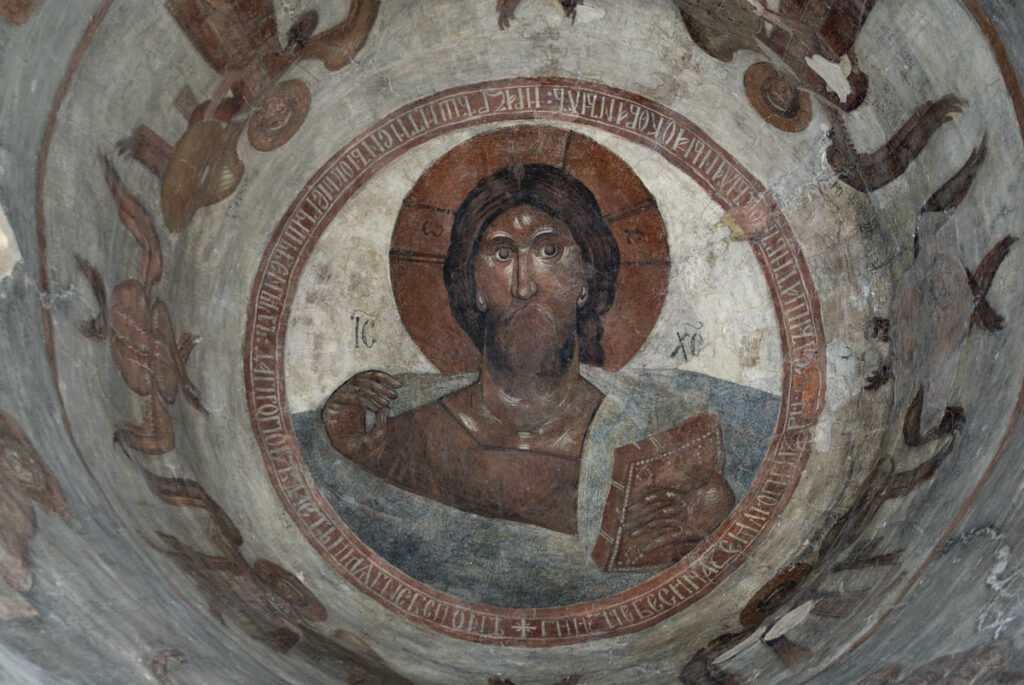
The only frescoes of Theophan the Greek that have survived to this day are the paintings on the walls of the Church of the Transfiguration in Novgorod.
The frescoes have suffered from time, but give an idea of the artist’s creative style of painting. The remains of the Eurastichea can be seen on the altar pillar, the Descent of the Spirit and the figures of saints — on the walls. The dome painting is represented by the figure of Christ Pantocrator and angels with seraphim. The forefathers are depicted in the walls of the dome drum. The frescoes are best preserved in the choir. Theophanes broke the traditions of Byzantine writing: all his figures are different. They differ in size and pose, giving the image a special rhythm and vitality.
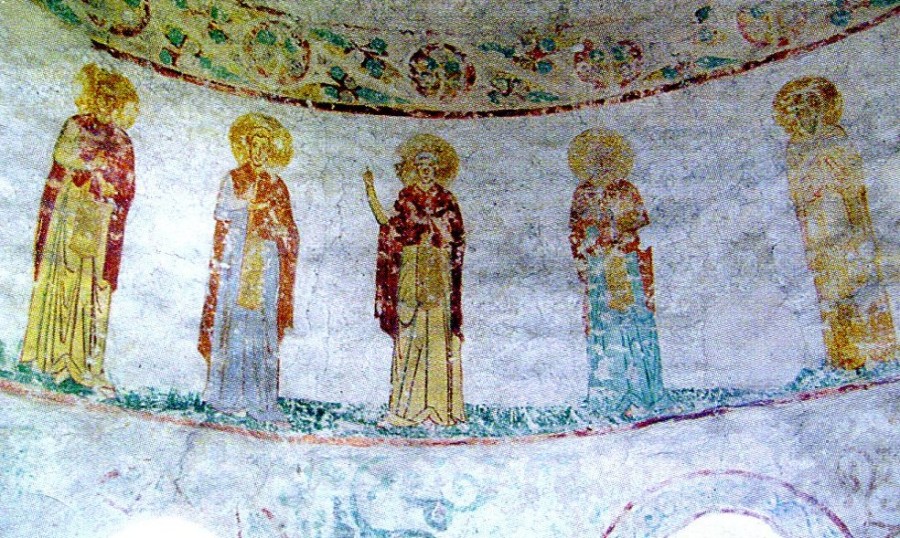
The fate of the frescoes of St. George’s Cathedral in the Yuryev Monastery is tragic. They were barbarously knocked down and new ones were painted in their place, by historical standards, quite recently, in 1901.
Only fragments of the painting in the cathedral tower have survived. These are images of Hodegetria, St. George and saints. The manner of writing clearly indicates that local craftsmen painted the temple, but they did it not during the construction of the temple, but 50-60 years later. In 2014, archaeological excavations began inside the temple. When dismantling the floor, it turned out that every time it was re-floored, the remaining part of the painting on top was cut down and used as a substrate for the new floor. Therefore, scientists were able to clear multiple images of faces, arms, legs, and clothing. But the main thing is the faces, because they best convey the traditions and style of painting.
The frescoes are definitely ancient; during and after the Mongol yoke, this composition of plaster was no longer used. So the fragments are confidently attributed to the 12th century. In addition, the graphic style of writing (little color, a lot of outline) corresponds to the Byzantine canons of this time.
4. Anthony Monastery
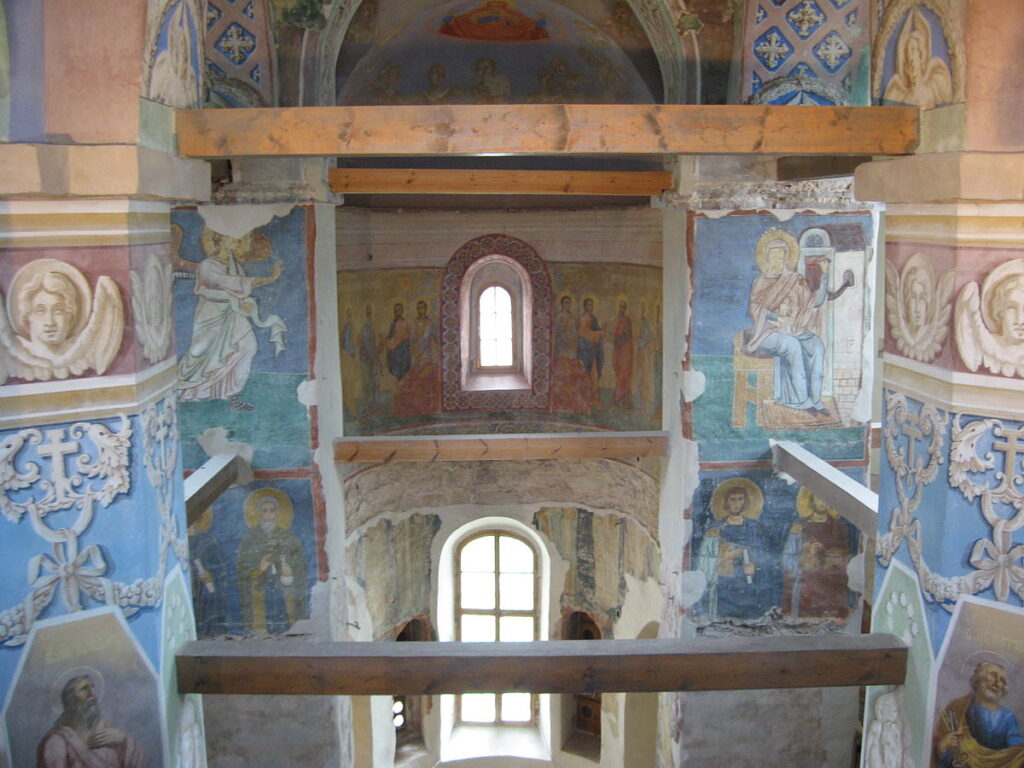
According to the chronicle, the Church of the Nativity of the Virgin Mary in the Anthony Monastery was painted in 1125. Alas, they were barbarously covered with notches to secure new layers of plaster. However, already in 1923, attempts were made to clear the painting. The work, with interruptions, continued until the end of the 70s.
This painting is interesting because it is made in the Romanesque style, which is completely uncharacteristic of either Byzantium or Rus’. There may be several explanations. Novgorod was a trading city; representatives of different countries and cultures lived, worked, sold and bought here. The founder of the monastery, Anthony, was a foreigner, a native of Rome. Arriving in Rus’, he could only communicate with the “Greek Gotfin.” It would not be surprising if he hired overseas masters to paint the temple.
Four temples, centuries of history and a lot of restoration work — everything so that we understand how the Orthodox worldview was formed in Russia.
Saint Charitable Foundation Earth
Investment in the Soul!