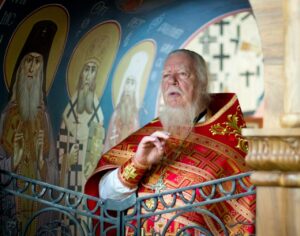
The Hieromartyr Vasily Nadezhdin (1895-1930) was a very happy man: he had a favorite business and a beloved wife. After nine years of service, the father was arrested. In prison, he fell ill with typhus, gangrene, but before his death he managed to leave his wife an amazing letter of will.
Vasily Nadezhdin met his future wife Elena Borisoglebskaya during the First World War at a charity concert in Moscow.
The young seminarian, admiring the young pianist, handed her a letter and a rose.
Then there were more letters, meetings. She wrote in her diary: ‘Yesterday I got some sweet poems from him. So gentle, joyful in the soul!
The chosen one of Vasily Fedorovich graduated from the Moscow State Philharmonic. It was said that such a talented pianist would have a great future, but as the bride of a man aspiring to the priesthood, she knew that her life would be different.
Elena Sergeevna wrote to her beloved after her engagement: “Tonight I did not sleep, and suddenly I felt our connection as a Sacrament very vividly.” His symbol is the rings on our hands. We’re connected, engaged… How’s your soul? Your heart? Is the soul alive, has it been opened again? And the heart? Is it ready for the Sacrament?
Vasily Nadezhdin admitted: Yes, my joy, my Lenusya, now you are my bride, and I feel it vividly. On the other hand, I am fully aware that I am not worthy of you, I am not worthy of you, and I do not know when the balance will be established between us. It seems to me that you have enriched me more with your ignorance than I have enriched you with my marriage.
In March 1919, saving his older sister and her three sons from hunger and typhus, Vasily Fedorovich, moved with them to live in the Penza province, where his friend the priest served. There he worked as a mathematics teacher. In April of the same year, Vasily Nadezhdin briefly returned to Moscow to marry Elena Sergeevna and take her with him. A year later, the young couple will have their first son Daniel, and a year later Vasily Fedorovich became a priest.
“When I first came to him for confession, it was very difficult to start,” the parishioner of Father Vasily recalled. — Father is so extraordinary, with a serious look, thoughtful, deep. In his eyes I wanted to look as good as possible, to gain respect, and then confession, and I have to say everything.
The first issues were turning points, and within two months we established close relations and mutual understanding. In his leadership, Father Vasily did not allow the slightest compulsion, but only advised to do this or that, and always so seriously and meaningfully that conscience did not allow disobedience.”
In early 1929, a decree of the Central Committee of the AUCPB on measures to strengthen anti-religious work was sent to all representatives of the authorities in Russia: it stated that religious organizations were the only legally active counter-revolutionary force exerting great influence on the masses. In October 1929, Father Vasily was arrested.
Father said: When we touched on the question of confession, here I held this point of view.
There are different limits for each Christian to reconcile himself to the non-Christian reality that surrounds him. If these limits are violated, he must come to terms with the possibility of personally unpleasant changes in the conditions of his life. Otherwise he is not a Christian.
Oh. Vasily was sent to Solovki. Even on the way, in Kemi, determined to live before the opening of navigation in the barracks, where previously there were typhoid patients. O. Vasily became infected, in the sanitary unit he was given an injection, after which gangrene began.
Surrounded by a mortal premonition, as soon as he was placed in the place of a patient with typhus, Father Vasily left his will letter, written on December 24, 1929.
The relatives received a letter on February 19, 1930, on the day of the death of the Hieromartyr, which coincided with the birthday of his wife Elena Sergeevna.
“Lord, help me to do this well.”
Today, on the Angel Day of my eldest son, my Dodik, I have a sad thought, but it seems to me right, that I should write a farewell letter in case I die. For if I fall ill with typhus, I will not be able to write, I will not see or hear any of my relatives, I will not be able to convey anything to them except this letter, if it is written in advance and… if the Lord arranges it so that it will reach my loved ones.
This letter should replace me, farewell to me, participation in my funeral, which will take place here without the participation of my loved ones, without their prayers and tears.
I write all this calmly and complacently, for there is an ineradicable hope in my soul that I will not die here at all, that I will leave this damned place and see all my dear ones again. But this will be a matter of God’s special mercy, which I may not have deserved, so I am writing this letter.
First word to you, my dear, beloved, the only Elinka, my Lenusia! First of all, I bless you for your faithful love, for your friendship, for your devotion to me, for your inexhaustible tenderness — the unfading freshness of love relations, for your intelligent sensitivity to everything I have, for your exploits and labors associated with fivefold motherhood, for all the hardships associated with your marriage, finally, for all these last tears of separation after my arrest.
May the Lord reward you for everything, may the love of our children, the love of my sad parents (if they outlive me), my brothers and sisters, and all my friends reward you.
Alas, I loved you so little in recent years, so little belonged to you spiritually; thank you for our recent meetings in Ilyinsky, on Senezh; thank you for keeping me with you and asking you not to hurry to move to a new apartment. How good we were together in our cabin!
How vividly I remember our comfort, our bright world, our family happiness, created and decorated by you! Ten years of cloudless happiness! There is something to be thankful for.
And you and I have to do it… at least if you don’t see me in this world. May it be God’s will! We will wait for a joyful rendezvous in the bright realm of love and joy, where no one will be able to separate us, and you will tell me how you lived your life without me, how you managed to bring up our children in a Christian way, how you managed to inspire them with horror and disgust at the dark godless worldview and impress in their hearts the bright image of Christ.
Please don’t be discouraged, I will be with you by the power of my love, which never fades away.
My wish: educate the children in the Church and make them educated in European and Russian; let my children be able to understand and love the books of their father and to perceive the high culture with which he breathed and lived.
Indoctrinate them to spiritual experience and to art of any kind, if only authentic. One of my sons must be a priest in order to continue his ministry and offer prayers for him. I had so little to do and wanted so much. Elinka, my dear!
If only you knew if people knew how easy it was for me to love and how happy I was to feel at the center of the love radiating from me and back to me. How sweet it was to be a priest! May the Lord forgive me my weaknesses and sins through your holy prayers.
Thank you for your music, for the music of your soul that I heard. Sorry, honey! Peace be upon you. I love you forever, forever.
Vasily Vasilyevich Nadezhdin is the only one of the five children of Father Vasily who survived to this day, and the only one of the five who did not see his father alive, recalled that his mother, having learned about her husband’s illness, obtained permission from the authorities to come to him and take care of him.
She wrote to her relatives from Kemi: I walk in the morning and in the evening along the wooden fence with wire at the top and reach the infirmary, where my gentle fading sun lies. I see the top of the frozen window and I say hello and pray. At three o’clock I make the transfer of milk, broth (chicken here you can get), I receive his receipt, written in weak handwriting. That’s it!
The night passes in longing and painful dreams. What do we do?
How am I better than many others who have lost loved ones here? We have to endure this ordeal, live without my dear friend.
Every time the door of our apartment is opened, I see if they have come to tell the fatal news. He has been cut, he has changed greatly and has become thin, they say, the bandages are painful and exhaust him. I am so happy that I live here and can help him at least in some way.
The head of the camp allowed Elena Sergeevna to sit next to her dying husband, pray and give his body to burial.
In 1933, the same night that they came for Father Vasily, came for Elena Sergeevna. The reason for her arrest was a denunciation: the widow of the priest continues the work of her husband, gathers young people in the apartment, conducts anti-Soviet conversations with them. Together with her mother, children who attended a religious and philosophical circle founded by Father Vasily were arrested.
Elena Sergeyevna recalled: On a date in Butyrskaya prison, I gathered all my strength so as not to cry when my heart broke at the sight of children. We’re separated by a grid. I can’t kiss them or touch them.
The sentence of 5 years of the northern camps at the request of relatives was replaced by exile in Saratov. For 8 long hard years, the separation of mother and children stretched. All this time was with her only the youngest, named after his father Vasily, who was then three years old.
After returning from exile, Elena Sergeevna wrote in her diary: “I thank God for everything,” as if fulfilling the will of her late husband.
History Author: Ksenia Orabey
The Holy Land Charitable Foundation
Soul investment!
Orthodox stories from life