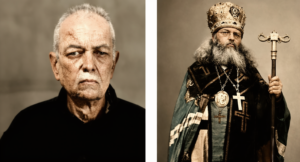
There is little information about the life of the saint. He lived in the era of the birth of Christianity, communicated with the apostles, was a disciple of one of them, John.
The legend says that it was he who was taken in the arms of Christ, punishing his disciples: “be like children, otherwise you will not enter the kingdom of heaven.”
John Chrysostom argued that Ignatius received wisdom and love for Jesus directly from the apostles, “both in speech and in ineffable things.”
It was the apostles who entrusted him with the bishopric in Antioch. There, Saint John worked tirelessly, cultivating the seeds of faith in the residents of the city and surrounding area.
For his meekness and humility, for caring for the suffering and supporting the weak, the bishop was loved and revered. Christians were strengthened in their faith, unbelievers were baptized, and the fallen repented and were reborn in the bosom of the church.
In 107, Emperor Trajan, during his eastern campaign, stopped in Antioch.
The pagans immediately began to complain about the growth of the Christian community, headed by Ignatius.
Called by the emperor, he did not hide his holy faith and refused to make sacrifices to idols. For this, the enraged Trajan ordered him to be taken in shackles to Rome and there to be torn to pieces by wild animals for the amusement of the crowd.
The path from Antioch to Rome became a hymn to Christ and showed the steadfastness of Ignatius’ faith.
At all stops he did not stop preaching, and for those who could not listen to him because distance, he wrote messages. A total of 7 such messages were written and they have all survived to this day.
Ignatius courageously accepted death in the arena, before turning to the game lovers who filled the Colosseum. The saint said: “Viewers of my feat, know that I am dying for the faith in the One God, in whose love I abide and to whom I strive.”
After the execution, the remains of the saint were first buried near Rome, and in 108 they were transferred to the outskirts of Antioch. After 300 years they were moved to the city itself, because more and more pilgrims flocked to the grave to worship. A small suburban village (Daphne) could not accommodate them.
But a few centuries later, Antioch was captured by the Persians. Pilgrims could not venerate the relics in the Persian city, but the invaders did not interfere with the transfer of the relics. They were taken to Rome, where they are still kept in the Church of St. Clement (Pope).
On February 11, the church honors the memory of Saint Ignatius, who was nicknamed the God-Bearer because he carried Jesus in his heart. Neither torture, nor threats, nor death itself shook his faith in Christ. On this day, it would be good for us to pray to the saint, so that he would strengthen our faith, give us humility and intercede for us before the Lord for the forgiveness of sins.
Days of Remembrance
February 11-Transfer of Relics
January 2
Charity FondHoly Land
Investment in the Soul!