The festival is set in honor of the event of the year 944, but the history itself began much earlier, even during the life of Christ.
The ruler of the Syrian city of Edessa Avgar was sick with leprosy. The disease is severe and incurable. No magicians, healers or healers could help him. But somehow Abgar heard of an extraordinary man who preached the Kingdom of Heaven. The governor believed overnight. He outfitted the court painter, Ananias, to Jerusalem with the important task of capturing the face of Jesus.
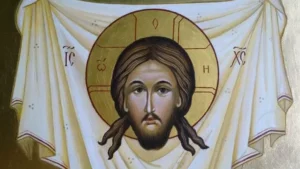
Ananias reached Jerusalem, but he could not approach Christ. Jesus was accompanied by crowds of people, there was no way to get through them. And then an incredible thing happened. Christ understood the need of Ananias and Abgar. He asked for water, washed himself and wiped himself with a canvas. His face was forever imprinted on the board. Ananias received more than he expected: not just the face of Christ, but His true, non-man-made image.
With great reverence the artist returned to his master. As soon as Abgar saw the image, he was healed. In gratitude, the governor himself and his whole house were baptized. He was one of the 70 apostles, Thaddeus.
The non-man-made image was placed above the city gates, and local Christians gladly came to pray to him.
As the years passed, the descendants of Avgar no longer believed in the story of the miraculous image and decided to get rid of it. Then the local bishop was led, in which he was ordered to hide the image. He laid it with a clay board and then walled it up with bricks.
Hundreds of years later, when the Persians attacked Edessa, there was again a vision of the bishop. The image was ordered to be opened. That’s what he did. With great joy they saw that not only the board with the image was preserved, the same imprint appeared on the clay board.
Centuries later, Edessa came under Arab rule. They did not forbid pilgrims to worship the face of Christ. But the emperor Constantine the Scarlet wanted to see such a relic not in a Muslim city, but in a Christian one. He bought the image. He took it to Constantinople.
This event formed the basis of the holiday on August 29. Unfortunately, in the Middle Ages, the face was lost. According to one version, he was kidnapped by the Crusaders during the sacking of Constantinople. Their ship sank and now the relic rests at the bottom of the sea. According to another, he was taken to Italy, and he was kept in the monastery of St. Bartholomew.
The image is lost, but the holiday does not allow us to forget that from the Lord you receive more than you expect and His mercy is unlimited. He heals physical and mental pain, gives us peace and joy.
The image of the Savior Not Made by Hands in Russia first came in 1355. For him, immediately building a temple, and then the construction of churches, chapels, towers and gates in honor of the Savior spread to all cities and villages. All these buildings became known as Spassky. Horugvi with the icon of the Savior accompanied all the military actions of the Russian troops. The tradition was laid by Dmitry Donskoy, who took it with him to the Kulikovo field.
In the 14th century, the church officially began to celebrate the Day of the Transfer of the Image. I loved the holiday in Russia. He became known as the third Savior, after apple and honey. And Savior on canvas.
Charity foundHoly Land.
Soul investment!