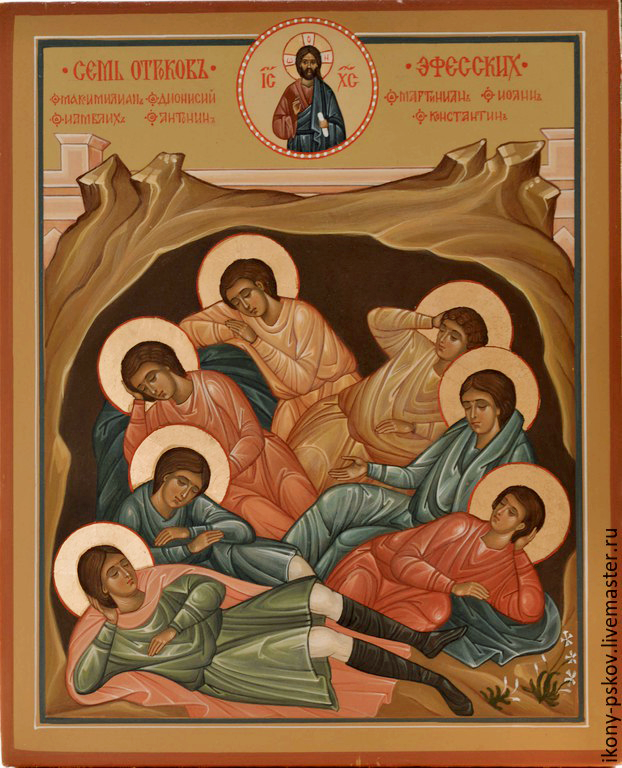
The story, which dates back to the third century, tells the story of a group of young residents of Ephesus whose unusual experiences became a powerful argument in the religious disputes of the fifth century. The seven men, named Maximilian, Jamblichus, Martinian, John, Dionysius, Constantine, and Antoninus, came from wealthy urban families and served in the army.
During the visit of the ruler Decius to their city, all residents were obliged to participate in pagan rites. The young people refused, openly declaring their faith. As punishment, military belts symbolizing status were seized from them, but they were released, hoping that fear of future reprisals would make them change their minds. Instead, the company left the village and found shelter in a rocky cavity on the Ochlon hill.
In order not to die of starvation, the youngest of the group — Jamblichus — periodically went down to the city for provisions, masquerading as a vagrant. When the emperor returned from the campaign and resumed the search, the fugitives were threatened with imminent execution. Finding out where the fugitives were, Decius ordered the exit blocked with stonework.
However, there was no death. According to legend, the prisoners plunged into a state of abnormally long sleep, which lasted almost two centuries. Their awakening coincided with a period in which the church was actively discussing the possibility of restoring the physical body after death. Some currents argued that after the death of matter, it is pointless to talk about the return of the flesh.
Everything was resolved when the owner of the site decided to use the stone from the entrance to the cave for construction. The workers opened the opening, and the youths woke up without realizing the temporary break. Going to eat Jamblichus noticed the symbol of the cross on the gate and heard the free mention of Christ, which caused him confusion. The attempt to pay with an antique silver coin caught the attention of the police. The young man was taken to the mayor and bishop, who, having compared the details and found the records in the walled masonry, moved to the cave.
What they saw inside convinced the audience of the reality of what happened. The rumor of the event reached the emperor Theodosius, who personally talked with the young men. Soon after, they fell asleep again, but finally. In the Orthodox calendar there are two dates associated with their memory: August and October. Places claiming the title of the same cave, today show pilgrims in several countries, including Turkey and Jordan. The plot is reflected in the Muslim tradition, where it appears under the name “People of the cave”.
Memorial Day
August 17
Charity foundHoly Land.
Soul investment! News