Orthodox believers on August 28 celebrate the Assumption of the Most Holy Mother of God — one of the twelve main church holidays.. It concludes the two-week Assumption Lent and is dedicated to the end of the earthly life of the Virgin Mary. In the church tradition, this event is perceived not as a tragedy, but as a quiet transition to Christ, so the people sometimes call the holiday “Theotokos Pascha”.
The very word «dormition» goes back to the verb «to sleep.» The death of the Mother of God is interpreted as a short sleep followed by an awakening to eternal life. The canonical Gospels contain no account of her passing. The Church is based on Holy Tradition and ancient apocryphal texts.
According to legend, the Virgin after the ascension of the Son lived in Jerusalem, in the house of the Apostle John the Theologian on Zion. She often climbed the Mount of Olives, where she prayed for an early meeting with Christ. One day, during such a prayer, the archangel Gabriel appeared to her. He said that in three days the Lord would call her to him, and presented her with a luminous branch of paradise, a symbol of victory over death. The branch was to be carried in front of the burial bed.
Mary received the news with joy, but wished to see before the death of the apostles, who dispersed with preaching in different lands. According to church tradition, the power of the Holy Spirit carried them on clouds to Jerusalem. Thomas arrived three days after his burial.
In the room where the Virgin was, other disciples gathered, including the Apostle Paul with Dionysius the Areopagite, Hierophaeus and Timothy. At the third hour of the day the room was illuminated with light, and according to legend, Christ himself with the angels received the soul of the Mother.
She was buried in the Garden of Gethsemane, next to the graves of her parents Joachim and Anna and the betrothed Joseph. When the late Thomas asked to open the tomb, only burial veils were found inside. Tradition says: The Virgin Mary was taken to heaven with her body, and in the evening of the same day she appeared to the apostles with the words “Rejoice!” I am always with you.
Theologians distinguish several meanings of the holiday. The assumption shows that man is capable of participating in the victory over Christ’s death. It also exemplifies the Christian attitude toward death, not as an end, but as a transition into the fullness of being. The tropar of the holiday emphasizes: “In the time of the world did not leave you” – the Virgin continues to pray for people.
The single date of the celebration — August 15 according to the Julian calendar — was fixed under the Emperor of Mauritius at the turn of the VI-VII centuries. In Russia, a special veneration of the holiday was formed by the XII century. It was then that the Assumption Cathedrals began to be erected. The main one – in the Moscow Kremlin – became a place of royal wedding and election of patriarchs.
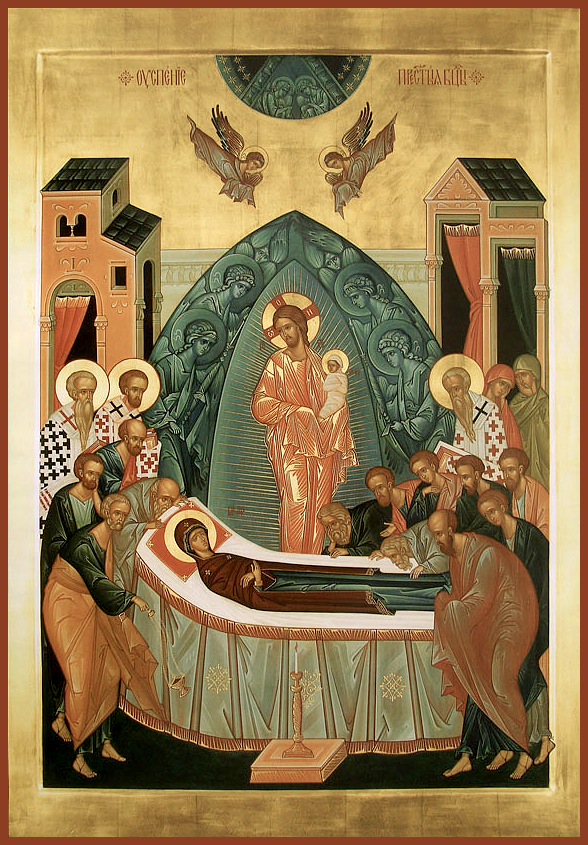
The worship on this day is distinguished by solemnity. In a number of temples, the rite of burial is performed with the removal of the shroud depicting the bed of the Mother of God. On the icons of the holiday in the center is the Virgin Mary on her deathbed, around the apostle, above – Christ holding a swaddled baby in his arms, symbolizing the soul of the Virgin.
In folk tradition, the Assumption was associated with the completion of summer and field work. The day was called the “first pure.” They tried to refrain from hard work, devoting time to prayer.
Memorial Day
28 Augustin 2026 1 day of celebration 8 days of celebration
Charity foundHoly Land.
Soul investment! News