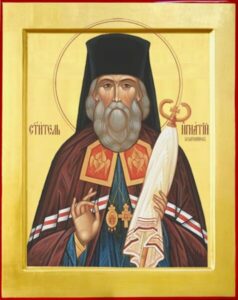
At the height of the Caucasian War, a man who had recently been on the list of military engineers went to manage a huge diocese from the Black Sea to the Caspian Sea. In January 1858, Bishop Ignatius (Bryanchaninov) arrived in Stavropol to establish church life in the region where the fighting took place.
Born in the family of poor Vologda landowners, Dimitry Bryanchaninov from childhood gravitated to monasticism, but relatives insisted on a military career. In 1822, a fifteen-year-old boy brilliantly passed exams at the St. Petersburg Engineering School, beating more than a hundred competitors. For his achievements in science, he came to the attention of Grand Duke Nikolai Pavlovich.
After graduation in 1826, instead of building fortifications, the young officer submitted a resignation report. The family saw it as a failure of all hope. Only a few years later, in 1831, in the Vologda Cathedral, his tonsure took place with the name Ignatius — in honor of the Hieromartyr Ignatius the God-Bearer.
The key stage was the appointment of the rector of the Trinity-Sergius desert near St. Petersburg. At the time of the arrival of the 27-year-old abbot, the monastery had 15 inhabitants and was in decline. For a quarter of a century under him, the number of brethren grew, the worship led to a single pattern, and the choir of the monastery became famous thanks to work with composers Peter Turchaninov and Mikhail Glinka.
In October 1857, Archimandrite Ignatius was ordained bishop of the Caucasian and Black Sea. Arriving in Stavropol three months later, the bishop was faced with neglect. Funding was scarce, some parishes were in the war zone, and schismatics operated among the population.
In less than four years of administration, the bishop achieved an increase in salaries to the clergy, established seminary training and personally participated in the laying of churches. In 1859, under him, the Ioanno-Maria community was transformed into a convent. During trips to the diocese, he consecrated the springs in Pyatigorsk and the grotto Proval. Missionary work was carried out in conditions of real danger — the bishop carried a gift-bearer with him in order to have time to commune the dying.
The disease forced him to retire in 1861. In recent years he lived in the Nikolo-Babaevsky monastery, where he was engaged in literary work. On the day of his death on April 30, 1867, only a few copper coins were found in his clothes — all the accumulated property.
The local council of the Russian Orthodox Church in 1988 included the name of Bishop Ignatius in the list of saints. His remains are in the Yaroslavl Tolga Monastery. A particle of relics was transferred to Stavropol St. Andrew’s Cathedral in 1994. In prayer practice, the saint is asked to get rid of passions and grant humility.
Remembrance Day May 13, 2026
Charity foundHoly Land.
Soul investment! News