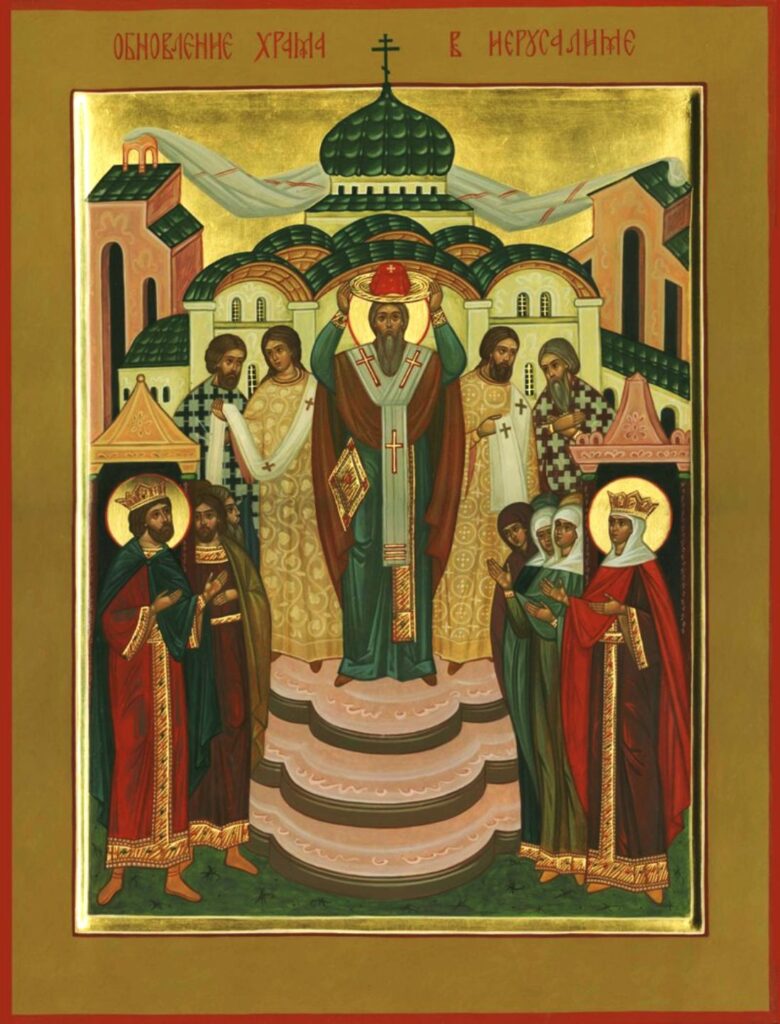
September 26 (September 13 Old Style)The Orthodox Church commemorates the rebirth – the consecration – of the Church of the Resurrection of Christ in Jerusalem. The very temple, which today is more often called the Church of the Holy Sepulcher, was built in the IV century on the place where, according to Christian tradition, the Crucifixion, Burial and Resurrection of the Savior took place. The holiday is established in memory of the solemn consecration of this temple, held on September 13, 335.
The day was called the Resurrection of the Word. The word “speaking” is from the verb “to hear”, that is, to be considered, to be named. The holiday only “remembers” the Resurrection, because it is dedicated not to the very event of the Resurrection of Christ (this is Easter), but to the consecration of the temple erected in honor of this event. However, the name has another meaning: the churches dedicated to this day in Russia could not be called simply “the temple of the Resurrection of Christ” – this name belonged only to Jerusalem. Therefore, the Russian churches, built in memory of the consecration of the Jerusalem temple, were called the Resurrection of the Word, that is, the so-called Resurrection.
Holy Places Under Pagan Persecution
The history of the site on which the temple stands dates back to the very first years of Christianity. After the Roman emperor Titus ravaged Jerusalem in 70 AD and destroyed the Second Temple, the holy sites associated with the earthly life of the Savior were abandoned. But the real blow was struck by the emperor Hadrian (117-138). On the site of the ruined Jerusalem, he ordered the construction of the Roman colony of Elia Capitolina and forbade the city to be called by its former name. The Holy Sepulchre was covered with earth and stones, and an idol was placed on top. On Calvary, where Christ was crucified, in 119, a temple was erected in honor of the goddess Venus — sacrifices were made in front of her statue and pagan rituals were performed. In Bethlehem, at the place of Christmas, the idol of Adonis was erected. All this Hadrian did deliberately: to erase the very memory of Christ and the places of His earthly path.
For almost two centuries the holy places remained under the bush of paganism.
Queen Helen and the acquisition of shrines
The turning point came under Emperor Constantine the Great (306-337), the first Roman emperor to convert to Christianity. Together with his mother, Queen Helena, he decided to renew Jerusalem – to cleanse the defiled places and build Christian churches on them. Constantine wrote a letter to Patriarch Macarius I of Jerusalem, asking him to contribute to the holy cause.
Queen Helena, who by that time was about eighty years old, went to Palestine with great means and the only intention was to find the Cross of the Lord and the places where the main events of the New Testament history took place. Arriving in Jerusalem, she ordered to demolish the pagan temples and excavate the site where the temple of Venus stood. The excavations gave an amazing result: under a layer of earth and stone, the cave of the Holy Sepulcher and the Lobnoye place – Golgotha were found. Three crosses and nails were found nearby.
Which of the three crosses belonged to the Savior was determined by a miracle. Patriarch Macarius ordered to alternately lay crosses on the deceased, who was carried past to the place of burial. When the Life-Creating Cross touched the dead body, the deceased came to life. Queen Helena and Patriarch Macarius raised the Cross high and showed it to the people.
Ten years of construction
The holy queen immediately began to build a large temple, which was to include both Calvary and the Holy Sepulchre in its walls, which were at a short distance from each other, as the Evangelist John the Theologian describes: “In the place where he was crucified, there was a garden, and in the garden a new tomb, in which no one was yet laid; there they laid Jesus for the sake of the Jewish Friday, because the tomb was near” (John 19:41-42).
The Resurrection Temple was built for ten years. Queen Helena did not live to see its completion — returning to Constantinople, she died in 327. But during her stay in Palestine she managed to lay temples in other places: in Bethlehem — at the place of the Nativity of Christ, on Mount Olives — at the place of the Ascension, in Gethsemane. For their efforts to acquire shrines and build temples, Elena and her son Constantine were included by the Church as saints in the rank of equal-to-the-apostles.
The temple was called “Martyrion” in memory of the Savior’s sufferings on the Cross. According to Constantine, it was supposed to be a temple “more magnificent than all temples,” as he wrote in a letter to Patriarch Macarius. Eusebius of Caesarea called it “the new Jerusalem”, deliberately contrasting the new Christian temple with the ruins of the Old Testament.
Consecration of 13 September 335
The completion of the construction coincided with two events at once: the meeting of the Tyre Cathedral and the thirtyth anniversary of the reign of Constantine the Great. The emperor ordered the bishops who participated in the cathedral to immediately go to Jerusalem for consecration. The ceremony was attended by hierarchs from Bithynia, Thrace, Cilicia, Cappadocia, Syria, Mesopotamia, Phoenicia, Arabia, Palestine, Egypt – virtually from all parts of the Christian world of that time.
The consecration took place on September 13, 335. On the same day the whole city of Jerusalem was consecrated. Eusebius of Caesarea, an eyewitness to the events, describes the celebration as follows: the ministers of God “exalted the feast with prayers and teachings, propitiated God with bloodless sacrifices and mysterious sacred actions.” Long sermons were given before the meeting. The emperor was not present in person, but was represented by an official named Marian.
In memory of this day, the Church Fathers established an annual holiday. In Jerusalem, it became one of the three main festivals of the year, along with Easter and Epiphany, and remained so for many centuries.
Eight days of celebration
Evidence of the celebration of the Renewal in Jerusalem in the first centuries comes from the pilgrim Egeria, who visited the Holy City around 381-384. According to her notes, the feast lasted eight days and was accompanied by a huge congregation of believers. In Jerusalem came monks and ascetics from Mesopotamia, Syria, Egypt, Thebaids, gathered forty or fifty bishops. Many Christians considered the presence at this holiday a must – by analogy with the Old Testament festival of Tabernacles, when it was required to come to Jerusalem. “Whoever does not attend such a great festival commits a grave sin,” Egeria writes, conveying the mood of the pilgrims.
The first day of the holiday, September 13, the service was performed in the rotunda of the Resurrection — Anastasis, above the cave of the Sepulchre. The second day, September 14, is in the Basilica of Martirium, with the same Bible readings repeated. In the following days, services were performed in the other holy places of Jerusalem – on Zion, on Olives – symbolically covering the whole city.
The festive prayers, preserved in the manuscripts of the Jerusalem Euchology, included special texts: “To you, holy Lord, to sanctify Your holy churches…” and “Unprecedented God, who gave birth to Your unprecedented Word…”
How the Elevation Festival came about
Neighborhood in the calendar of two holidays — the Renewal (September 26) and the Exaltation of the Cross (September 27) — is not an accident. According to legend, it was on the days of the eight-day holiday of Renovation that huge crowds of pilgrims gathered in Jerusalem. On the second day of the celebration, September 14, the Life-giving Cross was carried out and erected before the people so that everyone could worship it. So there was a custom, which eventually grew into a separate holiday — the Elevation. Over time, the Ascension became church-wide and marked the Renewal, but in the Church of Jerusalem the main thing was the day of consecration of the temple.
The term “renewal”: biblical roots
The word “renewal” in the name of the holiday is a biblical term. In the Old Testament, it goes back to the Hebrew verb, meaning “to instruct, sanctify a house or temple.” In the Greek translation of the Old Testament (Septuagint), the word enkainia is used for this purpose – “sanctification, initiation”. The same term is found in the Gospel of John: “Then came the feast of renewal in Jerusalem, and it was winter” (John 10:22) – here we are talking about the winter festival of Hanukkah, established in honor of the purification of the Second Temple by the Maccabees in 165 BC. In Hebrews, the verb “renew” is used in the context of a “new path” to the heavenly sanctuary that the Lord Jesus Christ “renewed” (Hebrews 10:20). Thus, the feast of the consecration of the Resurrection Temple in Jerusalem is understood not just as a building event, but as a spiritual renewal — in the image of the Old Testament consecrations, but in the light of the New Testament grace.
Worship texts of the holiday
In the modern practice of the Russian Orthodox Church, the Feast of Renewal is celebrated in conjunction with the pre-feast of the Exaltation of the Cross and the memory of the Hieromartyr Cornelius Sotnik. At the vespers after Kathisma, six stantars are sung: three — to the Renewal and three — to the saint, on «Glory» — to the Renewal. After the evening entrance, three paremias from the Old Testament are read: 3 Kings 8:22-23, 27-30 (Solomon’s prayer at the sanctification of the First Temple), Proverbs 3:19-34, and Proverbs 9:1-11.
The liturgy reads the Apostle (Hebrews 3:1–4) and the Gospel (Matthew 16:13–18), a passage in which Christ says to Peter, “You are Peter, and on this stone I will build my church, and the gates of hell will not prevail against it.” The Lord says, “To thy house is holy, O Lord, in the longness of days.”
Celebration Tropar, Voice 4:
Like the highest firmament splendor, / and the lower showed the beauty / the holy village of Your glory, O Lord, / confirm this in the age of the age of the age / and receive our incessantly offered to You the prayer of the Mother of God, / all Life and Resurrection.
Kondak, voice 2:
Renewal of the Spirit in the hearts / and enlightenment in the inner give, / by faith performing the sacred renewal of the temple to Your house, / it pleased you to be created / in Your divine name / One in the saints glorified.
Another kondak, voice 4:
The whole enlightening faithful Church is revealed in heaven, and in her standing we call: ‘Establish this house, O Lord.
Temples of the Resurrection of the Word in Russia
In Russia, the holiday has been known since ancient times. Already in the XI century, the days of renewal of the Kiev church of St. Sophia and the Tithe Church were celebrated. Numerous Resurrection churches throughout Russia are dedicated to the Feast of Renewal, and not to the Resurrection of Christ (Easter). According to Orthodox views, no church except Jerusalem can be called “the temple of the Resurrection of Christ” in the full sense – therefore, Russian churches were called “the Resurrection of the Speaker.” This initiation was also traditional for cemetery churches: it reminded that the Resurrection of Christ is the basis of Christian hope for a universal resurrection.
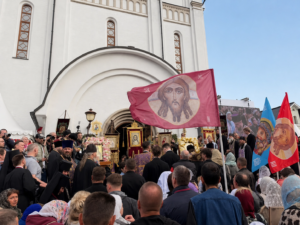
In the temples consecrated in honor of the Resurrection of the Speaker, on September 26, the divine service is performed by the Easter rite. Sounding Easter chants, full of morning, believers greet each other: “Christ is risen!” – “Truly risen!” In autumn, when Easter is long past and the next one is still far away, this day becomes a reminder that the joy of the Resurrection is not tied to one date in the year.
The spiritual meaning of the holiday
Metropolitan Hilarion of Volokolamsk in his sermon on the feast of Renewal reminds that Jerusalem is “the holy capital for all Christians”, “the mother of Churches and the dwelling place of God”, it was from here that the Christian faith shone. But, as St. Gregory of Nyssa wrote in the fourth century, in order to be united with God, it is not necessary to go to Jerusalem — you can live so that in your heart there will be Jerusalem, Calvary, the Resurrection of Christ, and you yourself will be the temple of God.
The Kondak of the feast asks God for “renewal of the Spirit in the hearts and enlightenment within” for those who faithfully perform the sacred renewal of the temple. It turns out that the holiday is addressed not only to the past — to the events of 335 — but also to every person: the renewal concerns not only walls, but also the heart, which needs cleansing, rethinking and a new breath. The image of the renovated temple becomes a symbol of the inner transformation to which the Christian faith calls.
Memorial Day
26 September
Charity foundHoly Land.
Soul investment! News