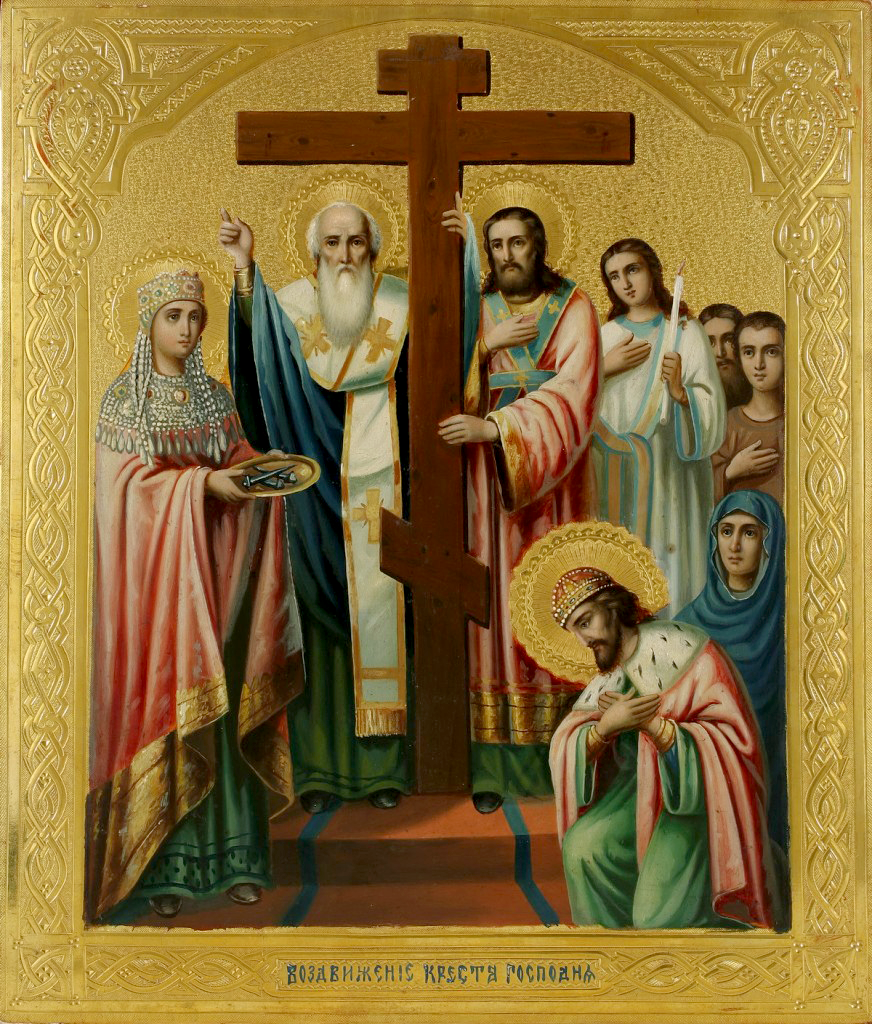
27 SeptemberThe Orthodox Church celebrates the Elevation of the Holy and Life-giving Cross of the Lord, one of the twelve great feasts of the church year. The day before, on Saturday evening, a special rite is performed in churches throughout the country: the priest carries out the Cross and raises it to all sides of the world, and those who pray repeat “Lord, have mercy.” This rite repeats an event that occurred almost seventeen centuries ago and gave the holiday its name.
How Queen Helena sought the Cross
The story began in 326. The Roman emperor Constantine, who legalized Christianity and stopped many years of persecution against believers, wanted to find the tools of the Passion of the Lord – the Cross on which Christ was crucified. He entrusted the search to his mother, Queen Helen. By that time she was already eighty, but she went to Jerusalem on foot – according to legend, the pious Helena did not want to ride.
Arriving at the scene, Elena began to question the locals, but no one really knew where the events of Holy Week took place. Three centuries have passed and the Jerusalem landscape has changed. Someone pointed her to the place where the Romans built a pagan sanctuary as a symbol that the old faith had been defeated. Elena ordered the site to be excavated.
Under a layer of earth and stones found an old buried well, and in it – three crosses and a board with the inscription “Jesus of Nazareth, King of the Jews”. Which of the three crosses is the Savior? There was only one inscription, and it was impossible to understand what cross it belonged to.
Then, according to legend, they decided to do this: they found a seriously ill woman (according to other versions, they carried the body of a deceased young man by their side) and began to alternately attach each of the three crosses to her. Two didn’t give anything. The third healed. So the Cross was identified.
Patriarch Macarius of Jerusalem, seeing that there was a huge crowd of people who wanted to see the shrine at least from the corner of their eyes, raised the Cross over their heads and turned it to all sides of the world. The people fell to their knees and cried out, “Lord, have mercy.” This moment became the prototype of the current festive order of Exaltation.
The Persians took away the shrine, the emperor returned
But the Cross had another story, which was also reflected in the festive service. In 614, the Persian Shah Khosroy II captured Jerusalem. The city was destroyed, many Christians were killed, and the Cross was taken to Persia as a war trophy. For believers it was a disaster – the main shrine was in the hands of the enemy.
The cross was held captive for nearly fifteen years. It was returned by the Byzantine emperor Heraclius, who in 627 won a decisive victory over the Persians. The return of the Cross was part of the peace treaty.
Heraclius personally carried the shrine back to Jerusalem. Tradition tells that when he came to the temple of the Resurrection, dressed in royal clothes and regalia, at the entrance he seemed to be stopped by something – an invisible barrier. Patriarch Zacharias, who was walking next to him, said to the emperor: “Thou shalt not enter by royal pride where the King of all walked the path of humility.” Heraclius took off his robe, crown, jewels, and then he was able to go in and put the Cross in its former place. This episode reminds us that the path to shrine is the path of modesty, not greatness.
Holiday fasting
The peculiarity of the Elevation is that it is a holiday in which a strict fast is put. Even if September 27 falls on a Sunday, meat, dairy and fish should not be on the table. The Church established this fast not by chance: the holiday is inextricably linked with the Passion of Christ, and the joy of finding the Cross goes hand in hand with the memory of the sufferings that the Savior suffered on it.
Many people wonder: how is it a great holiday, and the diet is lean? But that’s the combination that makes sense. The cross in the Christian sense is both an instrument of execution and a symbol of victory. It combines pain and hope, death and resurrection. Fasting on the day of the Ascension helps not to lose sight of this duality.
What does it mean to carry your cross?
The phrase “everyone carries his cross” has long been colloquial, almost everyday. But it is based on a very specific evangelical expression. Jesus said, “Whoever wishes to come after me must deny himself, take up his cross, and follow me.” That is, it is not about passive patience of circumstances, but about a conscious choice to accept your life with everything that is in it, and at the same time not to be locked in your own suffering, but to go forward.
Elevation is a day when it is worth thinking about especially carefully. Not because the holiday demands it, but because the very history of the Cross says that the shrine was lost, piled up, forgotten — and found. Sometimes people lose sight of what is really important to them.
Memorial Day
27 September
Charity foundHoly Land.
Soul investment! News