On April 12, 2026, Orthodox Christians celebrate the Holy Resurrection of Christ. The holiday is considered central in the annual liturgical circle. Catholics celebrated Easter seven days earlier on April 5.
The word “Easter” comes from Hebrew. “Passover” literally means “passed by” — this is the name given to the night when, according to the Old Testament, the pestilence did not touch Jewish families before they left Egypt. Christians put a different meaning into this term: not the exodus of an entire people, but the deliverance of each person from the power of death through the resurrection of Jesus Christ.
The number in the calendar is not fixed. The calculation is carried out according to the formula adopted back in 325 at the Council of Nicaea: the first Sunday that follows the first full moon after the spring equinox. A full moon on Saturday or Sunday moves the date forward by a week. The range of possible dates is from early April to early May. The next two years: May 2, 2027 and April 16, 2028.
Easter is preceded by a seven-week Lent — in 2026 it ran from February 23 to April 11. The final segment, Holy Week, focuses on the gospel events: the evening with the disciples, the arrest, trial and execution of Christ. Good Friday is considered the most strict day: the liturgy is not served, the shroud is taken to the center of the temple.
The service begins at midnight from Saturday to Sunday. Parishioners with candles leave the temple and walk around it outside — this procession reproduces the Gospel episode: women go to the tomb at dawn. After returning to the church, the Easter troparion sounds and the liturgy begins.
Easter greeting — “Christ is Risen!” with the answer “Truly he is risen!” — used at meetings throughout Bright Week. According to tradition, it is followed by a three-time kiss.
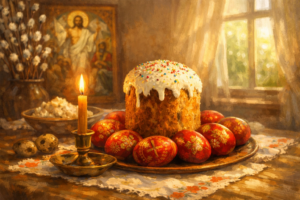
Three dishes form a mandatory set of the festive table. A painted egg is a sign of new life; The red color is explained by the legend of Mary Magdalene, whose white egg allegedly instantly turned red in the face of the Roman emperor. Kulich — tall yeast bread with white glaze — goes back to the apostolic custom of leaving bread on the table for the resurrected Teacher. Cottage cheese Easter is formed in the form of a tetrahedral truncated pyramid; the letters “ХВ” are traditionally extruded on its side faces.
Charity FondHoly Land
Investment in the Soul! News