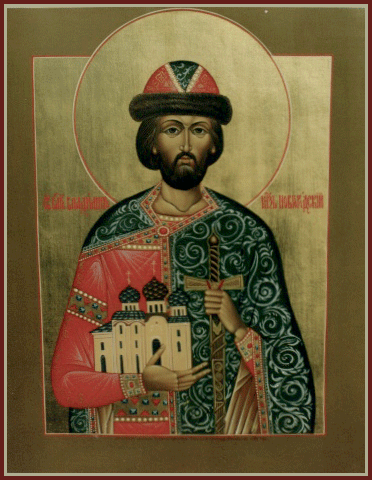
17 OctoberThe Russian Orthodox Church honors the memory of St. Prince Vladimir Yaroslavich, the Novgorod ruler, the son of Yaroslav the Wise, a man whose short life has become an example of how power can serve not only earthly interests, but also the cause of strengthening faith. This date is not just a calendar mark, but an occasion to remember how the spiritual foundations of the Russian North were laid in the middle of the XI century, and what role the prince played in this, who built one of the oldest stone churches in Russia in Novgorod.
Path to service
Vladimir Yaroslavich was born in 1020 in the family of Grand Duke Yaroslav the Wise and Princess Ingigerda, who took the name Irina in baptism. From an early age he was brought up in an atmosphere where state wisdom was combined with Christian piety. Already in his youth, Vladimir was sent by his father to reign in Novgorod — the most important center of Ancient Russia, which required both a firm hand and a subtle understanding of local customs.
The chronicles do not give us a portrait of the prince in color, but his deeds speak louder than words. He was helped to manage Novgorod by experienced mentors: the voivode Vyshat, known for his military acumen, and Bishop Luke Zhidyata, a man of deep faith, later also glorified as saints. In this union of secular and spiritual power, Vladimir’s style of government was formed – not just princely will, but responsibility before God and people.
Warrior and builder
Prince Vladimir was not a recluse: he participated in major military campaigns of his time. In 1042, he defeated the Yam tribe, strengthening the northern borders. A year later he headed the campaign to Byzantium — an event that became one of the last large-scale clashes between Russia and the Eastern Roman Empire. The campaign ended in failure, but it showed the courage of the prince, and the understanding that the strength of the state is not only in victories, but also in the ability to learn from mistakes.
However, the main business of Vladimir’s life was not the military field, but creation. It was he who erected in Novgorod the stone Sophia Cathedral – a temple that still amazes with its monumentality and spiritual depth. The consecration of the cathedral took place on September 14, 1052. This was not just an architectural achievement, but a sign that Novgorod is becoming not only a commercial and political, but also a spiritual center.
Just 20 days after the consecration, on October 4 (October 17 in the new style), the prince died. His death within the walls of the city, which he fortified and decorated, acquired a special meaning: he left, leaving behind not only fortifications and victories, but also the temple, which became the heart of Novgorod holiness.
Power and memory
The relics of the holy Prince Vladimir rest in the St. Sophia Cathedral – in the very temple that he built. For believers, this is not just a historical fact, but a visible evidence of the inseparable connection between earthly service and heavenly glorification. The prince, who devoted his life to strengthening the city and faith, and after his death remains its heavenly patron.
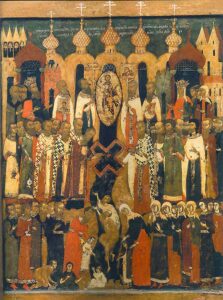
Local veneration of Vladimir Yaroslavich was established in the XV century, when Saint Euthymius, Archbishop of Novgorod, approved the celebration of his memory. And in 1981, the name of the prince entered the Cathedral of Novgorod Saints, consolidating its church-wide veneration.
Memorial Day
October 17 is not only a memory of a specific date of death, but also an occasion to think about what it means to be a prince. In the Orthodox tradition, this image of holiness is given to rulers who, while remaining statesmen, were guided by Christian values: justice, mercy, care for the spiritual needs of the people.
For Novgorod, the memory of Vladimir Yaroslavich is the memory of the time when the city found its main spiritual symbol. St. Sophia Cathedral, built at his will, became not only an architectural dominant, but also a place where generations of Novgorodians learned to see faith as the basis of social life.
Today, remembering the holy prince, we turn not only to history, but also to the example of service: how to combine responsibility for land and people with loyalty to spiritual ideals. His legacy is in the stone of the cathedral, in the annals, in the very tradition of honoring the noble princes, who by their reign testified that the true strength is in truth and faith.
Charity foundHoly Land.
Soul investment! News