

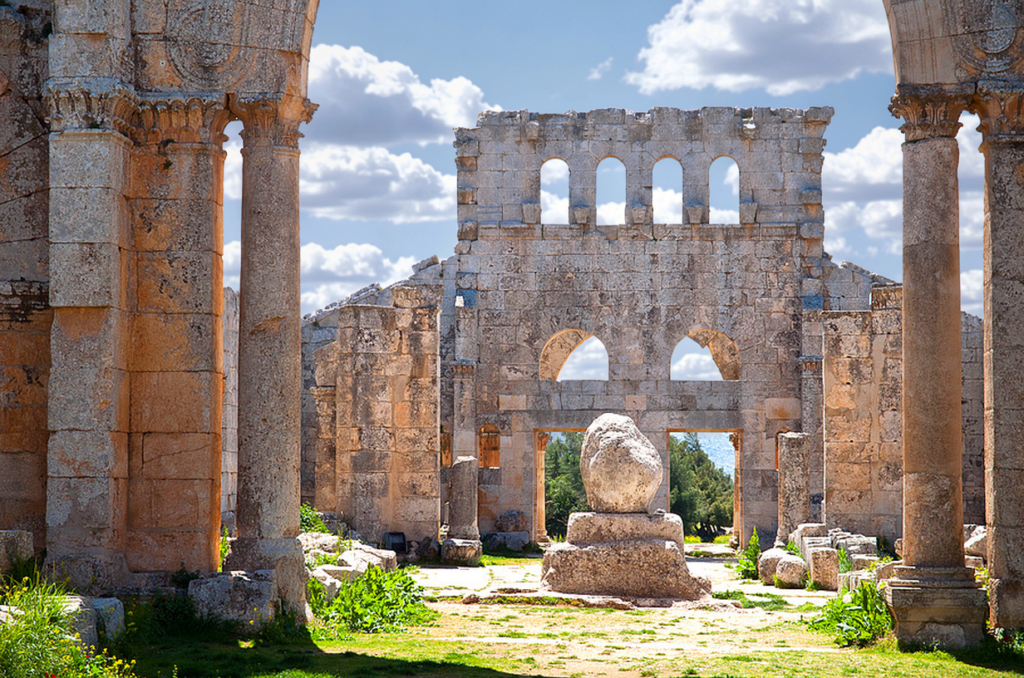
At the end of August 2025, in the Syrian province of Aleppo, the restoration of the sacred pillar in the monastery of Kalat Siman, one of the most important monuments of early Christian architecture, was completed. Events on the occasion of the completion of the works were timed to the beginning of the Church New Year and the day of memory of St. Simeon Stylpnik, which is celebrated on September 1 according to the New Julian calendar.
The monastery, also known as the St. Simeon Stylite Cathedral, is located 30-40 kilometers northwest of Aleppo. It was erected in the fifth century around a pillar, on top of which Simeon (356-459) spent about forty years in continuous prayerful labor. The monk voluntarily chose this incredible ascetic path — life on a stone pillar, in isolation from the world, amid wind, heat and cold nights. From his name begins the whole tradition of columnism — a special kind of Christian asceticism, spread in Syria, Asia Minor and later in other lands.
Before the construction of Hagia Sophia in Constantinople, the temple at Calat Simana was the largest Christian temple in the world. The grandiose structure with four basilicas located cross-shaped around the central courtyard, where the pillar itself was located, amazed contemporaries with its scale and elegance. In ancient times, thousands of pilgrims from all over the Christian world flocked to the pillar — from Britain to Persia.
Over the past fifteen centuries, the monastery has repeatedly suffered from earthquakes, wars and the destructive effects of time. Earthquakes of X and XI centuries caused serious damage to the complex: the domes, part of the walls and chapels collapsed. During the civil war in Syria, the territory of the monastery was also destroyed — some fragments of buildings were damaged, infrastructure was damaged.
Before starting to recreate the pillar itself, specialists carried out large-scale work on cleaning and restoring the ruins. The surviving sections of the walls were strengthened, fragments of masonry were restored, the foundation for the pillar was prepared. The restoration was carried out with the utmost respect for the original architecture — as much as possible in the absence of a complete set of historical drawings.
The restoration of the pillar was the culmination of a week of Light from Aleppo events organized by the Archdiocese of Antioch. The program included prayer meetings, lectures on the life and heritage of St. Simeon, excursions to the historical places of Syrian Christianity.
On September 1, the archdiocese organized a mass pilgrimage of believers to the monastery under the motto “Following in the footsteps of St. Simeon.” Hundreds of people — clergy, monks, laymen, families with children — traveled from Aleppo to Qalat Siman. The Divine Liturgy was celebrated in the monastery in the open air, at the foot of the restored pillar.
The celebrations were led by Metropolitan Ephraim (Maaluli), Primate of the Aleppo Archdiocese. Concelebrating with him was Bishop Paul of Tarsus (Orduluglu), who cares for the Orthodox flock of historical Antioch. In his address to the believers, Metropolitan Ephraim thanked everyone who participated in the organization, support and conduct of the events, and asked for the prayerful intercession of St. Simeon before God.
The organizers emphasized that the restoration of the pillar is not only an architectural event, but also a sign of spiritual renewal. For the Christians of Syria, who survived years of difficult trials, it became a symbol of the revival of hope and confirmation that the memory of spiritual roots lives on, no matter what.
Reverend Simeon the Stylite was born in the Syrian village of Sis, into a small peasant family. As a young man, he heard the Gospel reading in church: “If anyone wants to follow me, let him deny himself” — and these words determined his entire future life. After several years of monastic life and ascetic solitude in the desert, he chose the feat of stylite life. At first the pillar was small — a few cubits high, then Simeon enlarged it until it reached a height from which the ascetic was visible from afar. People came to him for advice, consolation, and healing. Rulers wrote to him and asked him for blessings on state affairs. But he himself remained on the pillar, in prayer and fasting, until the end of his days.
Now the restored pillar again rises above the Syrian plain — just like one and a half millennia ago. And although times have changed beyond recognition, the meaning of this gesture remains the same: the memory of a holy place survives generations, empires and wars.
Charity FundndHoly Land
Investments in Soul! News


