

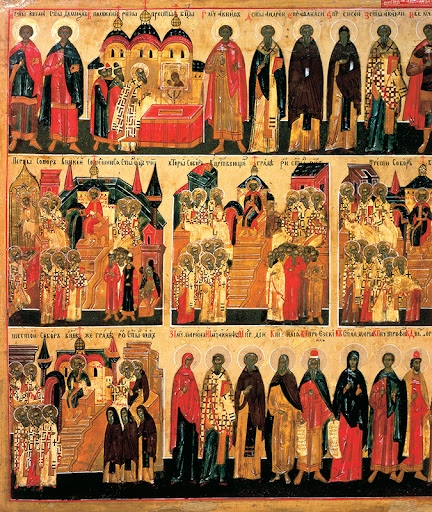
In the middle of summer, on the next Sunday to July 26 in a new style, Orthodox believers pray to remember the holy fathers of the six Ecumenical Councils. These meetings of bishops, held from the fourth to the seventh century, in an era of fierce theological disputes, formulated the key dogmas of Christianity and outlined the boundaries of church doctrine.
A special date in the calendar is set for the six, not the seven, Councils recognized by the Church. The status of the Seventh, convened in 787 against the iconoclasts, was finally confirmed later — at the Local Council in Constantinople in 879-880. The memory of its participants is celebrated separately, on October 24.
The texts of this day’s services remind us of the Church’s dramatic journey from the catacombs to the imperial basilicas. In the Roman Empire, Christianity was outlawed. The state, jealously guarding the emperor’s monopoly on coinage and religious worship, saw the new faith as a threat. Until Christians were distinguished from the Jews, whose ancient tradition the Romans tolerated, persecution was not systematic. But as soon as it became clear that this is an independent confession, legal mechanisms of persecution came into force.
The turning point came in the reign of Constantine the Great. According to church tradition, the sign of the Cross and the victory over political rivals led the emperor to recognize Christianity as a legitimate religion. Already in 325 he convened the First Ecumenical Council in Nicaea, opening the era when doctrinal truths were formulated by the conciliar mind of the Church in the face of heresies.
The First Council, with the participation of 318 fathers, among whom were Saints Nicholas the Wonderworker and Spiridon of Trimifunt, condemned Arianism. The truth of the co-existence of the Son of God with the Father was affirmed, which formed the basis of the Creed. At the same time, the order of precedence of the sees was determined: Rome, Constantinople, Alexandria, Antioch.
Half a century later, in 381, the Second Council at Constantinople supplemented the Creed with the doctrine of the Holy Spirit as the Life-giving Lord emanating from the Father. Thus was rejected the heresy of Macedonia, who reduced the third hypostasis of the Trinity to the level of created forces.
The chain of subsequent councils resolved Christological disputes. The Council of Ephesus of 431 proclaimed the Virgin Mary the Virgin, condemning Nestorius, who divided God and man in Christ. The Council of Chalcedon of 451, on the contrary, protected the fullness of the human nature of the Savior from the Monophysites, who taught about its absorption by the Deity. The Fathers formulated the principle of the inseparable, unchanging, inseparable and inseparable union of two natures. The Fifth (553) and Sixth (680) Councils completed this work by establishing the doctrine of the two wills, the divine and the human, in the one Person of Christ.
The result of the dogmatic thought of the six Councils was consolidated by the Trullian Council of 691. His first rule emphasized the immutability of the truths and canons worked out as a guide for believers for all time. Church tradition insists that dogmas were not invented by cabinet theologians, but were extracted from the depths of the apostolic faith, when it was necessary to give a clear answer to distortions. These doctrinal definitions are considered not as a dry theory, but as a compass on the way to salvation, directly affecting the spiritual and moral life. Therefore, the fathers of the Councils went for the purity of these formulations for martyrdom and confession.
Remembrance days
26 July
Charity foundHoly Land.
Soul investment! News


