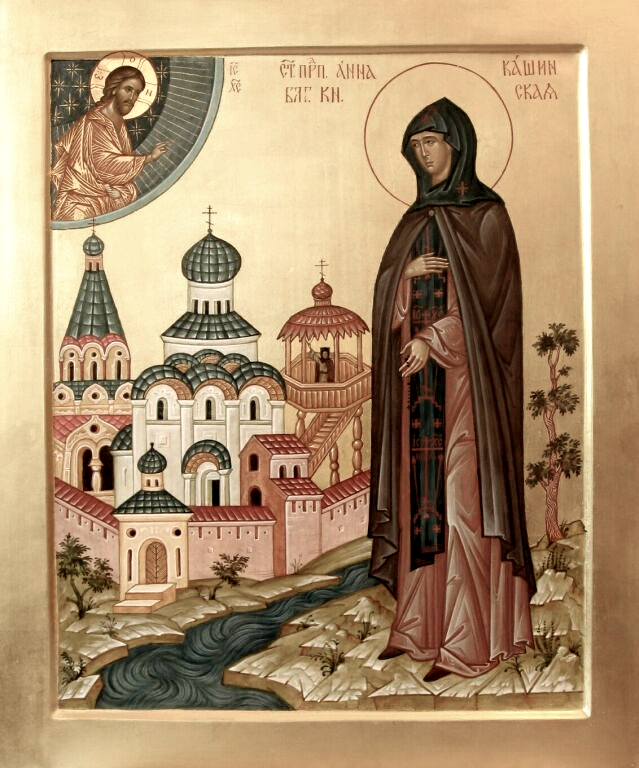
October 15 Orthodox believers prayerfully remember the holy blessed princess Anna Kashinskaya. On this day in 1368, she peacefully departed to the Lord, completing a long journey where each decade was a test of the strength of faith and meekness. Her life is not about loud victories, but about the ability to remain human and Christian where, it would seem, there is no strength left.
Youth and marriage: the beginning of a journey in a troubled era
Anna was born at the end of the 13th century in the family of the Rostov prince Dmitry Borisovich. In those days, Rus’ lived under the heavy burden of Horde rule, and strife between the principalities did not subside. In 1294, Anna was married to Mikhail Yaroslavich, the future Grand Duke of Tver. This was not just a dynastic union: in difficult times, the family became the only support, and Anna became for Mikhail not only a wife, but also a safe haven.
Their life together was full of anxiety from the very beginning. The prince had to go to the Horde to get a label to rule — and such trips often turned into disaster. Anna learned to greet her husband not only with joy, but also with a readiness to share any news, no matter how bitter it may be.
A series of losses: how not to break under the weight of grief
Fate seemed to test Anna’s resilience. In 1318, her husband, Prince Mikhail, was executed in the Horde. For the princess, this meant not only a personal tragedy, but also a loss of protection, status, and habitual support. But Anna did not become bitter. She continued to live according to the laws of mercy: she helped the poor, supported churches, tried to be a support for children.
However, the trials did not end. One after another, her sons and grandson died: in 1326, her son Dimitri, nicknamed Terrible Eyes, was executed in the Horde, and in 1339, her son Alexander and grandson Fyodor died there. For the mother and grandmother, this was a blow that could destroy any soul. But Anna chose the path of prayer and humility. She did not try to drown out the pain with anger or despair — she carried it like a cross, trying at the same time to remain a source of light for those around her.
Monasticism and last years in Kashin
Gradually Anna moved more and more away from worldly concerns. She took monastic vows with the name Sophia, and at the end of her life — the Great Schema, returning her name Anna. According to legend, for some time she was the abbess of the Tver Convent, where she showed by personal example how work, prayer and compassion are combined.
In recent years, she lived next to her youngest son Vasily in Kashin. It was this city that became her last earthly home and gave her the name under which she went down in history — Anna Kashinskaya. Here, until the end of her days, she maintained simplicity and meekness, not demanding special respect for herself, but remaining a living example of faith for those around her.
The difficult path of veneration: from glorification to ban and back
The history of the veneration of Anna Kashinskaya is unusual in that she was canonized, then her veneration was officially banned — and restored again. In the mid-17th century, during the time of church reforms and schism, attention to the relics of the princess became part of a heated controversy. On her relics they noticed a sign of a finger, which supporters of the old rituals perceived as confirmation of their rightness. As a result, in 1677, a church council canceled her canonization.
But popular veneration did not fade away. People continued to turn to Anna for consolation and recorded cases of help and healing. Decades passed, passions subsided, but the memory of the blessed princess remained alive. At the beginning of the 20th century, the question of restoring her veneration was raised again, and in 1909 her second glorification took place. Thus, history has shown that true holiness does not depend on temporary disputes: it lives in the hearts of people.
Why exactly October 15th and what do they pray to Anna Kashinskaya
October 15th is the day of the repose of the saint. Special prayers are heard in churches on this day, and believers try to remember her life path. Anna Kashinskaya is revered as the patroness of widows, mothers who have lost children, and everyone who is going through difficult family trials. People turn to her not so much for miracles, but for quiet consolation and strength to survive grief and not lose themselves.
Her image is close to those who know what loss is: it does not promise instant relief from pain, but reminds that even in the deepest sorrow you can preserve love, mercy and faith.
Charity FundndHoly Land
Investments in Soul! News