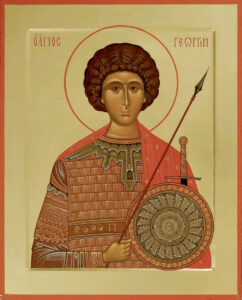
Roman officer George of Cappadocia, sentenced to death for refusing to worship pagan gods, became one of the central figures of the Christian martyrologist. The execution took place in 303 in Nicomedia Minor, at the height of the reign of Emperor Diocletian.
The family of the future martyr settled in the Palestinian Lidda after the death of his father, a career soldier. The Christian mother Polychronia owned the land there and raised her son in her faith. The young man followed in the footsteps of his father: he entered the service, quickly rose to the commander of a thousandth detachment and found himself in the closest entourage of the emperor.
The turning point came in Nicomedia. At the hearing, where orders were made to destroy Christian communities, George publicly opposed it. Before that, he got rid of all his possessions and released his servants. Coming forward, he openly called himself a Christian and declared that the decree of the emperor was contrary to justice. That was enough to get him arrested.
Seven days of torture did not break him. The methods of execution changed: a wheel with blades, a pit with lime, boots with nails, lashes. According to the testimonies recorded later, each time the martyr remained alive. Attempts to convince him were also unsuccessful. After he refused to offer sacrifice in the temple of Apollo, the sentence was carried out. Simultaneously with George was executed a woman, whom legend calls the wife of Diocletian. She converted to Christianity when she saw what was happening.
The body was transported to Lydda at the behest of the deceased. There, a church was erected over his grave — the first appeared in the VI century. The building acquired its current appearance in 1872 with the participation of Russian philanthropists. Inside is stored a particle of relics and a chain with which George was chained.
The nickname Victorious goes back to another legend — about a rider on a white horse who struck a snake with a spear near Beirut. The monster that lived in the local lake, allegedly demanded human sacrifice. The appearance of the horseman, in which the inhabitants recognized the deceased George, put an end to this. The image of a warrior fighting a snake passed through the centuries: he was included in the coat of arms of Moscow, and the plot itself took a central place in the iconography of the saint.
In the Orthodox calendar George is mentioned four times. Georgia, which adopted Christianity under Nin, a relative of the martyr, considers him its patron. In the Russian village tradition, Yuriev’s day was associated with the first cattle drive and the last day when a peasant could leave the landlord – before Boris Godunov consolidated this practice.
Remembrance Day 06 May 2026.
Charity foundHoly Land.
Soul investment! News