

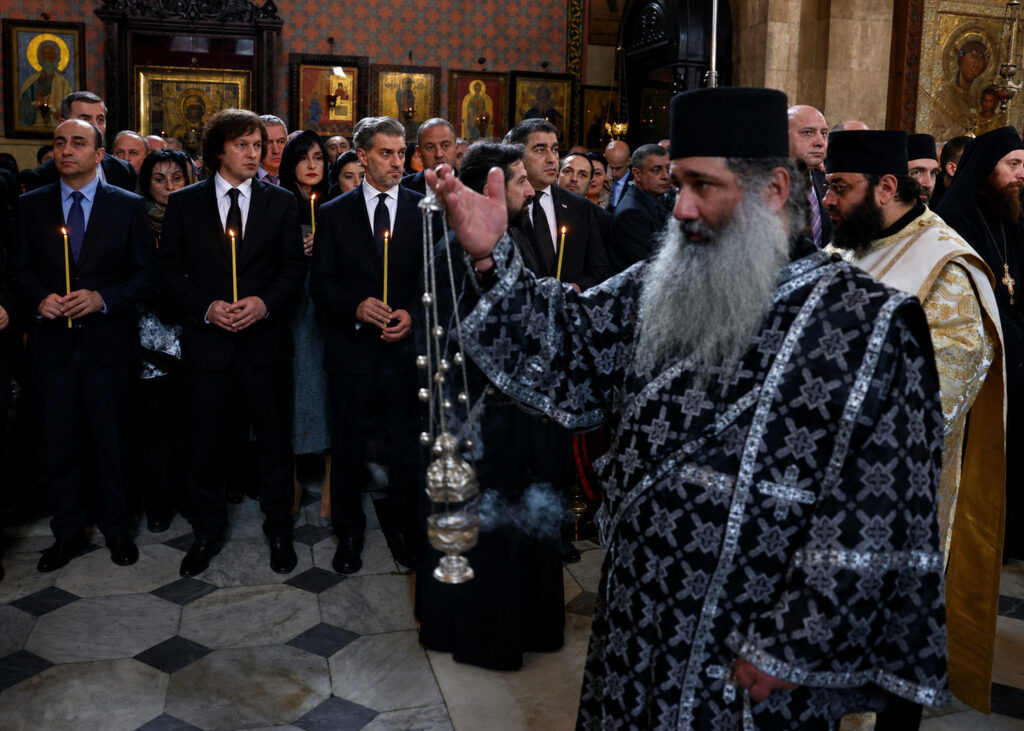
There are such turns in the history of peoples, after which it is impossible to imagine them as before. For Georgia, such a turn was the adoption of Christianity as the state religion. Not just a change of beliefs, but the birth of a new destiny – this is how the country used to talk about an event that recently turned 1700 years old.
Not a sudden decision, but a long way to the light.
Often in the stories of great changes one wants to see one bright moment: the king raised his hand, the people bowed their heads — and everything changed. But in reality, everything was deeper and quieter. Christianity came to Georgia not by order, but by word, deed, and personal example. And the main voice of this change was St. Nina.
Her journey to Iveria was not a conqueror’s campaign, but a quiet mission. It did not demand, threaten, or promise benefits; it prayed, helped, and spoke about Christ in such a way that people began to see it not as a tradition but as an answer to their own questions. Especially important was the healing of Queen Nana: when the illness receded, the royal house for the first time seriously listened to the words of the saint.
King Mirian was cautious at first. For a ruler, faith is also a responsibility to the country, to neighbors, to history. But a series of events that he perceived as signs gradually tilted him toward a solution. According to legend, during the hunt suddenly came darkness, and in despair Mirian turned to God, about whom Nina spoke. The darkness was dispelled, and for the king it was not a miracle for a miracle, but a testimony: there is a power that hears and answers. Around 326, Christianity became the state religion.
Faith as the basis of culture and independence
Adopting Christianity was not just a religious act. It became the foundation on which Georgian culture grew. There were their own temples, their own church architecture, their own chants and even their own tradition of bookmaking. Christian values are imperceptibly but firmly embedded in the ideas of justice, mercy, family relations.
Mtskheta, the ancient capital, became the heart of this new life. It was here, in Svetitskhoveli, that people gathered for centuries at the most important moments: at the coronation, on big holidays, on days of trials. This cathedral for Georgians is not just a monument, but a place where history becomes alive.
Importantly, Christianity has helped Georgia maintain its identity surrounded by strong neighbors. At different times, the country found itself between great empires, but it always had its own faith, its own language of worship, its own saints and its own traditions. And it was this inner unity that helped to survive.
A holiday that has become a meeting of generations
The 1700th anniversary was celebrated not as a dry date from a textbook, but as a great national holiday. In Mtskheta and Tbilisi, solemn services were held, ancient chants sounded, pilgrims from different parts of the country and the world gathered. But the most touching were not official speeches, but simple human stories: young people who first came to the procession, families who decided to baptize their children on a memorable day, elderly parishioners who told their grandchildren about how faith was transmitted to their family.
One of the most symbolic moments was the mass baptisms at the merger of Aragva and Kura. The water here seemed to connect the past and the present: the same rivers, the same shore, the same words of prayer, only now they are pronounced by people of the XXI century.
Exhibitions and concerts showed how the Christian tradition lives in Georgian art: in ornaments, in stone carvings, in melodies that have sounded in churches and houses for centuries. It turned out that even in the usual things – in the pattern on the fabric, in the shape of a bowl, in the intonation of a song – you can see echoes of the very faith that came to Georgia almost two millennia ago.
A living tradition, not a museum exhibit
Today, Christianity in Georgia is not only big holidays and ancient monasteries. It is part of everyday life: family customs, attitudes towards elders, understanding what it means to help others. There are still many people in the temples, and icons and prayer books inherited from grandparents are carefully kept in the houses.
1700 years is not so much about the distant past as about continuity. It’s about how one generation transmits to another not just rituals, but meaning: why it’s important to be compassionate, why you can’t betray trust, why faith is not about fear, but about responsibility and love.
The anniversary was an occasion to remember: the history of the country is not only battles and treaties, but also the quiet decisions of ordinary people who, day after day, chose to live according to conscience. And this choice is the essence of the very heritage to which Georgia has remained faithful for seventeen centuries.
Charity fund
Holy Land.
Soul investment!
News


