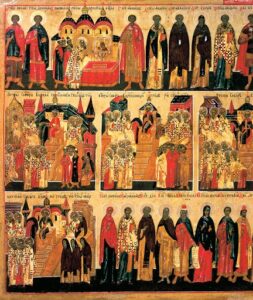
A chain of dramatic events stretching over six centuries accompanies the remains of one of the most revered Russian saints. The first acquisition occurred in the XV century, the rebirth of the shrine survived after a secret rescue operation in the Soviet years, and the return to the native monastery took place after the Great Patriotic War.
The founder of the Trinity monastery died in the autumn of 1392. He was buried in a wooden temple, which after a decade and a half was destroyed by fire during the raid of the Horde Temnik Yedigei. In 1412 the church was rebuilt, but still made of wood.
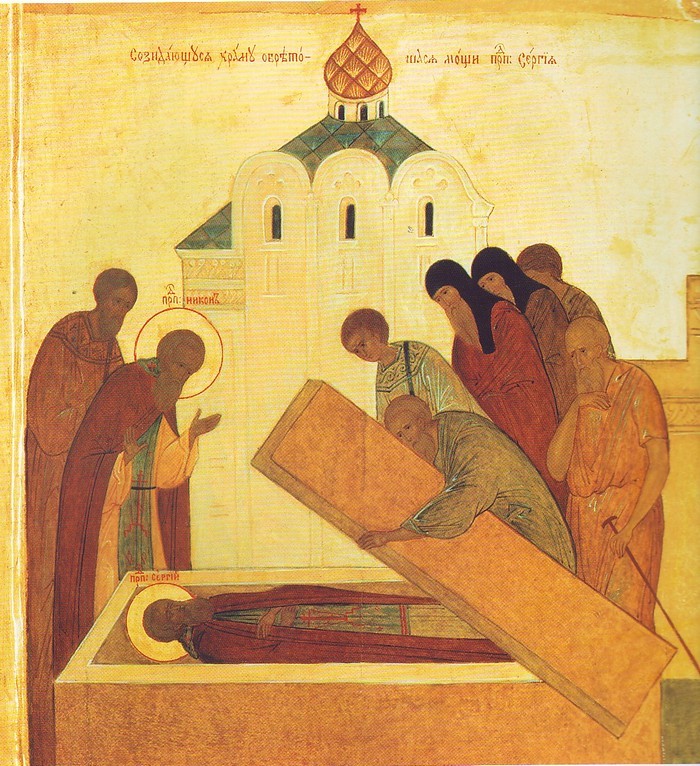
Everything changed in 1422 when the first stone cathedral was laid. The reason for the retrieval of the remains was a wonderful vision: the ascetic himself turned to the pious layman with a reproach addressed to the abbot Nikon and the brethren that his body remains for a long time in the earth and water. The tomb was opened. On July 5, 1422, those present saw that neither flesh nor vestments were affected. The shrine was temporarily placed in the existing church, and after the construction was completed, it was moved to the new Trinity Church.
After 163 years, in the reign of Theodore Ioannovich, expensive silver crayfish was made for the ark. The solemn ceremony of exposing and transposing the relics took place in 1585 under the leadership of Metropolitan Dionysius.
The fires forced the tomb to be removed. In 1709, it was installed on the square, where then the Krasnogorsk chapel appeared. At the beginning of the XX century, while the Trinity Cathedral was being repaired, cancer for the summer moved under the vaults of the Assumption Church.
The most dangerous chapter in the history of the shrine was the period of persecution. In April 1919, the Bolsheviks staged a demonstration autopsy. The action lasted two hours, filming was conducted, but instead of reducing religiosity, an increase in the number of pilgrims was recorded. Participants in those events, including Father Pavel Florensky, recalled the pronounced subtle aroma that came from the remains despite the caustic smell of magnesium flares.
Realizing the risk of complete destruction of the relic, Pavel Florensky and Count Yuri Olsufiev went on a secret operation. The honest head was replaced with a skull from the burial of the Trubetsky princes, and the real one was hidden in the Olsufiev estate. In 1938, when the count was arrested, the shrine was dug up under the cover of night and transported to the temple of the village of Vinogradovo, near the station Dolgoprudnaya. Abbot Hilarion (Udodov) hid her in the altar for the whole battle for Moscow.
In parallel, most of the remains were listed as a museum exhibit. In 1941, they were evacuated to Solikamsk, where employees of the Zagorsk Museum under 40-degree frosts monitored the safety of boxes in the cold Trinity Cathedral. The cargo returned to Zagorsk only at the end of 1944.
The final reunification began with the transfer of the head to Patriarch Alexy I. Olsufiev’s heir Ekaterina Vasilchikova presented it to the primate. The authenticity was confirmed by experts, comparing the seam from the incision on the skull with a mark on the upper vertebra left by Father Florensky. In strict secrecy, the head was returned to his place during the re-exposure.
The official transfer of the Trinity-Sergius Lavra took place on the eve of Easter 1946. Since 1948, the tomb rests forever in the Trinity Cathedral, where the holy remains that passed through decades of turmoil were returned.
Remembrance days
July 18
Charity foundHoly Land.
Soul investment! News