

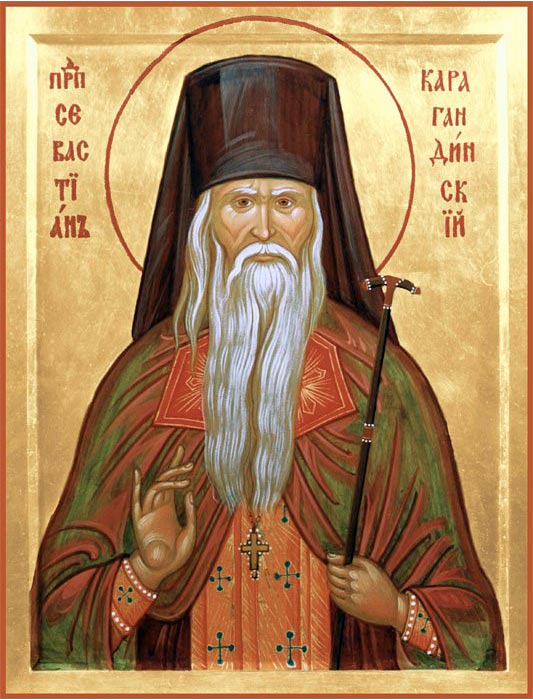
Before talking about the day the relics were found, it is important to remember what kind of man Father Sebastian was. Even in his youth, he found himself in Optina of the desert, became a cellmate with Elder Joseph and absorbed the very spirit of Optina old age — the ability to be a support when everything around collapses. Then came the years when the monasteries were closed, and for a word about the faith could send to the camp. For Sebastien, this was no reason to back down. He was arrested, exiled, held in Karlag near Karaganda, but even there he did not cease to be a pastor: he consoled, instructed, prayed with those nearby.
After his release, he did not go to a quiet place. He stayed in places where people especially needed a kind word. In the village of Bolshaya Mikhailovka, a community gradually gathered around him. He served at home, sought registration of the parish, and in 1955 the faithful were able to open the temple. Until his death in 1966, he remained the only reliable voice in a world where it was hard to believe openly. He was buried in the Mikhailovsky cemetery in Karaganda, and even after his death, people continued to come to his grave – not for the sake of spectacles, but for the very silence in which the main thing is heard.
The Day That Gathered the City
The discovery of relics occurred in 1997. It was not a ceremonial holiday, but an event that seemed to have grown out of the people’s memory. By that time, the stories about Father Sevastian had long lived in Karaganda: they were passed on to each other, they were shared with visitors, they were remembered in difficult moments. And when it came time to officially gain power, it felt not as a formality, but as the return of something very important.
The relics were found in the Mikhailovsky cemetery, where Father Sevastian was buried. For many, it was a sign that what they were trying to forget was not gone. His quiet feat, his ability to hold on to the truth without shouting or pathos, his willingness to be around people when it was most dangerous — all this remained not only in the stories. The relics were transferred to the Church of the Nativity of the Most Holy Mother of God in Karaganda — to the very space where his community gathered during the life of the father.
In 2000, at the Jubilee Council of Bishops of the Russian Orthodox Church, the Monk Confessor Sebastian was listed as a saint as part of the Council of New Martyrs and Confessors of Russia. Thus, his path received not only popular, but also church-wide recognition.
Why this story sounds special
We are used to representing saints in ancient robes, among ancient walls and solemn processions. And Father Sebastien is a sanctity of a very different time. He lived among barracks, mines, in a city that grew up on hard labor. His feat is not in loud words, but in the fact that he continued to serve when any word about faith could turn into trouble.
Finding his relics became for people more than just a church event. It was the moment when memory ceased to be just the stories of grandparents and became something tangible. For Karaganda, for all who remember these years, it was a sign: loyalty and kindness are stronger than time and prohibitions.
Today the relics of the Monk Confessor are in the Vvedensky Cathedral of Karaganda. Not only pilgrims come here, but also ordinary people. Someone is looking for solace, someone wants to feel connected to their family history, someone is just trying to understand how it was possible to remain kind and firm when everything around demanded another.
The memory of Father Sebastian is not a dry page from a textbook. This is a living story about how one person with his choice and patience could change the life around him. And finding his relics is a reminder that such people do not leave without a trace: their quiet light remains where they lived, and continues to warm those who now especially need warmth.
Memorial Day
22 October
Charity fund
Holy Land.
Soul investment!
News


