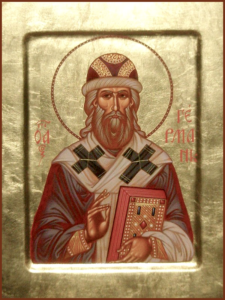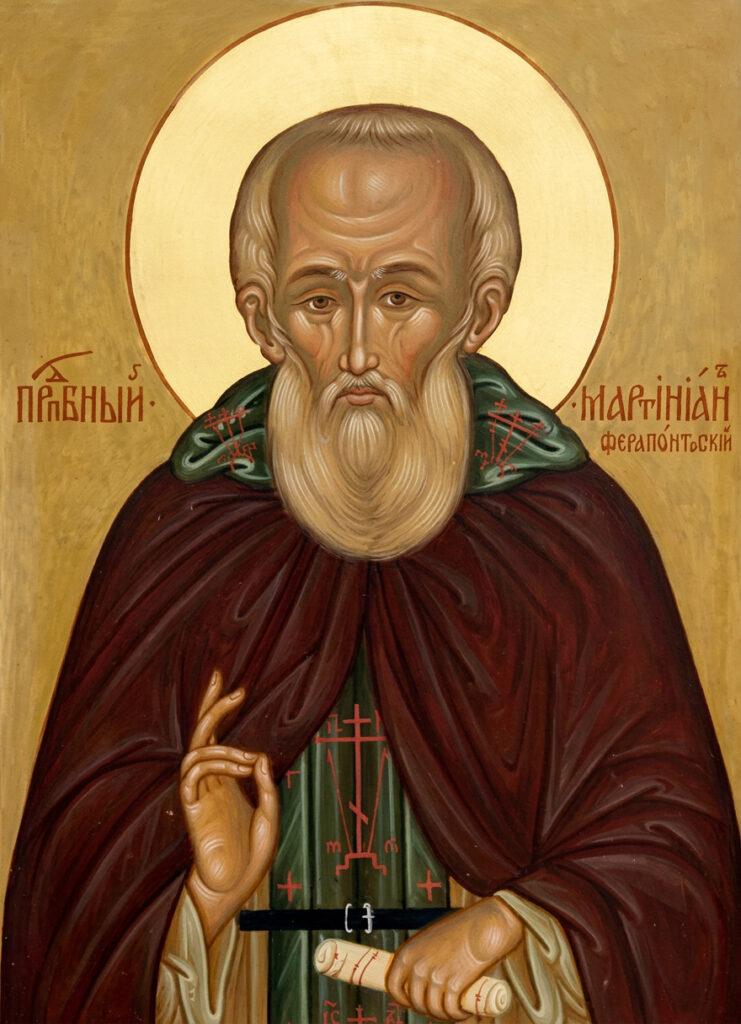
There are moments in Russian spiritual history when time itself seems to freeze and it becomes clear: before us is not just a chronicle of events, but a living memory of the saint. It was such an event that the relics of St. Martinian Belozersky were found.
It happened in October 1513 in the Ferapontov monastery. The reason was the burial of Archbishop Joasaph of Rostov (Obolensky), who was a student of Martinian. When the brethren were preparing a place for the repose of Joasaph next to his teacher, something amazing happened: at the opening of the tomb of the monk it turned out that his body was preserved incorruptible. For the people of that era, this was not just a rarity – it was a direct sign of God’s mercy and a testimony of holiness.
At that time, the attitude to relics was deeply personal and at the same time popular. Incorruptibility was perceived not as a miracle for the sake of a miracle, but as confirmation that a person really lived in feat, in prayer and humility. And so the news of finding relics quickly spread around the neighborhood, and pilgrims reached the place of burial.
The Monk Martinian was one of those ascetics whose life was spent away from the bustle of the city, among the northern forests and lakes. A disciple of the great Kirill Belozersky, he himself became a spiritual mentor for many, and later founded the Vozheozersky monastery. His journey is the story of how silence and labor become the school of holiness. And now this silence seems to speak again: the earth has restored the memory of him in the most literal sense.
Decades later, the veneration of the reverend only strengthened. In the middle of the XVI century, at the Makariev Cathedral, Martinian was officially listed as a saint. At the same time, his life appeared — not a dry list of dates, but a story about a man who could hear God in the silence of northern nature.
Over time, a stone tent church was built over the burial place — it was built at the expense of Tsar Mikhail Fedorovich. It was not just a temple, but a sign of the state’s respect for the spiritual tradition: even in difficult times, the memory of ascetics remained an important part of people’s life.
Today, the relics of the Monk Martinian rest under a bushel in the Ferapontov monastery — in the very place where once the brethren first saw the imperishable body. Next to the tomb is kept the nutcrutche of the saint and his icon. These things are not museum exhibits, but silent witnesses to the very era when faith manifested itself in simple but profound actions: in work, in prayer, in readiness to go where it is quiet and difficult.
Interestingly, the memory of this event has not disappeared in modern times. In 2013, it was exactly five hundred years since the acquisition of the relics, and in the Vologda diocese this date was marked especially: divine services, a procession, as well as the Ferapontov readings, where they talked not only about the facts, but also about the meaning of veneration of saints.
The acquisition of relics is not just an archaeological or ecclesiastical fact. This is the moment when the past becomes close: when you realize that holiness is not an abstraction, but real people who lived in specific places, in specific circumstances, and managed to preserve the main thing. The Monk Martinian of Belozersky is one of them.
Memorial Day
October 20
Charity fund
Holy Land.
Soul investment!
News