

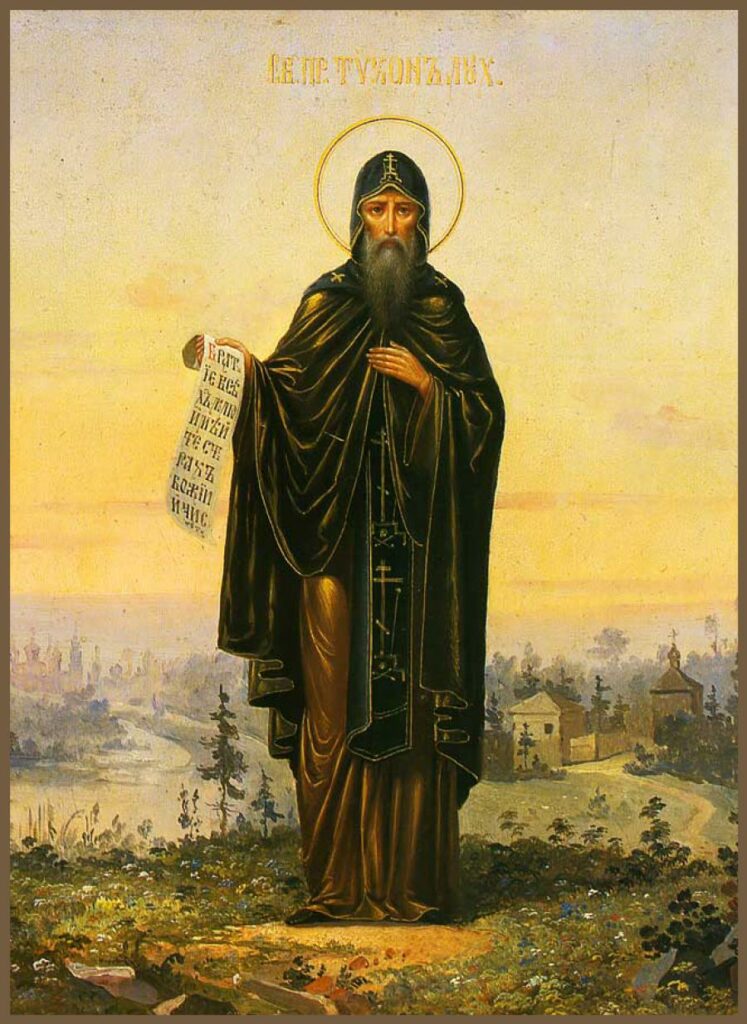
On the Ninth of July, according to the new style, the Orthodox Church celebrates the event of the discovery of the remains of St. Tikhon, who labored within the Kostroma region at the turn of the 15th–16th centuries. The path of this saint began in the Grand Duchy of Lithuania, and ended in a remote forest near Lukh, where decades later the incorruptibility of his body and numerous miracles were witnessed.
The future hermit was born with the name Timothy in the Lithuanian lands, and carried out military service. His reluctance to deviate from Orthodoxy under pressure from the Catholic side forced him to permanently move to Rus’. At first he lived in Moscow, distinguished by a quiet and God-fearing disposition, and later, striving for complete dedication to the Lord, he got rid of all his property in favor of those in need and became a resident of the monastery of St. Sergius of Radonezh. There he took monastic vows with the name Tikhon. However, the Lavra life seething around him did not respond to his inner craving for silence — the monk went to the northern forests and, after a series of transitions, chose a remote pine forest in the vicinity of the present village of Lukh.
The hermit personally cut down a cell in the Kopytovka tract. Over time, the solitude was broken by the first followers: the monks Photius and Gerasim are known, and according to the ancient synodikon, also Thaddeus and Philaret. When the community began to take shape, Tikhon moved the housing three miles away, choosing a more convenient site. Everything necessary for food was obtained through his own labor: the ascetic masterfully copied liturgical books and practiced the woodturning craft. Out of deep humility, he refused to accept the priesthood until his death.
The death of the saint followed on June 16, 1503. Extreme poverty surrounded him in his last days: the brethren had nothing to cover the body of the deceased. The Suzdal archpastor came to the rescue — he sent outer clothing and a scroll for burial, in which the monk was buried. After a short time, a monastic community dedicated to St. Nicholas grew up at the site of the exploits.
The year 1569 became a turning point: at the burial site, people who were ill began to receive healing, and when the grave was opened, the relics were found untouched by decay. Abbot Constantine decided to install a shrine on top of the ground, but immediately became blind; Having repented and received insight, he again hid the remains under a bushel. It is from this moment that church veneration of the saint is recorded. The first detailed life with a description of seventy cases of afterlife assistance was compiled in 1649, and the memory of the discovery of relics, falling on June 26 according to the Julian calendar, became firmly established in the calendar.
Days of Remembrance
February 5 — Cathedral of the Kostroma Saints
20 June — Cathedral of Saints of the Ivanovo Metropolis
June 29
July 9 — Finding of relics
Charity FondHoly Land
Investment in the Soul! News


