

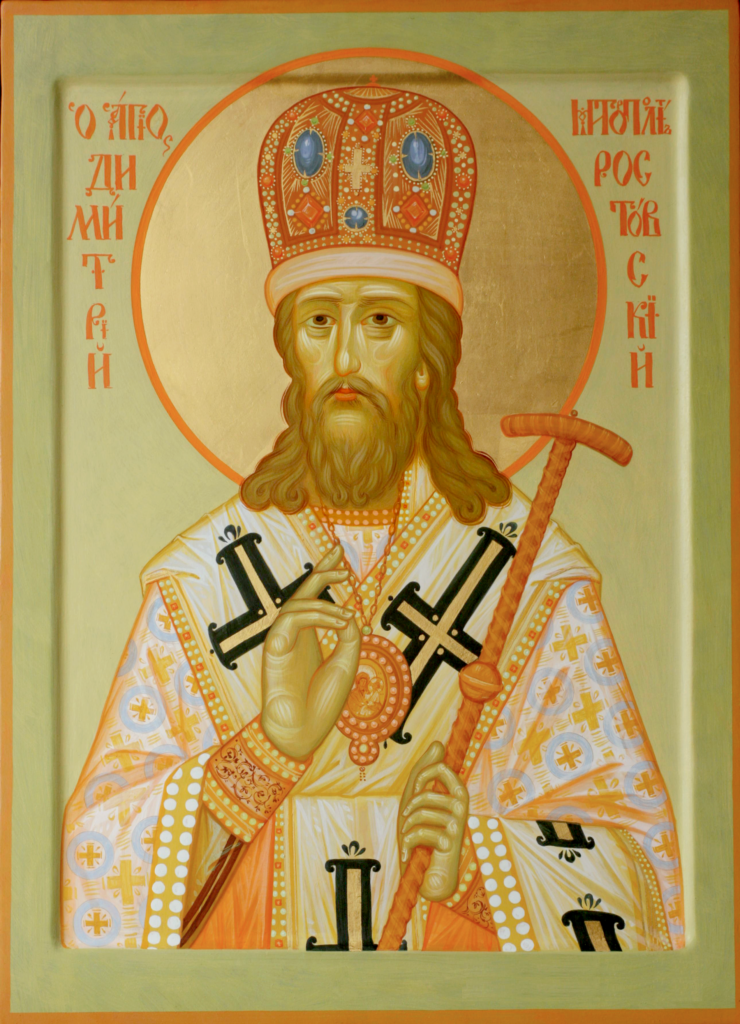
How it all began
In the autumn of 1709, Metropolitan Dimitri was buried in the Spaso-Yakovlev Monastery near Rostov the Great. Stefan Yavorsky himself, the locum tenens of the patriarchal throne, a longtime friend and like-minded person, was going to see him off on his final journey. But Yavorsky stayed in the capital, and the funeral took place without him. We were in a hurry. In a grave dug inside the Church of the Conception, they put together a wooden frame, placed an oak coffin inside and covered it with earth. Thus, without unnecessary ceremony, a man who would be declared a saint in less than half a century was laid to rest.
And several years before that, as soon as he arrived in Rostov in 1702, Dimitri visited the Yakovlev monastery and pointed to a place at the altar of the Church of the Conception. The words that he uttered then were remembered more than once: “Behold my peace, here I will dwell forever and ever.” He seemed to know.
Dimitri — in the world Daniil Tuptalo — was by that time a famous person. Originally from near Kyiv, a monk from his youth, a preacher and scribe. His main work, “Cheti-Minea” — a twelve-volume collection of the lives of saints — he wrote for almost twenty years, at night, by candlelight, after daytime services and trips around the diocese. These books were then copied by hand, printed, republished dozens of times — and for two hundred years they remained the main reading in every literate Russian home.
The floor caved in
By 1752, the floor in the Conception Church noticeably sank. The moisture and weight of the earthen embankment did their job. The monastery authorities decided to put the covering in order — routine work, of which there are hundreds of church renovations. They lifted the boards, dismantled the brick pavement — and came across an old log frame.
The oak coffin crumbled inside. The manuscripts that were placed with the deceased also decayed, a custom common at that time. But the body itself was preserved. And the vestments — sakkos, omophorion, miter — too.
The workers, understandably, were confused. Hegumen Joachim ordered to cover the grave with boards and post a guard. By evening there was already a crowd at the temple.
Arseny Matseevich arrives himself
The Metropolitan of Rostov at that time was Arseny Matseevich — a bright and not simple figure in Russian church history. A tough, straightforward man who was not afraid of either the Synod or the Empress — for which, by the way, he would pay later, ending his life in captivity. But in 1752 he was at his zenith. Having received a report from the Yakovlev Monastery, Arseny went there personally, without delay.
They examined everything in detail: the body, robes, the remains of the coffin, the log house. A protocol was drawn up. The relics were transferred to a stone tomb — temporary, hastily constructed. The protocol with the letter went to St. Petersburg, to the Synod.
Arseny did not declare the relics saints. Didn’t have any celebrations. He did what the order prescribed: he recorded it, reported it, and began to wait for the decision.
Commission from St. Petersburg
The Synod responded quickly. Two experienced bishops were sent to Rostov — Metropolitan Sylvester of Suzdal and Archimandrite Gabriel of the Simonov Monastery. The task was specific: to figure out whether genuine incorruption was taking place or whether we were talking about the natural preservation of remains in specific conditions.
The commission worked meticulously. They compared the remains of Demetrius with the bones of others buried in the same monastery — they, of course, turned to dust. In a report to the Synod, members of the commission wrote that the remains of the saint, although they bear traces of being in damp earth, retain the shape of the body and this is their difference from ordinary perishable burials.
At the same time, they collected testimony about miracles. By that time the people were already reaching out to the tomb. The first documented evidence concerned healings from blindness — people said that after praying at the relics their sight returned. Each testimony was entered into the investigative file: name, circumstances, witnesses.
This investigative proceeding itself is a weighty document that was conducted from 1752 to 1763. It has survived to this day and is stored in the Russian State Historical Archive. This is not a clerical certificate, but living material: interrogations of eyewitnesses, records of healings, medical reports where they could be obtained.
April 1, 1757
After all the checks, the Synod made a determination to canonize Demetrius of Rostov. Empress Elizabeth Petrovna approved the decision.
Two days of celebration were established: September 21 according to the old style — in memory of the discovery of the relics (October 4 according to the new style) and October 28 — on the day of death. The relics were transferred to the Trinity Cathedral of the monastery, where they remained the main object of pilgrimage for a century and a half.
What happened next
In 1920, when the Soviet government launched a campaign to open the relics, Demetrius’s tomb was officially opened. The commission worked with doctors and representatives of the clergy. The relics were not destroyed, but they were confiscated and transferred to the Rostov Museum, where they were listed as an exhibit.
The monastery itself was closed. Some of the buildings were given over to household needs. Worship services have stopped.
Only in 1991 was the monastery returned to the Church. Monastic life began to take shape in her again, and the relics of the saint were returned home. In 2007–2009, a new gilded shrine was made for them, which was installed in the Demetrius Cathedral, a church built in honor of the saint by Count Nikolai Sheremetev.
What else is worth knowing
The “Cheti-Minea” is not the only legacy of Demetrius. He owns “Search for the schismatic Bryn faith” — an extensive polemical treatise against the Old Believers. The tone there is harsh, but not malicious: Demetrius tried to understand his opponent, although he did not accept his arguments.
His sermons during his lifetime were inconsistent in the lists. Their style is simple, without ornate tricks — the saint believed that the pastoral word should be understandable. For a person who wrote the most complex hagiographic texts at night, this is a position, not a limitation.
Where to look
The relics of St. Demetrius rest in the Demetrius Cathedral of the Spaso-Yakovlev Dimitriev Monastery. Address: Yaroslavl region, Rostov the Great city, Malaya Yakovlevskaya street. The monastery is open every day, from seven in the morning to seven thirty in the evening
Charity FundndHoly Land
Investments in Soul! News


