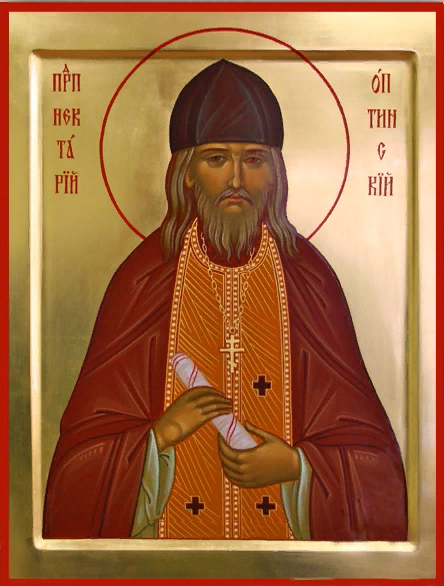
He was called the most secret of the Optina elders. Not because he was hiding from people, but on the contrary, people came to him from all over Russia. Just behind the external simplicity, jokes and a quiet voice, there was such depth that even loved ones did not always understand who they were dealing with. He said of himself, “I am a monk of the last degree.”
Orphan from Yelets
Nikolai Tikhonov was born in 1853 in Yelets, in a poor family of a working mill. The father died when the boy was seven years old. Before his death, he blessed his son with the icon of St. Nicholas — the future elder will never part with this icon. His mother also left early, and Nikolai remained an orphan.
From the age of eleven he worked in a merchant shop. He was hardworking, by the age of seventeen he became a junior clerk. The master wanted to marry him to his daughter, and sent the young man for a blessing to the hundred-year-old schema Theoktista, the spiritual daughter of St. Tikhon of Zadon. The old lady blessed him to go to a monastery instead of a wedding. Nicholas listened.
In the spring of 1873, he came to Optina Deserts with one kit in which the Gospel lay. The great Elder Ambrose received him and spoke to him for two hours. Nicholas did not tell anyone what the conversation was about, but after it he remained in the hermitage forever.
Twenty years of silence
He didn’t stand out for a long time. He was a gardener, a ponomar, a sacristy. The brethren complained: the young monk is scattered, sleepy, late for services. Elder Ambrose answered calmly: «Wait, Nikolka will sleep — everyone will need it.»
In 1887, Nicholas was tonsured in a mantle with the name Nectarius — in honor of St. Nectarius of Kiev-Pechersk. After cutting his hair, he almost stopped leaving his cell. For twenty years, I didn’t talk to anyone except the priest. But these years were not idle: in the Skete library, which numbered more than thirty thousand books, he read theology, history, geography, mathematics, Latin, foreign languages. He said, “God not only permits, but requires that man grow in knowledge.”
With the blessing of the elders, Father Nectarius carried the feat of folly — deliberately concealed his spirituality behind eccentricity. He could answer a serious question with a joke, play a scene with dolls, talk with riddles. But those who came to him with real trouble left with the answer.
Old man for all
In 1912, the brothers elected him an elder. He received people in the very “hull” where Ambrose had previously taken him. Sometimes he left books on the table, and the visitor, looking through them in anticipation, found the answer to his question before the conversation. Nectarius himself said in humility: “They come to Elder Ambrose, and the cell itself speaks for them.”
He was visited by peasants and professors, monks and officers, ordinary women and educated intellectuals. He could speak to everyone in his language. He gave artificial flowers to a spiritual daughter who was getting married and said, “When you walk along the field of life, pick flowers, and you will get fruit later.” Flowers are sorrow and sorrow. And they must be collected so that you will have a beautiful bouquet, with which you will appear on the day of judgment, and then you will receive fruits – joy.
Prayer is a capital that yields more interest over time. The Lord is merciful to us when we are blessed. Sometimes after a year, God fulfills the petition. An example should be taken from Joachim and Anna – they prayed all their lives and were not discouraged.
He said, “Lord, I believe that I have received what I deserve.” But Thou, O Lord, in Thy mercy, forgive and have mercy on me, until there is peace in the soul.
Exile and end
After the closure of the monastery on Palm Sunday in 1923, the elder was arrested. He was kept in the monastery bread corps, turned into a prison, then transferred to Kozelsk, then to the hospital due to eye disease. They were released two weeks later, but banned from living in Kaluga province.
He settled in the village of Kholmishchi, Bryansk region, in the house of peasant Andrei Denezhkin. When Nina Pavlovich, the elder’s spiritual daughter, asked if she could find a more comfortable home, he replied, “God brought me here.”
At first he was sad and didn’t immediately start taking people in. But, according to his own story, all the deceased Optina elders appeared to him and said: “If you want to be with us, do not leave your spiritual children.” And he returned to old age.
It was difficult to get to Kholmishchi — in the spring, even horses did not pass because of the flood of the rivers. Sometimes pilgrims had to walk up to seventy-five versts past the forest, where there were many wolves. Wolves came out on the road and howled, but, through the prayers of the elder, did not touch anyone. Patriarch Tikhon himself addressed him for advice through confidants.
The Elder predicted in 1917: “Russia will rise up and will not be materially rich, but it will be rich in spirit, and in Optina there will be seven more lampstands, seven pillars.”
Since 1927 his health has deteriorated. On April 29, 1928, his father Adrian Rymarenko hardly reached him — an elder was in his arms and died the same night. When asked where to bury him, he pointed to the village cemetery. I refused to drive to Kozelsk. Near the Intercession Church in the Hills, he did not order to be buried, saying: “There will be worse pig pasture there.” And so it happened — the temple was destroyed, and a fair and dance floor were arranged on the square. He was buried in a cemetery with three birch trees growing from the same root.
Incorruptibility and glory
In 1935, robbers dug a grave, hoping to find valuables. Tore the coffin lid, leaned it against a tree. In the morning, the kolkhoz saw: the elder stands incorruptible — waxy skin, soft hands. The coffin was closed and lowered back with the song «Holy God».
July 16, 1989, after the revival of Optina desert, the relics were found. When the festive procession moved through the monastery, fragrance came from the relics, they were amber in color. In 1996, Nectarius was listed as a local saint, and in August 2000 – glorified for church veneration.
Remembrance Day is May 12 (April 29, old style) and October 24 (October 11, old style, in the Cathedral of Optina Elders). The relics rest in the Vvedensky Cathedral Optina of the desert, in the Amvrosievsky chapel.
What the old man teaches
St. Nectarius did not abandon voluminous labors. His legacy is short phrases spoken in conversation, and his life itself. “Stop thinking, start thinking,” he said. “To think is to be vague in thought, to have no purpose. Thoughts above doom.” “Life is defined in three senses: measure, time, weight. The best and most beautiful deed, if it is above measure or not in time, is meaningless.”
He taught us not to look for miracles — “we have one miracle, the Divine Liturgy” — and not to be afraid that God does not hear prayer. “We must continue to pray and not be discouraged,” he repeated. And again, you can’t ask a fly to do the work of a bee. Every man must give his own measure.”
In a world where people are asked for results, success, and compliance, these words sound like medicine. Elder Nectarius lived quietly, died in exile, was buried in the village cemetery — and it was this invisibility that became his main testimony. He showed that the present is not measured by visibility.
Memorial Days
May 12
July 31 — Cathedral of Kaluga Saints
September 23 — Cathedral of Lipetsk Saints
October 24 — Cathedral of All Saints, in Optina Desert Shining
Lives of Saints