

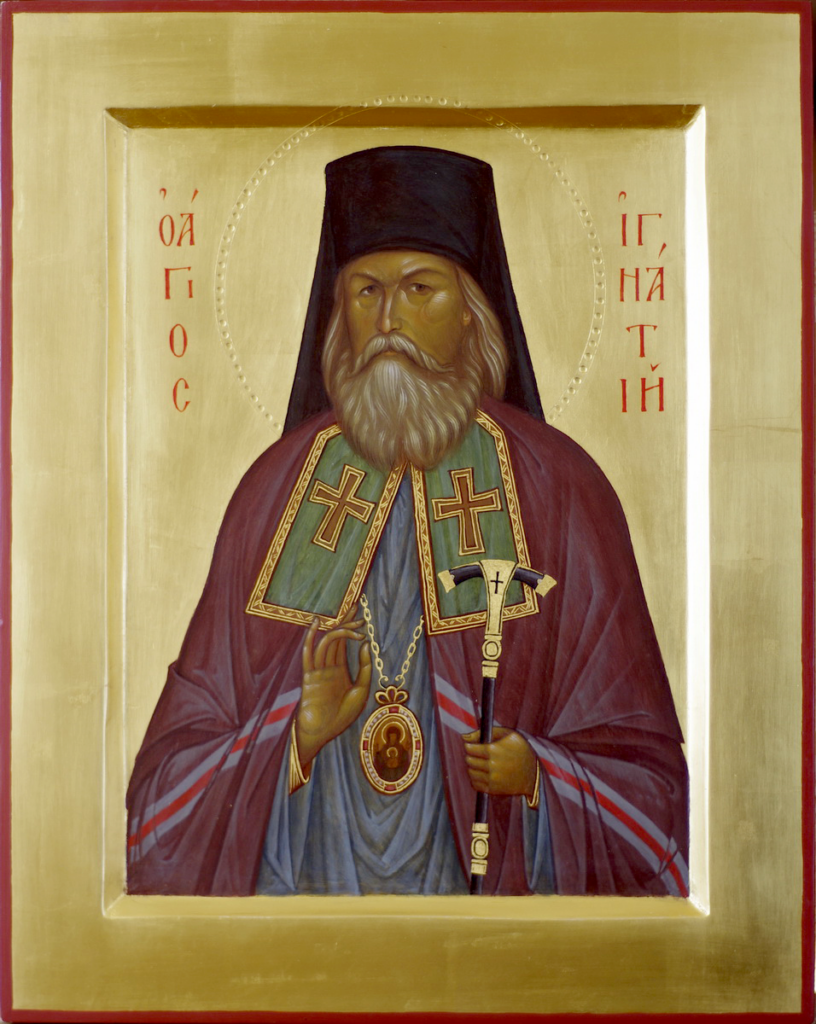
He was prophesied by general epaulets, salons of St. Petersburg, a brilliant career as an engineer. The pedigree went to Dmitry Donskoy. Teachers called him the best student in the history of the closed engineering school. Friends — Pushkin, Krylov, Gogol. Everything was ready for the fate that parents dreamed of. At the age of twenty he submitted his resignation and went to a monastery.
A begged child
Dmitry Bryanchaninov was born on February 5, 1807 in the village of Pokrovsky, Vologda province. Mother, Sofia Afanasyevna, for many years could not give birth. She prayed, went to the monasteries, and the child appeared — the firstborn, named after Dimitri Prilutsky, the Vologda saint.
My childhood was in the village. The boy drew, played music, read. His father, ambitious and secular, decided that his son would be a military engineer. In 1822, Dmitry was brought to St. Petersburg and assigned to the Main Engineering School — an elite closed institution, where officers came out for the most important buildings of the empire.
He studied so that the teachers shrugged: the first on the list, brilliant abilities to all sciences, perfect memory. But the further he immersed himself in knowledge, the more clearly he realized that they had no answers to the main questions. Neither mathematics, nor philosophy, nor literature have explained why a person lives or what will happen after death.
He found the answer in the Alexander Nevsky Lavra, where he met hieromonk Leonid, the future Optina elder Leo. This meeting decided everything.
Gone.
In 1827, Dmitry submitted his resignation. Formally — «by illness»: he really had tuberculosis. But the reason was different. The father was furious, society did not understand, relatives were worried. Dmitri later wrote about it as follows: he entered the monastery, as a warrior throws himself into a bloody sequel, to obvious death.
He followed his father Leonid to the Alexandro-Svir monastery. Then he was a novice in the Optina desert, in the Ploshchansk and Beloberezha deserts. His health, already poor, was failing. But he didn’t back down. At the age of twenty-three, in the Seven Towns of the Assumption Desert, he wrote The Lament of a Monk, the first work that struck contemporaries with maturity.
From builder to bishop
June 28, 1831 – tonsure with the name Ignatius, in honor of the Hieromartyr Ignatius the God-Bearer. A week later, the hierodeacon, two more, the hieromonk. Behind these dates were years of obedience, reading, struggling with oneself.
At the end of 1831, he was appointed builder of the Lopotov Monastery on Vologda, a poor, neglected monastery. The young hieromonk had to restore everything with his hands. A year and a half later he was appointed abbot.
Then the emperor intervened. Nicholas I, hearing of a capable abbot, summoned him to the capital and entrusted the management of the Trinity-Sergius Desert near Strelna, once famous, and then in complete decline. On January 1, 1834, Ignatius was elevated to Archimandrite. Twenty-seven years.
A quarter of a century near the Gulf of Finland
The Trinity-Sergius desert became the main work of his life for twenty-four years. He rebuilt temples, opened a hospital, a library, assembled a choir — Glinka personally gave him advice on church singing. The monastery was transformed: instead of a half-empty monastery, it was a flowering residence where St. Petersburg aristocrats and writers came to pray.
There were shadows. Envy, intrigue, denunciation. Ignatius could not maneuver — he was straight, sharp, principled. This caused discontent among both the hierarchs and the secular authorities. In 1847, after a severe attack of rheumatism, he asked for rest. He was given only a vacation for eleven months — to the Nikolo-Babaevsky monastery of the Kostroma diocese. Then he came back and continued.
Caucasus
On October 27, 1857, consecration took place in the Kazan Cathedral of St. Petersburg: Archimandrite Ignatius was ordained bishop of the Caucasus and Black Sea. Fifty years, poor health and the most troubled diocese of the empire.
On January 4, 1858, he arrived in Stavropol. The first words in the land of Stavropol: “Peace to this city.” The diocese stretched from Taman to Kizlyar. It was the Caucasian War. Getting to remote parishes was dangerous — a real risk of being taken hostage or killed. But he went around the diocese, established management, achieved a salary increase for the clergy, built a bishop’s house, founded churches. The Stavropol seminary under him flourished.
The disease didn’t go away. Shortly after his arrival, he suffered from smallpox. In the summer of 1861 he asked for rest. On October 13, he left for Nikolo-Babayevsky Monastery for good.
The silence for which he lived
In the Nikolo-Babayevsky monastery, Ignatius finally received silence. He reviewed everything he wrote and created new works. Here were written “The Word of Death”, “Fatherman”, “An Offer to Modern Monasticism”. The first two volumes of Ascetic Experiments were published in 1865. The third and fourth came from the printing house on 21 April 1867, nine days before his death.
On April 16, on Easter, he celebrated the last liturgy. On April 30, the Week of Myrrhbearing Wives, Saint Ignatius died. He was sixty. There were five thousand people at the funeral.
Books that have survived centuries
He was canonized on June 6, 1988, at the Local Council, in the year of the millennium of the Baptism of Russia. The relics were found on May 26 of the same year and transferred to the St. Vvedensky Tolga monastery of Yaroslavl.
His books – “Ascetic Experiments”, “Fatherman”, “Word of Death” – are still being reprinted and read not only by monks, but also by laity. He wrote not as a theorist, but as a practitioner: a man who went from St. Petersburg salons to the remote Caucasus and a quiet monastery in the Kostroma region. He taught to recognize the charm — spiritual conceit, which destroys ascetics more often than open sin. He taught me to pray not formally, but from the heart. He repeated, “Do not become slaves of men,” and explained how to distinguish a true teacher from a false one.
He was called the teacher of repentance. Not because he preached repentance to others, but because he himself went through it – from aristocratic comfort to monastic poverty, from the splendor of the capital to the loneliness of the cell. And along the way, he found something that no engineering blueprint could give him: the answer to the question of why man lives.
Memorial Days
13 May
June 5 — Cathedral of Rostov-Yaroslavl Saints
July 11(transient)— Cathedrals of Vologda and St. Petersburg Saints
October 4(transient)— The Cathedral of Saints of the Kuban Metropolis
Lives of Saints


