

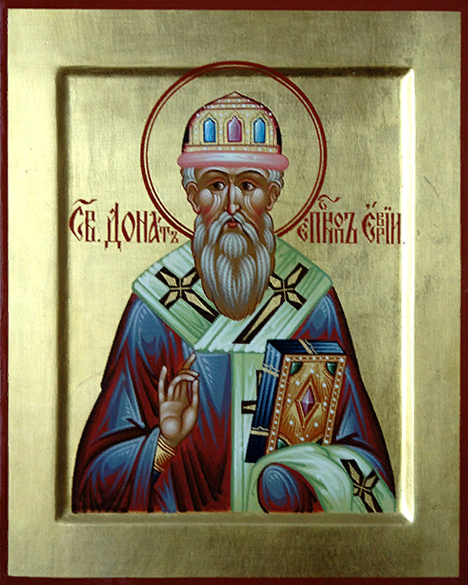
The main event, thanks to which Donat went down in history, occurred at a spring near the town of Soria. The water in the spring was poisoned: people drank and died in torment. The locals explained this simply: the spirit lives in the spring, and it must be appeased by the victim. An old pagan fear that has endured for centuries.
Donat came to the source with clerics. From under the earth came thunder, and snakes crawled out. Huge, poisonous, capable of killing with a single touch. The monster rushed to the bishop, tried with his tail to knock down the mule on which he was riding. Donat did not recoil, did not cross on the run — struck the snake with a whip, which chased the mule, right on the ridge. The snake is dead.
The body was so huge that it took eight pairs of oxen to get out. The locals burned him at the stake. But they were afraid to approach the source. Then Donatus prayed, scooped up the water first, drank it and ordered everyone to drink. The water was clean. Pagan fear was put to shame not by preaching but by action.
The church historian of the fifth century, Sozomenus, who told about this, adds an important detail: he himself saw the bones of a snake, exhibited at the source as evidence of a miracle. That is, in the fifth century history was not just a legend — it had physical evidence.
The rain that didn’t soak
There was a drought in Epirus. The field was dry, people were starving. Donatus went out of town, prayed, and it rained. When he returned home, his clothes were dry. Not one drop on the fabric.
The same thing happened later in Constantinople. The Emperor Theodosius, who heard about the miracle worker, asked him to pray for rain — the capital suffered from waterlessness. Donat came out, prayed, and it rained. Back in the palace dry. Theodosius only shook his head.
In the lives of saints, it is usually the opposite: they suffer, freeze, get wet along with everyone. Donat is a rare exception. It was as if the element itself did not dare to touch him. It is not pride or privilege, but rather a sign that for a person living in full faith, the laws of the physical world are receding.
Emperor’s daughter
His fame reached Constantinople. Theodosius the Great had an only daughter, and she was tortured by a demon. The doctors didn’t help. The emperor ordered all the bishops of Epirus to come to the capital, hoping that among them would be the same Donatus.
When the delegation entered the palace, the king asked, «Which of you is Donatus?» He stepped forward. Theodosius and the queen fell at his feet. Donatus answered, as all the saints answered in such cases: I do not heal, but the Lord. He went in with the girl. The demon cried, threw her to the ground, and came out. She recovered.
The emperor offered gold, estates, honors. Donat gave up everything. He took only the royal charter for a plot of land in his diocese — to build a church. With these funds, he built a temple in which he prepared a place for his own burial. He knew he’d be home for a while.
Dead Man vs. Fraudster
While Donat was in the capital, a story happened at home that could have been the plot of a courtroom drama. One man died before he could repay his debt. In fact, he returned — but the lender, knowing that the debtor died suddenly, came to the funeral with a receipt and did not let him be buried. He demanded two hundred more gold from the widow. The memorial procession has stopped. Screaming, crying, confusion.
Donat, who had already returned, was walking by. He heard a noise, went to the coffin and addressed the deceased as if he were alive. He got up, sat down, told the lender the place and time when the debt was returned, took the receipt and tore it. Then he lay down and fell asleep in the dream of death.
In this episode, it is not the resurrection itself that is striking — such stories are found in the lives of several saints. Striking everyday life: the bishop intervenes in a property dispute, and on the side of the poor widow. The miracle here is not a demonstration of power, but an instrument of justice. Donat does not preach honesty; he merely restores the truth, slaps the liar with a miracle.
Expulsion of relics and return
Donatus died at a very old age, about 387, and was buried in the same church that he built with royal funds. Two centuries quiet. Then came the Avars.
In 602, when the hordes of invaders poured on Epirus, the relics were rushed to Corfu. Then Kefalonia. In 1125, the Venetian Doge, returning from the crusade, immersed them in a gallery and took them to Venice, on the island of Murano. There, in the Basilica of Santa Maria-e-Donato, they still rest – next to mosaics of the XII century and glass chandeliers, which locals call “dragon grains”.
In 2000, the Vatican transferred a piece of relics back to Greece, to the city of Paramity, built on the ruins of ancient Euria. Residents have sought this return for decades. For fourteen centuries the saint was in exile. I finally got home.
Man without fear
The memory of St. Donatus of Evria is April 30 (May 13 according to the new style). His life reads like a fairy tale: snake, rain, demon, dead. But behind each tale is a specific action of a particular person. Hit the monster with a whip. Get out in the rain and not get wet. Reject the imperial gold. Raise a dead man for a widow who was deceived.
He was neither a philosopher nor a teacher of the Church. He was a bishop in a remote corner of the empire, and he simply did not retreat before a serpent, a lie, or a death. This is the man the Church remembered: not the one who spoke beautifully about faith, but the one who lived as if faith were not words, but action.
Memorial Days
13 May
Lives of Saints


