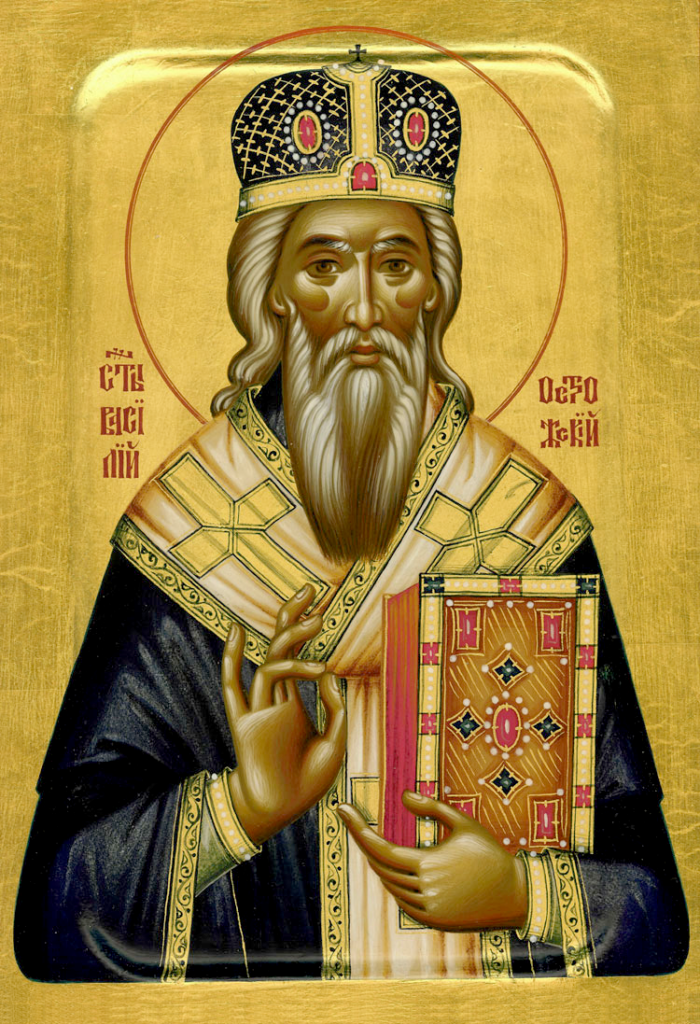
Stoyan Yovanovitch was born on December 28, 1610 in the village of Mrkonichi, in Popov Pole — a valley in the south of Herzegovina. His parents, Peter and Anastasia, were poor peasants, but very devout. At that time, Herzegovina had been under Ottoman rule for more than a century and a half, and being a Christian meant living in constant tension: paying a special tax for the faith, tolerating the arbitrariness of officials and always remembering the threat of forced conversion to Islam.
When Stoyan grew up, he was sent to the Zavalsky monastery, where his uncle Seraphim was his abbot. The boy was able: he had a good memory, a lively mind and a sincere desire for worship. After Zavala, he moved to the Trebin Monastery of the Assumption of the Most Holy Theotokos in Tvrdosh, where he took monastic tonsure with the name Vasily — in honor of St. Basil the Great. Soon he was ordained first in hierodeacon, and then in hieromonk.
The defamation test
For some time Vasily was an assistant to the Metropolitan of Cetin Mardarius. Then a story happened, which entered into all the legends about the saint and largely determined his fate.
Metropolitan Mardarius sinned with the maid, and when she became pregnant, he accused young Vasily of his sin. The young hieromonk was sentenced to hanging. He was able to delay the execution until the child was born. When the baby was born, Vasily took him in his arms and asked the judges who his father was. According to legend, the boy gave the real name of the guilty. After that, Vasily was appointed archimandrite of the Tvrdosh monastery.
Preaching among dangers
Being an archimandrite, Basil did not close himself within the walls of the monastery, but went to preach the Gospel through the villages of Herzegovina: he went to the houses, served, confessed, helped those who needed it. The Turks, learning of this activity, began to search for him to kill. He had to leave.
First, he went to Orthodox Russia and brought back from there to his homeland church books, sacred vessels and vestments — real treasures for the deserted churches of Herzegovina. Then, with the blessing of the Serbian Patriarch Paisius I, Vasily withdrew to Athos. He spent most of his time in the Serbian monastery of Hilandar, the oldest Serbian monastery on the Holy Mountain.
Hierarchical service in a burning diocese
On the feast of the Transfiguration of the Lord in 1638, Patriarch Paisios I ordained Basil as bishop and appointed Metropolitan of Trebin with a see in the monastery of Tvrdosh. Vasily was about twenty-eight years old – a very young age for the bishop.
A month after ordination, the residence was destroyed. Turkish persecution of Christians intensified, and many Serbian monasteries were destroyed. Vasily moved the department to Onogost — modern Niksic in Montenegro.
Later, the Serbian Patriarch Gabriel I (Rajic) reunited the Eastern and Western Herzegovinian dioceses into a single Zakolm Metropolia and entrusted it to Vasily. So he became Metropolitan of Zakholmsky or, in another version of the title, Zakholmsky and Skenderysky.
Ostrog: the cave that became home
Turkish oppression forced Vasily to leave Onogost. He found refuge in a remote mountainous area — at the foot of the rock Ostroshka Greda, at an altitude of about nine hundred meters above sea level. According to legend, the caves in these rocks served as a refuge for hermit monks even before the arrival of Basil.
With his appearance, the Ostrog cave turned into a real abode. In 1665-1667, with the blessing of Metropolitan Basil, two churches were renewed and painted — Vvedenskaya, in honor of the Introduction to the Church of the Most Holy Theotokos, and the Holy Cross, in the name of the Life-Creating Cross. The painting was performed by famous Serbian icon painters Radul and Jovan. The Holy Cross Church was built in a small cave at the very top of the rock — it was consecrated by Vasily himself.
Despite the opposition of the Ottoman authorities, the saint continued to build and restore destroyed churches throughout the diocese, often carrying stones for construction. He opened schools at monasteries and parish churches. According to the monastery legend, the last fifteen years of his life Vasily spent in the cave cell of the monastery Ostrog.
Death and incorruptible power
Saint Basil died on April 29, 1671 (May 12 according to the new style) in his cell in Ostrog. At the time of death, the cell was illuminated by an unusual light. The body was buried below the Vvedensky temple, under a spring flowing from the walls of the cave.
Seven years later, Vasily appeared three times in a dream to the monk of the monastery Zhupa Michael (according to another legend, the abbot of the monastery of St. Luke Raphael) and ordered the coffin to be opened. The monks fasted for seven days and served the liturgy, and on the seventh day they opened the coffin and saw incorruptible relics, from which emanated a fragrance similar to the aroma of basil grass. The relics were transferred to the cancer and installed in the Vvedenskaya church.
Over the following centuries, the relics of Saint Basil were sheltered from danger several times. They were hidden in the ground, transferred to other monasteries, hidden in caves. And each time they remained unharmed.
Vine from the rock
From the rock, which had the cell of the saint, after his death, a vine grew — without soil, without water, directly from the stone. This vine is still alive today. For pilgrims, it is a visible symbol of how faith takes root where, it would seem, there is no support for it.
Miracles that unite
Many testimonies have been preserved about miracles through prayers to Saint Basil. Among them there are stories not only Orthodox, but also Muslims and Catholics. In the monastery chronicle recorded dozens of cases of healing. People left crutches, sticks, stretchers and jewelry at the crayfish as a token of gratitude.
Such stories are not about magic and not about “wish fulfillment”. They are about how a person, being in trouble, finds support and strength to live on. And about the fact that this support for many began with a prayer at the relics of the saint.
What does Saint Basil mean today?
The Day of Remembrance of St. Basil of Ostrog is May 12 (April 29 according to the old style). On this day, tens of thousands of pilgrims flock to Ostrog.
Russian traveler E. Markov, who visited Ostrog in 1903, wrote: These relics are the greatest national shrine of Montenegrins. They are ready to leave all their houses to the enemy for burning, to leave their wives and children to their fate, but to defend the relics of their Saint to the last drop of blood.
Memorial Days
May 12
Lives of Saints