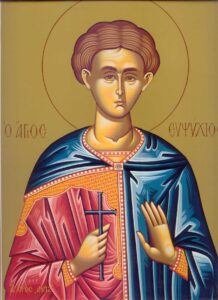
On April 22, according to the Julian calendar, the followers of Eastern Christianity remember a person from Galatia — the Monk Theodorus, known under the nickname Sikeot. A native of the village near Anastasiopol, who lived in the VI-VII centuries, entered the history of the church as a strict ascetic and bishop, whose biography is saturated with reports of interference of higher forces.
Omens and change of path
According to sources, the birth of the child was preceded by an unusual dream of his mother Mary: she dreamed of a shining celestial body penetrating into her womb. The interpreter of dreams explained this as the descent of special grace. The family, however, planned a military path for the boy. The family was forced to abandon these intentions by the insistent demand of the Great Martyr George, who repeatedly appeared in dreams. The father of the future saint served as a speedboat under the emperor Justinian, but died early, leaving his upbringing on his mother, grandmother and aunt.
Childhood in self-restraint
Already in the early years, the child showed unchildish restraint and settled the conflicts of peers. By the age of eight, he had drastically reduced his diet, and later began secret night retreats to church. Attempts of the household to hold him by force, tying him to his bed, stopped after a new vision: the holy warrior came in a dream to several women in the house.
The first recorded case of healing dates back to the tenth year of life. The boy was dying in the temple of John the Baptist. Two drops of moisture, separated from the wall face of the Savior, stopped the disease. Two years later, as the chroniclers write, the boy experienced a mystical meeting — he saw Christ on the throne. Since then, ascetic practices have been tightened. Soon a joint prayer with the hermit Glycerius for the end of the drought ended with an immediate downpour.
Feats and fame
At the age of fourteen, the young man left the shelter and settled at the temple, eating only prosphora once a day. At the same time, sources record the first episode of demonic healing. Then followed a voluntary two-year shutter in the cave, the entrance to which was littered with earth, retaining only a narrow hole for air. Retrieved half-hearted, it was quickly returned to normal. At the age of seventeen, the local bishop Theodosius ordained him deacons and priests.
He brought monastic vows already on a pilgrimage — at the Khozevit monastery near the Jordan. When he got home, he gathered the brothers. Physical restrictions continued to tighten: by order of the ascetic, a tight iron cage without a top was made, where he stood for whole seasons, replacing it with a cave retreat from Baptism to Easter. Eyewitnesses claimed that wild animals fearlessly approached him and took food from their hands.
Prophecy of the Throne and Hierarchy
Mass fame brought events like the sudden cessation of the locust invasion after the liturgy. However, the key episode is related to the military commander Mauritius, passing through Galatia. Theodore pointed him directly to the future ascension to the throne of Constantinople. When the forecast came true, the new emperor established a constant supply of bread to the monastery.
Despite the resistance, he was elevated to the rank of Bishop of Anastasiapol. He remained at the pulpit for several years, after which he voluntarily left his post and hid in the Lavra of Sava the Sanctified, hiding his title. To his duties he returned, as it is said in the life, another command of St. George.
Symptoms of the coming split
At the end of his life, the capital Patriarch Thomas summoned the elder to explain the disturbing events in one of the Galatian communities. There, during the processions, wooden crucifixes spontaneously moved and collapsed. Sykeot, according to his descriptions, possessed the gift of foresight, recognized in this a harbinger of a deep church upheaval — a future conflict around icon worship. Astonished by what he heard, the patriarch asked to pray for his imminent death. Tom died in 610. Theodore himself died three years later. His veneration as a saint is recorded by sources even before his burial.
Memorial Days
5 May
28 June— Transfer of relics
The Holy Land Charitable Foundation
Lives of Saints