He didn’t leave any books. He didn’t say the sermons that anyone wrote down. He did nothing that caught my eye. But from his monastery came people who turned Russian monasticism. And he himself was remembered by contemporaries one detail: the abbot always worked the most.
Tatar blood, Russian faith
Parthenius was born in 1394 near Borovsk, a small town in the south of Kaluzh region, near the edge of dense forests. His grandfather was a Tatar, a Baskak, a collector of tribute from the Golden Horde. He converted to Christianity, got Russo, got married. Partheny’s parents were already Orthodox and pious, but the Tatar vein was felt: the boy’s character was firm, stubborn, not smeared.
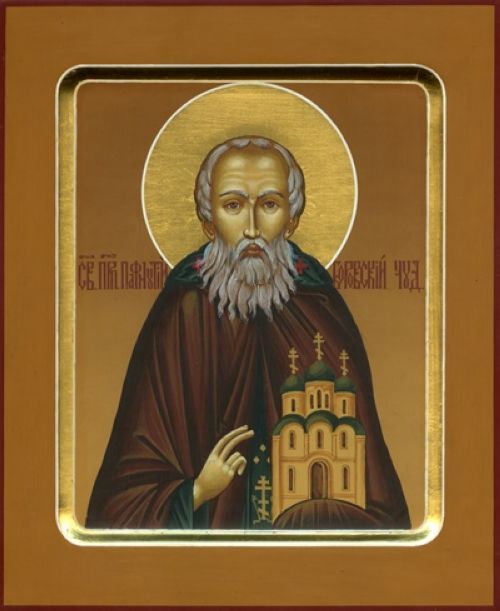
At the age of twenty, he left home — to the Pokrovsky Monastery on the High, which stood on the high bank of Protva. tonsure with the name Paphnutius — in honor of the famous Egyptian ascetic, a student of Anthony the Great. The name turned out to be prophetic: the life of Russian Paphnutius repeated the ancient path — desert, work, students, abode.
The abbot who cut wood first
The monastery on the high was not rich. Few brethren, obedience to all. Paphnutius carried everything: ponomary, served, dug a garden, harvested firewood. When the abbot died, the brethren chose him, thirty-two years old, young, but already recognized for his prudence and rigor.
Having become abbot, he did not change his habits. He was still the first to go to work. If you needed a fish, you went to the river with a net. If you needed wood, you cut it yourself. The cell is the tightest. Food is the simplest. Monday and Friday — complete abstinence, Wednesday — dry eating. He didn’t order: he did. And the monks followed him, not because they had to, but because they were ashamed to fall behind.
Forty days of silence
In 1444 Paphnutius fell seriously ill. Thought he was dying, took a schema. He survived and took it as a sign. He left the abbot, took a monk and left. To the shore of Protva, where the tiny Hystery flows into it. Forest, swamp, silence.
Then others came. One at a time, then in groups. Seeking elder counsel, prayer, simplicity. The place is full of cells. Thus was born the monastery of the Nativity of the Most Holy Mother of God — later it will be called Pafnutev Borovskiy.
The school from which the greats came
Paphnutius did not establish schools in the literal sense — there were no classes, programs, schedules. But his monastery became a school in another sense: a school of life. He taught me to pray and work so that one thing would not interfere with the other. And from this school came people whose names know everyone who is interested in Russian holiness.
The most famous disciple is John Saninus, tonsured by Paphnutius with the name Joseph. The same Joseph Volotsky, who later created his own monastery, wrote the Illuminator and became one of the most influential church figures in Russia. Paphnutius saw a fire in the young man and did not let him go out. When Joseph once objected to the elder in the presence of the brethren, Paphnutius did not pull him back, but said: You, child, understand the Scriptures better than I do. Develop this gift in yourself”. This was rare for the abbot of the XV century.
Another disciple, Joseph of Volokolamsk, described the way of life of the monastery: work from dawn to dusk, simple food, no idle talk, obligatory alms to the poor who flocked to the monastery. Paphnutius didn’t close the gate. Wanderers were fed, the sick were treated, the poor were not denied.
Walls and murals
In 1467, a stone cathedral of the Nativity of the Virgin was laid in the monastery. Paphnutius himself watched the construction — he walked through the forests, checked the masonry, argued with the masters. The temple was small, but strong, like everything he did.
Later, the cathedral was painted by Dionysius, the great icon painter of the turn of the XV-XVI centuries. The frescoes are partially preserved, but what remains is enough: strict faces, pure colors, no extra line. Like Paphnutius himself, there is nothing superfluous, only the essence.
Raven and bow
One of the most famous episodes of life is the story of the crow. The son of the voivode, driving past the monastery, shot with a bow and killed a bird nesting at the monastery. Paphnutius bequeathed not to touch the birds — they lived around the monastery as under protection. The young man did not know this or did not consider it important. After the shot, he lost the ability to turn his head — froze like paralysis. They brought him to the old man. Paphnutius did not preach about sin. He just said, «Repent.» The young man repented and was healed.
The story is not about punishment. It’s about the limit. Paphnutius believed that the monastery was a place where even birds should be safe. And if someone violates this order, it does not pass without a trace.
The final instructions
Paphnutius knew about his death in advance — a week. Gathered a brother. He said simply: do not seek glory, do not exalt, work and pray, keep peace among yourselves. “If you live in love, God will be with you.” If not, the walls will not help.”
On May 1, 1477 (May 14, according to the new style) he died. They were buried in the Cathedral of the Nativity of the Virgin, in the monastery, which he built with his own hands.
What’s left
He was canonized in 1547 under Ivan the Terrible at the Makariev Cathedral, where Russian saints were glorified with a whole list at once. The relics rest in the Pafnutiev Borov Monastery, which survived the devastation of the Poles, the closure under Soviet rule, and the revival in 1991. It is now an active male monastery.
Paphnutius did not write a single book. But his lesson has survived centuries: the real leader is not the one who gives orders, but the one who takes the axe first. And a real monastery is not built of stone, but of what one does when no one is looking.
Memorial Days
May 14
July 31 — Cathedral of Kaluga Saints
Lives of Saints