

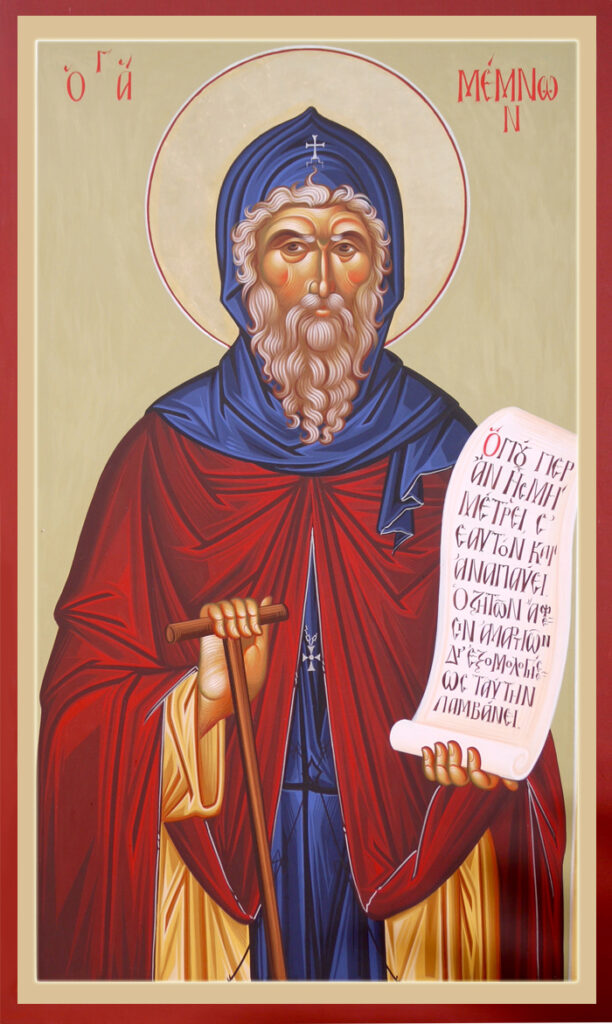
Among the Egyptian ascetics, whose names have lived in the people’s memory for centuries, a figure stands out surprisingly practical and at the same time hidden. Saint Memnon left no written works, did not establish a vast monastery, did not lead a theological dispute. But it was to him that the simplest, most earthly prayer was addressed for centuries: get rid of the locusts.
Who he was is impossible to say for sure. His name is not found in Palladius’ Lausaic, which pushes back the lower limit of life at the beginning of the fifth century. The canon in his honor was written by Joseph the Songwriter, who died around 886 — this is the upper border. Somewhere between these dates, in the Egyptian desert, there lived a man whose name means “persistent” in Greek. One manuscript places him in Lycia, but the tradition holds fast to Egypt.
His life is like a condensed sketch. The young man goes into the desert, fasts, prays, subordinates the body to the spirit. Over time, he becomes an abbot and leads the brethren as stingy and strict as he lived himself. Nothing superfluous, no decorations — only work and prayer.
But then the unusual begins. Memnon became famous not for abstract feats of contemplation, but for help that can be touched with your hands. By his prayer in the dead desert hammered a spring — water without which life is impossible. He drove away locusts that destroyed crops, and rescued sailors whose ships died in the storm. Three miracles – water, bread, salvation from the elements – the three basic things on which human existence rests.
It is amazing how the name of the saint became entrenched in popular practice. In the Bulgarian Apostle of the XIV century, the hand of an unnamed scribe is attributed: “By calling Memnon, the Pruze are driven away.” The word «pruzi» is a locust. For farmers who have lived for years under the threat of starvation from insect invasions, Memnon became not an abstract saint, but a working tool — the last argument when there is nothing else to rely on.
And after death, miracles did not subside. Healings were served at the coffin, and the mere pronunciation of the name, according to legend, destroyed the “machines of evil spirits.” Thus the ascetic, who had been silent all his life in the desert, was louder than many preachers.
Remembrance Day in the Russian tradition is April 29 in the old style, May 12 in the new. In Greek churches, April 28 is commemorated, and in some synaxaries, May 19. The Slavic Minea preserved the service to the saint: the stylers of the 8th voice, the canon of the 4th voice, the sedalen – all combined with the service to the nine martyrs of Cyzics. In Russia, May 12 was popularly called the Day of Memnon the Healer.
Memnon the Wonderworker is venerated in both the Orthodox and Catholic Churches. His image is a rare example of how the deepest inner life and severe austerity become a source of very specific, physical help to people. A saint who drew water from the desert and drove locusts from the fields is a saint whose intercession requires no interpretation.
Memorial Days
May 12
Lives of Saints


