Novgorod artisan, known at the Trade as an excellent coppersmith, Arseny was a deeply religious man. Gradually, he matured the decision to go to a monastery and one day, Novgorod residents saw that the copper shop was closed, and pots and jugs would have to be ordered from someone else.
Having lived in the monastery named after the Nativity of the Virgin for 11 years, Arseny went to Mount Athos. He spent 3 years there. At first he performed any work, but then the abbot of the Panteleimon monastery learned that Arseny was a copper man and ordered him to make copper vessels, keeping a vow of silence. When the time of the vow came to an end, Arseny decided to return to his homeland. With him he brought the dormitory Charter and the icon of the Virgin.
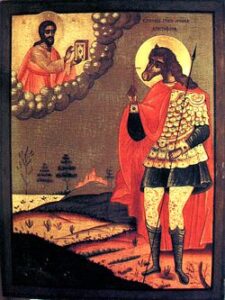
But life in the Nativity Monastery was too lively for the monk. He was looking for privacy. After leaving the monastery, Arseny went on a journey along Lake Ladoga. After an overnight stay on Konevsky Island, he wanted to go out to sea, but the headwind drove the boat back. Arseny considered it a sign and settled on the island. He built himself a cell, fasted and prayed, but most importantly, drove demons from the island. For a long time the pagans worshipped the holy horse here, offering sacrifices at the stone in the form of a horse’s head. Arseny prayed and a flock of crows soared over the island, which with a roar disappeared over the horizon.
Gradually, other monks arrived on the island and with the blessing of the Archbishop of Novgorod, the monastery of the Nativity of the Most Holy Mother of God was formed. This happened in 1394.
The monastery flourished, it was often visited by clergy, bishops and archbishops. Novgorodians also loved the monastery. After a while, Arseny went to Athos for a second time. At this time, famine broke out in the monastery. It was already decided to dissolve him, but one brother had a vision while praying on the mountain. The Most Holy Mother of God said that Arseny is on his way and will bring everything necessary. In the morning, 2 ears (rooks) with food and belongings came to the pier.
The mountain where the vision occurred was called the Holy Mountain. It was built there every year.
They came to him, remembering the miracle.
Saint Arsenius spent the rest of his life in the monastery and departed to the Lord in 1447. The relics of the saint were found in the 16th century, but were buried again due to constant clashes with the Livonians, which escalated into a full-scale war with Sweden. The Swedes captured the monastery in 1577. The brothers went to the village monastery. They took with them the Konev Icon of the Virgin, embroidered with a board, with the image of St. Arseny and the bucket from which he drank.
The Moscow Patriarchate negotiated with the Swedes on the transfer of relics, but their result was zero.
In 1760, the monastery was restored, all the shrines were returned. The old, and in 1809, new church of the Nativity of the Virgin was built. There, under the bush, were the relics of the saint.
During the Soviet period, the monastery was closed. The bucket and cover are still kept in the Museum of Orthodox Creativity in Finland. There, in the New Valaam monastery, there is an icon of the Virgin of Konev.
In 1991, the land and the remaining buildings were returned to the RCP. At the same time, the relics of Saint Arsenius were found again.
Remembrance days
June 25
18 – Cathedral of the Saints of Athos
3 – Cathedral of Karelian Saints
25 – Cathedrals of Novgorod and St. Petersburg Saints
28 — The acquisition of relics
June 18th Cathedral of the Monks of Athos
The Holy Land Charitable Foundation
Lives of Saints